Exploring the Undefined Creativity in Youth Theatre Education: An Interview with Wen-Qi Yu, Artistic Director of Flying Birds Theatre Group

Written by Yi-Cheng Sun; translated by Yi-Yu Lai. Before starting the interview, during lunch, Rei-Tzu, the production coordinator of Flying Birds Theatre Group, told us about the “earliest university.” In English, “University” is derived from the word “universe.” In Latin, “universus” is composed of “unus” (one) and “versus” (towards a particular direction), giving it the literal meaning of “towards a specific direction.” According to our limited knowledge of history, the University of Bologna, established by students in 1088 in Italy, is the first university in Europe, earning it the title “mother of universities.” The “earliest university” topic quickly sparked our discussion about knowledge and the essence of education, with art being the primary focus.

Plasticising Cultures through Art Education: An Interview with an Artist Wei-Lun Chang

Written by Yi-Cheng Sun; translated by Yi-Yu Lai. Before my interview with Wei-Lun Chang, I felt isolated and distant from her previous paintings. However, I experienced a contrasting feeling upon entering her home on the interview day. The toys in the corner and the children’s graffiti scattered around the walls made me feel the presence and interdependence of growing lives in this space. Wei-Lun’s role is not only that of an artist and educator, as I knew her to be, but also that of a mother––the mother of two children. The role of motherhood always brings significant changes, growth, and understanding in the continuous process of life, and Wei-Lun’s life journey is no exception.

Creating Artworks with Experience: An Interview with an Artist-Teacher Shao-Gang Wang

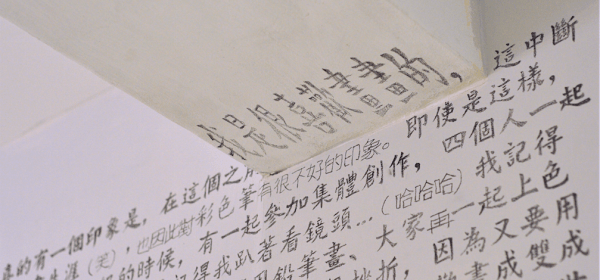
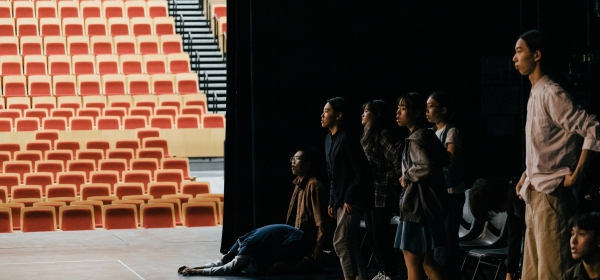
Written by Yi-Cheng Sun; translated by Yi-Yu Lai. In 2022, at the Taipei Fine Arts Museum’s “Taipei Art Awards” exhibition, artist Shao-Gang Wang was honoured with the Excellence Award for his artwork titled “The Bird’s Still Singing.” This piece continues his collaboration with young actors that began in 2019 with the works “AppleGreen” and “DeepBlue.”

The Director-Sensei of Shadow Puppetry: An Interview with an Artist-Teacher Yun-Hsuan Kao

Written by Yi-Cheng Sun; translated by Yi-Yu Lai. The night following the conclusion of the 2022 National Creative Drama Competition, residents of the Ciwidiyan community (Shuilian village) learned that their representative troupe had won the Modern Shadow Puppetry Excellence Award of the Elementary School Division. The community members prepared drinks and delicacies to celebrate, eagerly awaiting the return of the students and teachers from Shuilian Elementary School. The fried chicken cutlets cooked long ago turned cold, and the elders holding congratulatory red envelopes were also a bit weary. Only when the firecrackers along the way burst into loud noises did the delight in the air, with flying paper scraps both inside and outside the houses, seem to repeatedly congratulate: “Finally, it’s here!”

Art Education for the Real World: An Interview with an Artist-Teacher Pin-Hsuan Tseng

Written by Yi-Cheng Sun; translated by Yi-Yu Lai. Pin-Hsuan Tseng taught art at Gongliao Junior High School in New Taipei City from 2012 to 2022. Besides being an art teacher, she is well-known for her 2017 initiative called the “Ordering Dishes to End Discrimination” movement. This gentle movement embedded in everyday life aimed to restore the proper name of “Fushan lettuce,” which is commonly referred to as “mainland girl”, with underlying discrimination against females from China. Regarding nationality and gender, Taiwanese media once used “mainland girl” to refer to Chinese prostitutes who arrived illegally in Taiwan, while the smooth appearance of Fushan lettuce was thought to correspond with this image.

For Molecular Archipelagic Thinking

It is a privilege to present this insightful piece ‘For Molecular Archipelagic Thinking’ from Professor Chun-Mei Chuang, a respected figure in the field of Sociology from Soochow University, Taipei. Professor Chuang’s work is marked by her interests in feminist theories, postcolonial discourse, ecology, and animal studies. In this contribution, she graciously shares her experiences and reflections on teaching sociology in Taiwan, providing a rare glimpse into her unique approach and the broader sociological landscape in Taiwan.Chun-Mei Chuang is a Professor in the Department of Sociology at Soochow University in Taipei, Taiwan. Her research interests include feminist theories, postcolonial discourse, ecology and animal studies.

Staging and Restaging Taiwan at the Centre Pompidou: Taiwanese Art on Display 2020 to Present

Written by Gabriela-Alexandra Banica. In the third decade of the 21st century, Taiwanese artists and exhibitions have appeared at the Centre Pompidou in Paris and Metz, and this could serve as a compelling case study of Taiwan’s pursuit of international recognition through arts. Through this exploration, this article aims to address the gaps in the current scholarship related to curatorial practices concerning art from contested territories while enriching the field of France-Taiwan curatorial practices. By analysing the current subject of interest, it is hoped that art from more disputed territories can be made accessible to audiences in France, Europe, and around the globe.

The Development of Taiwan Studies at Roma Tre University

Written by Rosa Lombardi and Silvia Schiavi. Since 2012, Roma Tre University carried out a series of activities to promote the knowledge and dissemination of Taiwanese culture and literature, contributing to the development of Taiwan studies in Italy. Before that, there was very little or no space devoted to Taiwanese literature in Italian universities, and courses in modern and contemporary Chinese literature mainly still deal with Chinese mainland literary production. Given this scarcity of studies on Taiwan in Italy, Prof. Rosa Lombardi and Dr Silvia Schiavi have promoted and implemented a series of events to raise awareness about the island and foster a better understanding of the Sinophone world through the introduction of Taiwan’s rich culture, history and literature to the students and the general public.

From Tradition to Institutionalisation: The Development of the Postnatal Care Centres Industry in Taiwan

Written by Amélie Keyser-Verreault. In Chinese culture, the tradition of yuezi (月子) or the practice of postpartum care for the mother, is a longtime established practice. In Taiwan, this practice underwent and continues to undergo the vicissitudes of social and interpersonal relationship changes. Before the 1970s, the birth rate in Taiwan was extremely high, and the idea of “more children, more grandchildren, more good fortune” (多子多孫多福氣) was widely accepted. The large family size also meant sufficient human resources for agricultural-related field labour. The practices of yuezi were already crucial at that time. Mothers in the postpartum period had some privileges like a long rest and special food, particularly meals containing meat like chicken, a precious food at that time. 

Taiwan’s Tibetan Buddhist Monk Dilemma and its Unintended Consequences

Written by Dolma Tsering. Taiwan is known as the beacon of democracy, and its competitive democratic principles and practices distinguish it from authoritarian China. Advocacy for promoting religious freedom is one of the important tasks undertaken by the government. For instance, as a part of this advocacy, in 2018, President Tsa Ing-Wen announced that Taiwan would donate US$200,000 per year for five years to the United States’ International Religious Freedom Fund as a part of Taiwan’s contribution to advancing global religious freedom. The government, annually in association with the American Institute in Taiwan (AIT), hosts an international forum for religious freedom to establish a more inclusive society in Taiwan. However, on 6th June 2023, more than 112 Tibetan Buddhist centres in Taiwan joined a press conference which called for the government’s unfair treatment of visa restrictions for Tibetan Buddhist monks in Taiwan and therefore demanded an amendment to the existing visa restriction.

Han-Heterosexual-Male Supremacy across the Pacific? A Critique of The Taiwanese Reminiscence Acrobatic Show

Written by Mark Hsiang-Yu Feng. Busy as usual was Highway number eighty, but Mother’s Day made downtown San Jose unexpectedly quiet. However, in front of the California Theatre, lively chat sounded out of the silence, marking this celebratory moment for the twentieth anniversary of the Taiwanese American Center of Northern California during Asian and Pacific Islander heritage month. Families came to fill most of the seats, and three languages—Hoklo Taiwanese, Taiwanese Mandarin, and English—were spoken to express the identity of these participants. To honour the culture of Taiwanese and Taiwanese Americans, the overall narrative of Taiwanese Reminiscence contextualises a mixture of stunts, acrobatic movements, and dance into a condensed representation of the twentieth history of Taiwan.

Triangulating the Taiwanese Spirit in Southern California: Colonial Hauntings at the 228 Commemorative Concert

Written by Chun Chia Tai. In February, I saw a text message in a Taiwanese group chat promoting a concert commemorating the 228 massacre caused by the Kuomintang dictatorship in Taiwan on February 28th, 1947. The concert was called The Spiritual Day of Taiwan: 2-28 76th Commemorative Concert and was hosted by two Taiwanese American organisations: the Taiwanese United Foundation and the Taiwan Elite Alliance, since 2007. The performers were mainly Taiwanese. Many of them were not professionals but members of local Taiwanese church choirs. Most of the audience was familiar with the songs being performed; therefore, they sang along with the performers.

1 16 17 18 19 20 55