Dispelling the monolith: The geopolitics of language in Taiwan and Hong Kong

Written by Justin Kwan. In an attempt to reach audiences in Taiwan and Hong Kong, China has attempted to use both Hokkien and Cantonese in its messaging through media and popular culture, eliciting mixed responses from locals in both places. In the case of Taiwan, Beijing resorted to a strategy of direct coercion in 2018, when it released a dubbed propaganda video in Hokkien titled ‘God of War’. The video featured bomber aircrafts flying around Taiwan, a warning from Beijing for the islands Taiwanese-speaking activists to curb their so-called ‘pro-independence’ activities.

A clash or reconciliation of nationalisms across the Taiwan Strait?

Written by Zhidong Hao. In 2014, the Umbrella Movement in Hong Kong failed to persuade the Beijing government to grant them full universal suffrage for the election of the chief executive. Since then the so-called high degree of autonomy guaranteed by the Basic Law was eroded so much that Hong Kong was becoming more like Macau. Macau has been touted by the Central government as a perfect model of ‘one country, two systems’, but in reality, it is more like a model of ‘one country, one and a quarter systems’, i.e. an authoritarian system plus some press freedom.

The Repositioning of Taiwan in the Global Supply Chain Network

Written by Min-Hua Chiang. The relocation of Taiwanese outward direct investment (ODI) away from China is a clear sign of the shifting global business landscape. The cross-strait division of labour in manufacturing production has started to fade after China’s wage hike, industrial upgrading as well as stricter rules on the environment and labour protection. Taiwan’s ODI in China has declined visibly after 2012.

Can Taiwan decouple from the Chinese economy?

Written by Michael Reilly. In the medium to long-term, the coronavirus outbreak may turn out to be the high-water mark of foreign investment in China. Even before this, foreign companies were growing increasingly frustrated as the government increased minimum wage levels in provinces such as Guangdong and Fujian, and they also became frustrated with a growing burden of regulations and a bias in favour of domestic companies.

City Pop in Taiwan: old mainstreams becoming new indies

Written by Yan-Shouh Chen. As City Pop become more known to Taiwanese indie music lovers, unveiling J-pop history might not be enough. Some fans turned their eyes toward Taiwanese artists that are good at creating groovy melodies. These artists might consider themselves as R&B and Hip Hop rather than City Pop, but the boom did them a favour, and now the spotlight is on them.

The public’s view on same-sex marriage legalisation

Written by Timothy Rich, Isabel Eliassen, Andi Dahmer and Carolyn Brueggemann. We ask to what extent has the public’s view on same-sex marriage changed in recent years and to what extent this influenced the 2020 election? The 2018 local elections clearly indicated a shift in the political saliency of the issue of same-sex marriage legislation over the past several years, while Tsai’s re-election with a continued Democratic Progressive Party (DPP) legislative majority would suggest that opposition to the issue has declined in salience.

THE SIGNIFICANCE OF TAIWAN AS THE FIRST AND ONLY CHINESE DEMOCRACY

Written by Frédéric Krumbein. As the only Chinese democracy that has ever existed, Taiwan shows that Chinese culture, authentic democracy and respect for human rights can coexist. It is thus pertinent to ask – to what extent is Taiwan a bastion of democracy and human rights? How has Taiwan gone about promoting these values in the region, and how will it continue to do so moving forward?

Taiwanese perceptions of diplomatic recognition

Written by Timothy S. Rich. Taiwan must find new strategies in order to strengthen formal and informal ties. However, it should not over rely on expanding unofficial relations with the US or overlook the inconsistencies of Trump’s foreign policy that could impact Taiwan. For example, the Trump Administration’s decision to cut hundreds of millions of dollars in aid to El Salvador, Guatemala, and Honduras for two consecutive years provides a greater opportunity for Chinese influence in the region and greater pressure on Taiwan’s remaining diplomatic partners.

Wu Zhuoliu’s Orphan of Asia and the Madness of the Colonial Reality

Written by Makiko Mori. Wu Zhuoliu’s (1900–1976) Orphan of Asia is a renowned work of colonial Taiwanese literature. Surreptitiously written towards the end of Japan’s colonial rule in Taiwan (1895-1945), this semi-autobiographical novel bears a powerful witness to Taiwan’s deeply troubled, albeit legitimately modern, claim for the right to self-determination and self-representation.

Why I Wrote Taiwan: Nation-State or Province? 7th Edition 

Written by John F. Copper. In 1990 when I published the first edition of Taiwan: Nation-State or Province?, friends and colleagues asked me why I wrote this book and the reason I chose such a title. I replied that a publisher, Westview Press, asked me if I could pen a book on Taiwan that assessed its unusual status in the world community, it being a possible trigger to an East-West conflict, and also a work that might serve professors looking for a reliable source on Taiwan they could teach from. The book sold well and five years later the publisher asked for an updated edition, to which I obliged.

What will the re-elected Tsai-DPP government’s foreign and defence policies look like?

Written by Yu-Hua Chen.
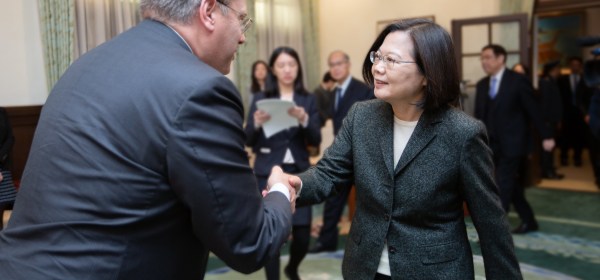
On January 11th 2020, the incumbent president of Taiwan, Tsai Ing-Wen, was re-elected to serve a second term as President of Taiwan by a land-slide majority. Tsai’s 8.17 million votes (57.1%) was a record high for Taiwan (well surpassing the record set by Ma Ying-jeou in 2008), and occurred in the backdrop of an unprecedented high turn out (19 million votes at 74.9% of the voting population). Yet the performance in the legislative election of Tsai’s party, the Democratic Progressive Party (DPP), was far less impressive.

“Taiwan’s January 2020 Election: The American Factor in President Tsai and the Democratic Progressive Party’s Big Win”

Written by John F. Copper. The United States has long (since World War II) played a critical role in Taiwan’s politics, including its elections. The reason is apparent: in 1950 President Truman sent the 7th Fleet into the Taiwan Strait to block Mao’s plan to invade the island; he saved Taiwan. America has served as Taiwan’s guardian ever since. Today China’s military could “liberate” Taiwan and make it part of China probably in a few hours if the US declined to intervene.

1 66 67 68 69 70 94