
Written by Charlie Smith.
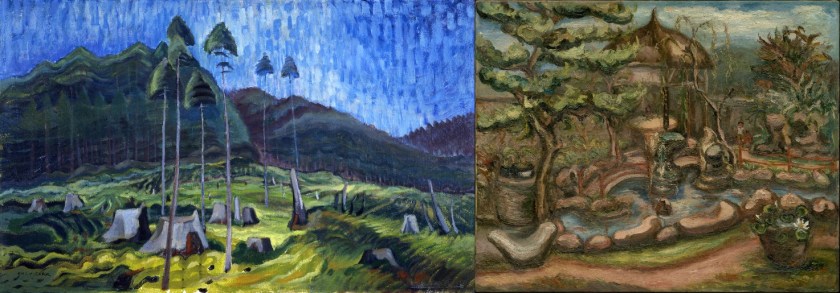
Image: Left: Emily Carr, Odds and Ends, c. 1939, oil on canvas, 67.4 x 109.5 cm, Art Gallery of Greater Victoria. Right: Chen Cheng-po 陳澄波, Linlang shange 琳瑯山閣, c. 1935, oil on canvas, 73 x 91 cm, private collection.
Swiss psychiatrist Carl Jung coined the term synchronicity to describe meaningful coincidences. To him, it meant that everything in the universe was connected. Synchronicity may be beyond the capacity of scientists to prove, and yet, there appears to be a meaningful coincidence in the rise of two legendary early 20th-century painters on opposite sides of the Pacific Ocean.
Emily Carr (1871-1945), who grew up on the West Coast of Canada, made her mark with vivid paintings of local scenery. She depicted changes in the landscape of British Columbia, touching upon industrialization. Carr was strongly influenced by Fauvism, which was advanced by Henri Matisse, André Derain, and other artists in France. Similarly, Taiwanese artist Chen Cheng-po (1895-1947) devoted much of his career to painting the natural landscape in bold, vivid colours. His oil paintings touched upon industrialization in Taiwan, and he, too, was influenced by Fauvism.
Another meaningful coincidence lies in that both Carr and Chen were painting in regions in the throes of colonial exploitation. In British Columbia, Canada, settlers could steal the land from Indigenous people, who were confined to small reserves under federal law; in Taiwan, Chen was painting the natural world in a land ruled by Japan through much of his lifetime.
More than 70 years after their deaths, they remain central figures in academic and popular discourse about 20th-century art in their respective homelands. It is one reason why the Asian-Canadian Special Events Association is trying to spur an ongoing public dialogue centring on both Carr and Chen to promote cross-cultural understanding. “They both lived in similar times in history,” says becky tu, a Taiwanese-born and Vancouver-based researcher with the Asian-Canadian Special Events Association. “They were able to see the beauty in their local surroundings. And their willingness to try to capture that in their painting is very good for historical records now.” As an example, becky tu sees the British Columbia capital of Victoria a century ago from Carr’s perspective and how her works reach through time and space to people like us today.
Carr’s bravery and determination to forge her own artistic path is highly respected, even if it was not widely accepted while she was alive. It was only long after her death that her paintings started selling for millions of Canadian dollars.
As tu researched not only Carr’s paintings but also her written work, she saw another connection between Emily Carr and Chen Cheng-po in their depictions of Indigenous peoples. Carr, like other white settlers, never saw them as being Canadian, and when it came to Indigenous people, Carr put herself in the position of an anthropologist recording a disappearing culture; yet, this was not true for Indigenous populations in Canada. For them, “their culture is still alive because they live it every day” (tu).
Meanwhile, the Asian-Canadian Special Events Association’s managing director, Charlie Wu, also sheds light on the fact that both Carr and Chen were eager to capture Indigenous life. According to Wu, Chen would venture into the mountains of Taiwan to make sketches of Aboriginal people: “He might have done this at the request of the Japanese government because they wanted an artist to be able to take these images down” (Wu). Interestingly, both artists’ paintings of Indigenous people reflect a certain degree of colonial influence.
Nevertheless, Chen was painting when the Japanese colonizers did not view the Taiwanese as Japanese, even though the island was part of Imperial Japan from 1895 to 1945, during which Chen studied Western-style watercolour painting under Ishikawa Kinichiro and, in 1924, enrolled in the Tokyo School of Fine Arts. Yet, when Chen moved to Shanghai to teach art in 1929, Chinese people viewed him as Japanese. As tensions between Japan and China intensified in the early 1930s, Chen could feel the stigma and the conflicts between his different identities. In 1933, Chen returned to his hometown of Kagi (now Chiayi), where he co-founded the Tai-Yang Art Society to help young artists. And through his career, he laid a foundation for the rise of a distinct Taiwanese identity.
One of Chen’s contemporaries and close friends was another brilliant landscape painter, Chen Zhi-qi, who also studied at the Tokyo School of Fine Arts and was twice selected for the prestigious Imperial Art Exhibition (Teiten). Chen Zhi-qi’s nephew is retired Vancouver businessman Leigh Pan. Pan says that whereas his uncle largely stuck to landscapes, Chen Cheng-po often inserted people in his paintings. Pan maintains that this reflects the influence of the proletarian art movement on Chen Cheng-po and that Chen wanted to show he was on the side of the people.
While still in his artistic prime, Chen was shot dead by Chinese nationalist soldiers in March 1947. It came in the wake of the Kuomintang government’s notorious 228 massacre on the last day of February, in which an estimated 18,000 to 28,000 people were massacred. Like Emily Carr, Chen Cheng-po’s work was not showcased in the period immediately after his death. Nor was the work of Chen Zhi-qi, who died from illness in 1931 at the age of 26. One of the reasons is that the KMT government under Chiang Kai-shek still saw Taiwan as part of China, and all the major galleries would only exhibit famous painters or artists from China, and the local artists were not seen as important. Likewise, it is suspected that some of this was due to an anti-Japanese mindset and a belief that Chen Cheng-po was influenced by the Japanese (Wu). As a result, Taiwanese art lovers kept the works of Chen and other painters and sculptors in their private collections, not showing them in public until after the end of martial law in 1987.
“They are surfacing now because Taiwanese identity is seen as important,” Wu says.
Perhaps this is another example of synchronicity.
The exhibition of Emily Carr-Chen Cheng-po will take place at the association’s events in the coming years, including the annual TAIWANfest Vancouver celebration in 2023.
Charlie Smith is the editor of Pancouver. He has more than three decades of experience in the Vancouver media. Charlie spent 13 years in radio and television with the Canadian Broadcasting Corporation and 17 years as editor of the Georgia Straight. He has won a community builder award from the Vancouver Asian Heritage Month Society and TAIWANfest, anti-racism awards from Radical Desi and Spice Radio, and a “Friend of Taiwan” medallion from the Government of Taiwan, in addition to two Western Canada Magazine Awards for business writing. Charlie taught journalism at Kwantlen University College (now Kwantlen Polytechnic University) for seven years.
This special issue on Taiwanese Canadians and TAIWANfest’s dialogue with the Netherlands was created in partnership with Pancouver, an online arts and culture media by The Society of We Are Canadians Too, with a slight revision to enhance readability in the Taiwan Insight.
 Taiwan Insight