

Written by Liang Ting-Yu.
Translated by Chee-Hann Wu.
Image credit: IMG_3299 by Jimmy Yao / Flickr, license: CC BY-NC 2.0.
Homeless ghosts are also known as “good brothers.” In Taiwan’s civil society, they are not Youying gong (有應公) who are sacrificed in ghost temples, but rather a kind of wandering spirits who do not have or appear on memorial tablets, tombstones, or graves, and who are not worshipped by anyone; there are no temples or shrines to which they can return, and no place in which they can take shelter. On the half of the seventh lunar month, commonly known as the “Ghost Month,” local families, stores and companies, temples and Wanshan shrines(萬善祠) offer sacrifices to homeless ghosts in the form of Zhongyuan Pudu(中元普渡)ceremonies and Chaodu devotions(超渡法會), which are rituals that free ghosts from suffering and reincarnation. It is believed that the rituals are not only to prevent ghosts from harming people but also to pray that they can get rid of epidemics and illnesses and bless the family with peace and security. In other words, in Taiwan’s civil society, Pudu is not only a cultural expression but also expresses human beings’ ethics and cognition when facing an unknown force or something supernatural. In this cosmology, human beings and wandering ghosts coexist in the same world during the “ghost month” in an extremely dense manner, requiring mutual respect and understanding and thus giving rise to many taboos and norms that must be avoided.
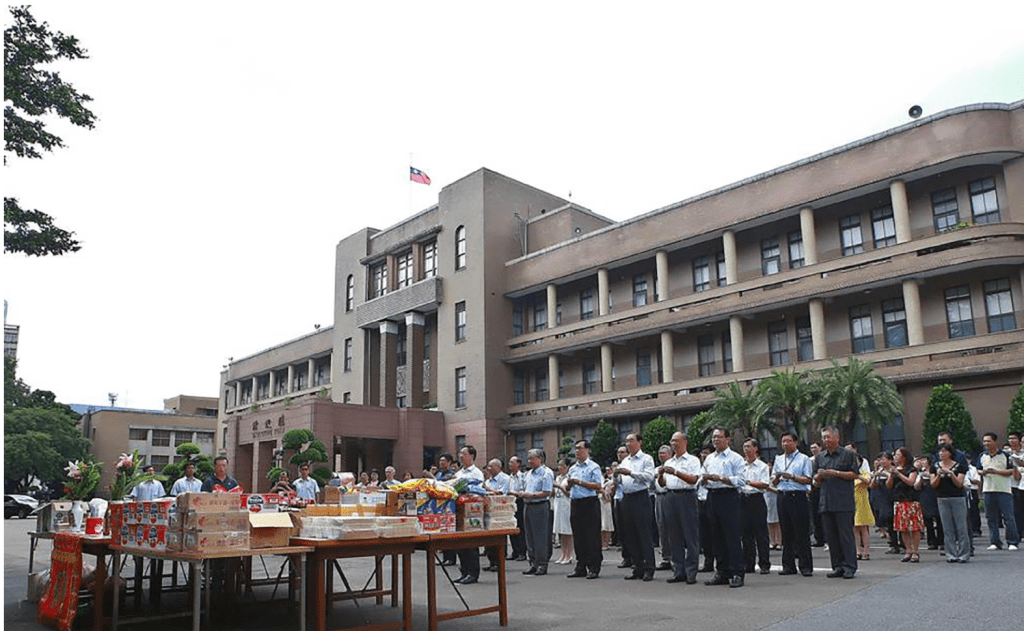
In addition to the rituals organised by the public, most government units at all levels of the central government (the Presidential Office, the Executive Yuan, the Legislative Yuan, and other ministries), as well as county and municipal governments and local administrative units, organise Pudu ceremonies, which have often appeared on the pages of Taiwan’s news media in recent years. For example, the Pudu ceremony organised by the Executive Yuan, the highest administrative body in Taiwan, was officiated by Premier Jiang Yi-hua in 2014. The offerings were provided by various offices of the Executive Yuan, including instant noodles, biscuits, beer, canned food, vegetable oil, and three sacrificial animals(三牲), usually pork, chicken, and fish, while the Premier’s office prepared barley tea, vegetable juice, and refined salt. Executive Yuan Premier of 2017, Lin Chuan, also attended the Pudu ceremony along with Vice Premier Lin Hsi-yao. In 2020, the Executive Yuan also prepared offerings for Pudu ceremony, with Premier Su Tseng-chang representing the ceremony by offering incense. As for the Legislative Yuan, in 2013, President of the Legislative Yuan Wang Jin-pyng was interviewed by the media and said that every year when it comes to lunar July, the Yuan would hold three ceremonies at the beginning, middle and end of the month. Likewise, in 2020, the President of the Legislative Yuan, You Si-Kun, led the ceremony and prepared offerings of three sacrificial animals, seasonal fruits(四果), wine and, paper money, etc. After the people had burned incense and bowed to each other three times, You read out the blessings to pray for good weather and good luck for the country. On the other hand, the ceremony of the Presidential Office, which houses the offices of the President and Vice President, was led by Chen Ju, the Secretary General of the Presidential Office, during the seventh month of the lunar calendar in 2019. This shows that the official authorities attach as much importance to the ghosts and spirits as the civil society, and those important state officials are responsible for the main ceremonial affairs of Pudu.
Interestingly, in 2015, the Ministry of Economic Affairs under the Executive Yuan held the Pudu Ceremony, and the offerings included the Want Want rice crackers(旺旺仙貝). When asked by a media reporter if there was any special meaning to it, John Chen-Chung Deng, the Minister of Economic Affairs and the ceremony’s officiant, expressed that he hoped “Taiwan’s economy will be prosperous”. In addition to the usual offerings, the Ministry of Economic Affairs’ Pudu Ceremony in 2019 also included an enlarged printout of the Triple Coupons(三倍券) that the government had issued to revitalise the economy. In the same year, the American Institute in Taiwan (AIT) also held a Pudu ceremony, and the Director, William Brent Christensen, led the staff in worship with incense. The flag dedicated to the ceremony read, “Your faithful W. Brent Christensen prayed with the greatest respect”. The following year, Sandra Oudkirk, who took over as Director of AIT, also participated in its Pudu ceremony. In addition to the traditional prayers, the offerings and paper money used to worship the spirits and ghosts are in the form of “New Taiwan Dollars” and “US Dollars” issued by the Bank of the Underworld.

In Taiwan in the 2010s, both the central government and the local government, regardless of the ruling party, did not show their advocacy for rationalism and scientism when facing “Ghost Month” in the civil society and did not dismiss the rituals of sacrificing homeless ghosts as pre-modern superstitious acts, as the Pudu ceremonies were held every year. In other words, during “Ghost Month”, the government puts aside the controversy over the existence of ghosts at the current scientific and empirical level so that political bureaucrats (mostly intellectuals), supernatural ghosts, and the democratic political system can form a space and time where they respect each other, do not conflict with each other, and are interdependent on each other in administrative operations. On the other hand, the government officials’ attitude toward rituals is not a special learning experience from the folk traditions, nor is it meant to be a show they put on for the public. Instead, these ideas often come from the social environment and upbringing of the officials and have not disappeared due to entering the Westernised political system and logic of governance. Even the foreign consulates in Taiwan are integrated into the time order of the “Ghost Month” and conduct actual acts of worship (rather than mere political performances).
Therefore, a deeper understanding of the phenomenon of Pudu rituals by Taiwan’s governmental units is to face the existence and power of ghosts in Taiwan with the mindset of “better to believe it is true.” The Pudu is not entirely a performance of ghost culture. Although there has been no official explanation from the governmental units, officials have shown us through the ceremonies and worship over the years that ghosts and spirits still bear the features of supernatural beings in Taiwan’s society.
Liang Ting-Yu (b. 1994, Taiwan) received his master’s degree in trans-disciplinary arts from Taipei National University of Arts. Studies and creates works that focus on the development and practice of project-based art, the methodology of ghostly discourse, problematic constructions, and related topics, as well as on the issues of panpsychism and Aboriginal history writing in the trend of late historical transformation justice and inhumanity.
This article was published as part of a special issue on Taiwan and Its Ghost Culture.
 Taiwan Insight