
Written by Yu-Chen Chuang
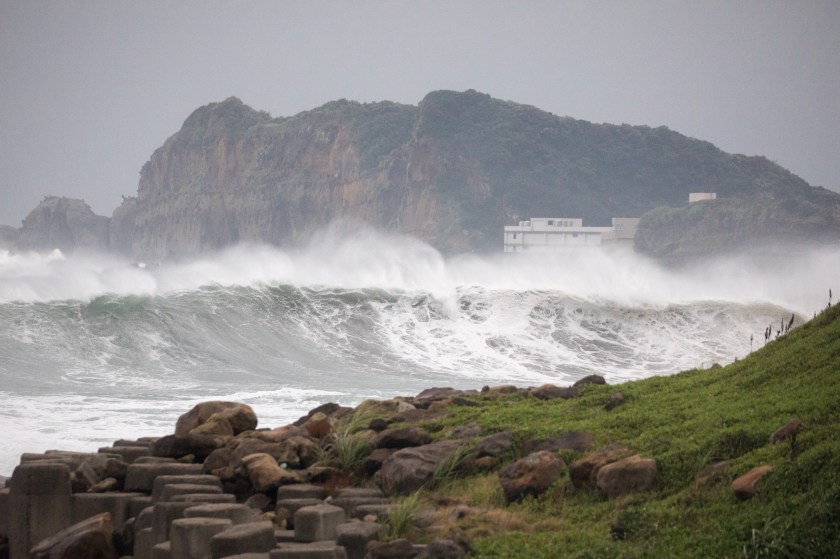
Image credit: 颱風 by Jameson Wu / Flickr, license CC BY-NC-ND 2.0 DEED.
In August 2023, Typhoon Khanun swept across Taiwan, particularly impacting the mountainous regions of central Taiwan. The resultant severe floods and landslides caused significant damage to infrastructure and disrupted the livelihood of local residents. One of the most severely affected areas was Renai Township in Nantou County, which is home to several Indigenous communities. The damages caused by Typhoon Khanun demanded significant labour and financial resources from Indigenous communities to manage the lengthy post-disaster reconstruction. Typhoon Khanun was not the only case demonstrating Indigenous peoples’ vulnerability when facing disasters. Typhoon Morakot in 2009, for example, led to a large-scale relocation of Indigenous communities in Southern Taiwan. This special issue, titled ‘Indigenous Peoples and Disaster Justice,’ will feature contributions from scholars and practitioners deeply involved in Indigenous-centered disaster management in Taiwan. We hope to foster discussions about the past, present, and future of disaster management, with a particular focus on addressing colonial injustice.
Disaster Vulnerability and Injustice in Taiwan
In the field of disaster research, the definition of a disaster is inherently influenced by social factors rather than being solely attributed to “natural” causes. Within this research framework, the term “vulnerability” is crucial as it delineates “the characteristics of a person or group and their situation that influence their capacity to anticipate, cope with, resist and recover from the impact of a natural hazard.” Vulnerable populations are especially at risk during disasters due to factors such as socioeconomic and racial status. For instance, previous studies emphasize the role of institutional and structural contexts in constraining effective coping and adaptation to disasters. They have revealed that hurricanes, floods, and earthquakes affect different groups of people disparately, as we consider factors such as race, ethnicity, gender, and economic status. Socially differentiated disaster impacts also manifest in post-disaster recovery projects, as they tend to perpetuate and exacerbate existing social inequalities.
In Taiwan’s context, Huang (2018) introduced the notion of “disaster (in)justice” to elucidate how Indigenous peoples’ vulnerability to disasters was produced historically. Focusing on two Indigenous communities in Southern Taiwan—Kucapungane and Makazayazaya—as a case study, Huang reinterpreted the concept of “disaster” from Indigenous peoples’ perspective, framing it as a persistent historical injustice. On one hand, state-led relocation projects since the Japanese colonial period have compelled Indigenous communities to settle in flood-prone areas. On the other hand, ongoing urbanization and modernization led to the erosion of Indigenous communities’ traditional livelihoods and self-governance.
Indigenous peoples’ vulnerability is a cumulative outcome of urbanization, modernization, and state-led relocation projects that have marginalized them from mainstream society. Moreover, the Taiwanese government also operated post-disaster recovery projects in ways that continue to exacerbate inequality and erode Indigenous peoples’ political, economic, and cultural autonomy. Several Indigenous communities in Southern Taiwan, including the Kucapungane and Makazayazaya mentioned above, faced controversial post-disaster relocation plans dominated by the government and NGOs after Typhoon Morakot in 2009. Forced into “permanent houses” designed without cultural sensitivity, Indigenous communities had to adapt to new living patterns and social relations, often leading to continuous economic difficulties and cultural loss. Previous post-disaster recovery projects failed to involve Indigenous peoples in the planning process, ignoring their cultural and subsistence needs, which are deeply rooted in their connection to the natural environment. As a result, these “recovery” efforts might end up causing long-term harm. They undermine Indigenous peoples’ collective ability to maintain their cultural practices, political strength, and economic activities.
Empowering Indigenous Knowledge for Disaster Resilience
Recognizing the colonial roots of Indigenous peoples’ vulnerability, researchers and practitioners in Taiwan have begun reevaluating the existing disaster management policies and exploring collaboration with Indigenous knowledge. Their goal is to empower Indigenous communities to take an active role in preventing, responding to, and recovering from disasters. Indigenous communities are relearning and applying their traditional knowledge to create community-based disaster prevention plans. Practising traditional knowledge goes beyond simply dealing with disasters; it fundamentally involves re-establishing an ethical relationship between humans and nature. In shaping future policies, it is crucial to adopt an Indigenous perspective when addressing “disasters.” By beginning with a historically informed and culturally sensitive understanding of disaster, it becomes possible to formulate disaster management and post-disaster recovery strategies that align with Indigenous peoples’ cultural norms, traditional environmental knowledge, and subsistence needs.
Globally, Indigenous knowledge and practices play a vital role in climate action, especially given the uncertainties in our climate’s future, which poses significant challenges to current adaptation strategies. For instance, the Sixth Assessment Report of the United Nations Intergovernmental Panel on Climate Change (IPCC) acknowledged that “Indigenous Peoples have been faced with adaptation challenges for centuries and have developed strategies for resilience in changing environments that can enrich and strengthen current and future adaptation efforts.” The IPCC statement acknowledges Indigenous peoples as key actors and contributors to climate science and policy. In this context, emerging scholarship, such as that focused on decolonizing climate adaptation, seeks to formulate strategies for addressing climate-related disasters that centre Indigenous peoples’ experiences, foster recovery from systemic injustice, and uphold Indigenous sovereignty.
This Special Issue
This special issue features three articles to interrogate Indigenous disaster Justice in Taiwan. The first article, written by Yi-Te Yu, traces the historical factors shaping Indigenous peoples’ disaster vulnerability. It also critically examines the post-recovery plan implemented after Typhoon Morakot. Trained as a disaster engineer, Yi-Te is currently involved in Indigenous disaster prevention efforts. His experience provides insights that challenge Taiwan’s mainstream disaster management approach. Following the historical analysis, the second article presents a case study that illustrates the valuable role of Indigenous traditional knowledge in disaster prevention. Bayis Atung, a member of the Atayal people from Cinsbu, discusses how their community incorporates traditional land ethics into agricultural practices. In the face of challenges posed by a shifting climate, Cinsbu’s farmers apply traditional land use knowledge, including agricultural production, sustainable land management, and disaster prevention, all within their multifunctional agricultural approach. Lately, Valagas Gadeljeman’s article explains the traditional decision-making mechanisms in post-disaster recovery, with a focus on the negotiation strategies of traditional female leaders.
The stories of Taiwan’s Indigenous communities in the face of disasters are not just about their vulnerability; they are narratives of resilience and reclamation of culture and sovereignty. Integrating Indigenous knowledge and perspectives into disaster management is an ethical imperative to forge an inclusive, sustainable, and decolonial future. This special issue invites continuous exploration, learning, and collaboration with Indigenous communities. By doing so, we integrate disaster management into pursuing historical justice and empowering Indigenous communities.
Yu-Chen Chuang, a PhD student in Geography at Penn State University, has research interests at the intersection of political ecology, decolonial geographies, and science and technology studies. Her research focuses on the intertwining of climate governance and settler-colonialism in Taiwan.
This article was published as part of a special issue on Indigenous Peoples and Disaster Justice in Taiwan.
 Taiwan Insight