
Written by Yi-Te Yu
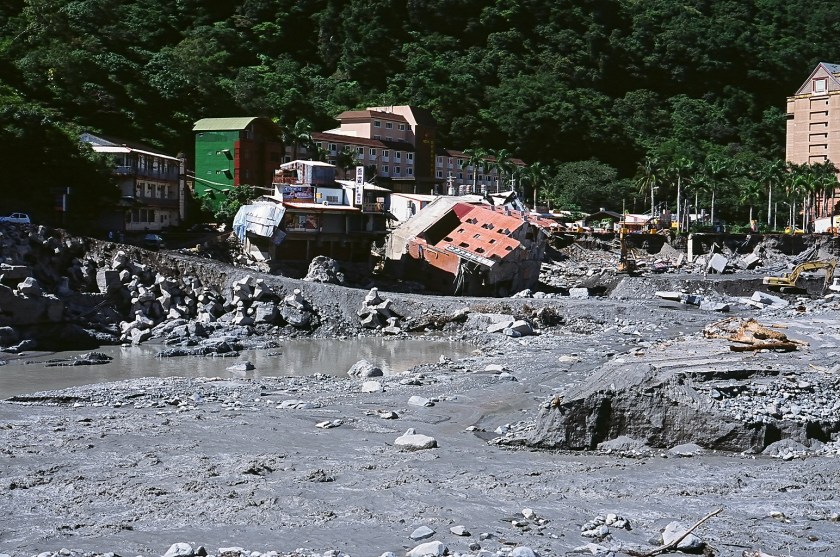
Image credit: 2009.08-莫拉克颱風之後-台東知本1 by 柯金源 / Flickr, license CC BY-NC 2.0 DEED.
In the past two decades, Taiwan has endured two major disasters: the 921 Earthquake in 1999 and Typhoon Morakot in 2009. Both events resulted in immense loss of life and property. The Indigenous regions of Taiwan, in particular, have borne the enduring impact that is yet to see a complete recovery. Taking Typhoon Morakot in 2009 as an example, during its onslaught in Taiwan, it unleashed a record-breaking deluge of rain. This led to a large-scale landslide in Mt. Xiandu(獻肚) in Jiaxian District, Kaohsiung, burying the village Xiaolin beneath a deluge of soil and debris. Moreover, this catastrophe also inflicted the mountainous Indigenous communities in the central and southern regions of Taiwan, including Chiayi, Kaohsiung, Pingtung, and Taitung counties, with the onslaught of floods, landslides, and debris flows. In total, it resulted in 678 fatalities and 33 injuries.
Due to this incident, both the public and private sectors initiated various forms of recovery efforts. Public opinion began to widely discuss the root causes and who should be blamed for the damage, such as extreme climate conditions, agricultural development in mountainous regions, and the exploitation of water resources. Back then, in 2009, I was a university student who majored in soil and debris disaster management engineering. However, the department where I studied disaster management showed no concern, discussion, or action towards Typhoon Morakot’s impacts on Indigenous communities. It wasn’t until the second year after the disaster, because of the required internship course, that I visited several severely affected Indigenous communities in Taitung, participating in a river restoration project led by the local government. Subsequently, in 2012, the third year after the disaster, I got involved in a community-driven reconstruction project in Namasia District, Kaohsiung. There, I witnessed how the Kanakanavu people endeavoured to explore the potential for disaster response through actions of reviving traditional culture.
These experiences raised many puzzling questions: Why is it that the Indigenous communities, situated on the periphery and unable to partake in the fruits of high economic development in modern society, bear the brunt of the climate cost? In the discussions concerning the causes and responsibility of disasters, why is the mountainous agriculture that sustains Indigenous people’s livelihood singled out as the culprit for environmental degradation? Furthermore, the post-disaster reconstruction policies designate Indigenous lands as hazardous, compelling Indigenous people to leave their homelands and relocate to the newly constructed “permanent” resettlement community housing. Instead of addressing the fundamental causes of disasters, this post-disaster policy displaced Indigenous peoples from their land and culture, repeating the historical harm they have endured since the colonial period.
However, when I posed these questions to my professors in the disaster management department, I received no satisfactory answers. This led me to reflect on the knowledge I had been acquiring. While it was based on the design of disaster reduction engineering to safeguard lives and property, it seemed to lack of any humanitarian concern. This prompted me to question Taiwan’s disaster prevention and rescue system, compelling me to shift towards the realm of social sciences and understand the challenges faced by Taiwan’s Indigenous peoples.
As my understanding of the colonial history endured by Taiwan’s indigenous peoples deepened, I became better equipped to understand the earlier-mentioned perplexities, including two facets of the issue. Firstly, the unequal power dynamics between the ruling ethnic group and the Indigenous peoples; secondly, the government’s policies and methods in disaster management lead to a power imbalance between the government and the populace.
Colonial Impact on Indigenous Peoples: Land, Culture, and Vulnerability
Initially, when Taiwan came under Japanese rule in 1895, the Japanese authorities, in their pursuit of Taiwan’s forest resources, seized the traditional lands of Indigenous peoples as state property. This act altered the Indigenous peoples’ traditional way of life, which relied on shifting cultivation and hunting for sustenance. Tribes were relocated to easily manageable upland areas, compelling them to leave their original homelands. The modern state’s administrative system replaced the tribes’ existing autonomous organizations, thereby diminishing the Indigenous peoples’ control over their land and political power.
In 1945, as Taiwan entered the era of Kuomintang government rule, it inherited the policies of the Japanese colonial administration. Further efforts were made to modernize Indigenous tribes, changing their cultures and languages, all in the pursuit of lifting Indigenous peoples out of what was perceived as ‘poverty’ and ‘cultural backwardness,’ aiming to mould them into ‘exemplary citizens.’ These colonial policies pushed the Indigenous peoples to the margins of Taiwanese society, rendering them a vulnerable demographic. This led to the loss of their long-standing way of life and culture, which the utilization of natural resources had sustained. On the one hand, it weakened the Indigenous peoples’ autonomous capacity to respond to natural disasters and, on the other, exacerbated their vulnerability when facing the risks of natural disasters.
Continued Colonial Influence on Disaster Management Policies
The government’s approach to forest, land, and natural disaster management has long operated in a top-down manner, predominantly guided by natural and engineering sciences. Yet, the Indigenous peoples, who are most profoundly affected, lack avenues and mechanisms for participation. The environmental knowledge generated from the Indigenous peoples’ long-standing interaction with nature is not integrated into policy considerations. Following Typhoon Morakot, a series of recovery and reconstruction measures were put into motion. In an effort to alleviate unsettled minds, the government urgently addressed the issue of housing for disaster victims by partnering with private charitable organizations such as Tzu Chi and the Red Cross, embarking on large-scale reconstruction and relocation projects. The government initially designated the disaster-affected areas as hazardous zones, compelling residents to relinquish ownership of their tribal homes and lands in exchange for the right to use housing in resettlement communities. Furthermore, residents were prohibited from returning to their original dwellings for prolonged periods. This undoubtedly amounted to a further deprivation of the Indigenous peoples’ land and space for living.
In the face of disaster’s impact and the destruction of their homelands, Indigenous peoples were forced into the dilemma of deciding whether to stay or leave while still amidst fear and confusion. In this hurried, chaotic, and, one might say, overbearing decision-making process, disaster victims were passively arranged. The policies were geared towards protecting the political careers of those in power and minimizing the responsibility and risk of administrative agencies. In reality, there was scarcely any space provided for victims to make choices. Instead, it gave rise to internal conflicts and tensions within communities, rupturing the unity and emotional ties.
The Indigenous peoples affected by Typhoon Morakot have borne the double burden of manufactured disasters stemming from colonial rule and natural disasters for over a century. However, the government’s environmental and disaster management approach, grounded in a faith in natural and engineering sciences, leans toward framing disaster causes as purely natural events, lacking a historical perspective. Additionally, the government’s comprehension of reconstruction and recovery has been limited to building physical infrastructure. It neglects the long-term issues such as the psychological recovery of disaster victims, rebuilding of lives, survival, and even the continuity of ethnic cultures.
The concept of Indigenous disaster justice cannot be comprehended solely through isolated natural disaster events. It requires an understanding of the broader social structure in which Indigenous peoples face political, cultural, and economic marginalization within Taiwanese society. This marginalization exacerbates the impacts of natural disasters in various ways. Now, more than a decade has passed since Typhoon Morakot. The second and third generations were born in resettlement communities, residing in houses that were not originally designed for long-term habitation. Indigenous residents have encountered challenges such as inadequate living functions, limited economic opportunities, and land ownership issues, to name a few. Meanwhile, we also witness many members of resettlement communities working diligently to rebuild autonomously. They are developing new economic models, preserving emotional and cultural connections with their original communities, and building confidence, identity, and dignity.
In the future, we must continue to oversee the government. Besides resolving the predicaments faced by resettlement communities, Taiwan’s environmental and disaster management should actively engage Indigenous peoples in decision-making. It should incorporate Indigenous cultural and ecological knowledge, as well as the needs of social development, in formulating policies. Indigenous peoples should not be viewed as a vulnerable group or disaster victims in need of assistance but rather as important partners and contributors to environmental governance.
Yi-Te Yu has a background in disaster engineering and sociology. His research interests initially focused on ethnic politics and Indigenous policies in Taiwan. Recently, he has circled back to the field of disaster studies, aiming to challenge the disaster management system. Yu seeks to critique the system, currently dominated by scientific rationality and engineering methodologies, from the perspective of Indigenous peoples.
This article was published as part of a special issue on Indigenous Peoples and Disaster Justice in Taiwan.
 Taiwan Insight