
Written by Ellen Y. Chang.
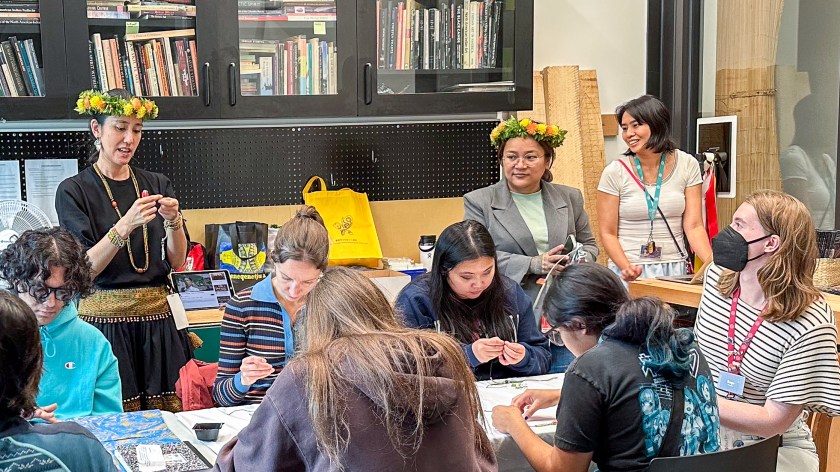
Image credit: Paiwan/Rukai Bead Crafting Workshop on November 17, 2023, at the Artist Studio in the Burke Museum. From left to right (in the back): Zuzule Demalalade, Tien-Li Schneider, and Nikal Kabala’an. Photo courtesy of Ellen Y. Chang.
Part I: An Introduction to Kuroshio Odyssey
The Taiwan Studies Arts & Culture Program at the University of Washington (UW) proudly presents Kuroshio Odyssey: Maritime Memories, Culture, and Landscapes. This initiative celebrates the rich Indigenous cultures of Taiwan and underscores their profound ties to the Pacific Northwest. It features a multi-sited exhibition at the Burke Museum and the UW Tateuchi East Asia Library, an online display hosted by Taiwan’s Indigenous Peoples Cultural Development Centre, and a series of family-friendly events.
Indigeneity has been a deeply contested issue in Taiwan due to the serial colonialism that the island nation has endured for centuries. The complex history of successive and overlapping waves of immigration has contributed to Taiwan’s proudly diverse and multi-ethnic society. However, such diversity is rooted in a painful history of exploitation, repression, and discrimination against Taiwan’s Indigenous Peoples. Taiwan President Tsai Ing-wen’s public apology on August 1, 2016, marked a significant moment in Taiwan’s Indigenous transitional justice movement. This historic gesture acknowledged the centuries-long pain and mistreatment endured by the Indigenous Peoples of Taiwan. However, according to leading Indigenous activists—Panai Kusui, Istanda Husungan Nabu, and Mayaw Biho—and their fellow protesters engaged in initiatives, there is another side to this story. Moreover, many Indigenous groups continued to grapple with discrimination, inequality, exclusion, and the lack of official recognition from the government. There is more work required for the pursuit of true justice and reconciliation.
Kuroshio Odyssey stands as a poignant reminder. With four curators—Zuzule Demalalade, Nikal Kabala’an (Margaret Yun-Pu Tu), Jiun-Yu Liu, and Tien-Li Schneider—representing diverse ethnic backgrounds and possessing unique socio-cultural and institutional expertise, the program embraces a multitude of perspectives. Their partnership extends beyond borders, connecting Taiwan to the Pacific Northwest. With the support of the UW Centre of American Indian and Indigenous Studies (CAIIS) and the Oceanic & Asian Culture Department at the Burke Museum, Kuroshio Odyssey brings a wealth of Indigenous knowledge and insights. It explores forms of reconciliation and decolonization at all levels of social life.
(Re)rooting/(Re)grounding holds a pivotal role in the process of decolonization and knowledge sharing, particularly for an expansive program like Kuroshio Odyssey, which spans centuries in time and thousands of miles in distance. The opening ceremony at wǝɫǝbʔaltxʷ (Intellectual House) on the UW campus began with a land acknowledgement ceremony. It was led by Robin Little Wing Sigo (Suquamish, Duwamish), expressing deep gratitude and respect for the land and its peoples that nurture the site from which Kuroshio Odyssey evolves. This was followed by a poem recitation in Amis (Pangcah), English, and Mandarin by the Kuroshio Odyssey curators and artists, as well as UW students and overseas Taiwanese community members, expressing a heartfelt gesture of blessing and thanks in return.
The CAIIS Knowledge Family Funding supports the crucial groundwork for the entire Kuroshio Odyssey series. The exhibition (re)examines the Indigenous Taiwanese holdings at the Burke Museum and (re)tells their stories in an accessible manner. Meanwhile, the Tateuchi East Asia Library invites curious minds to delve deeper with scholarly writings and curatorial/research notes without losing touch with the lifeworlds by surrounding and anchoring (perhaps even inspiring) the research with photographs of the natural landscapes that give rise to the Indigenous knowledge. Additionally, the opportunity for dialogues offered by the online exhibition grounds visitors in the homeland of Indigenous Taiwanese Peoples and forges meaningful connections between Indigenous cultures spanning Taiwan and Seattle.
Before Kuroshio Odyssey, our program, in collaboration with the Burke Museum’s Education Department, pioneered Indigenous Taiwanese crafting and storytelling workshops. These family-friendly events, alongside the Hu Tai-Li memorial series, co-hosted with the UW East Asia Centre and the UW Libraries, laid the foundation for a strong partnership among the organizers, as well as the Indigenous Taiwanese diaspora communities in Washington. The family-oriented approach effectively connected Indigenous Taiwanese cultures with Taiwan’s diaspora communities and the Seattle locals. With accessibility and inclusivity in mind, these Indigenous cultures, far from their roots and unfamiliar to many, built a bridge to their new audience.
Kuroshio Odyssey’s unique strength lies in its geographical separation: produced in Seattle yet rooted in the Indigenous Taiwanese cultures and knowledge of Taiwan. This distance offers a fresh and humble perspective as we (re)visit, (re)learn, and (re)experience Taiwan and its Indigenous cultures from a distance. It also enhances the emotional connection between the program and its beholders. The curators and artists’ residency at the UW in October and November, made possible through extensive collaboration mobilizing resources from various academic institutions, cultural organizations, and government agencies in Taiwan and the U.S., mirrors the excitement of a first meeting between pen pals.
Part II: A Dialogue with Zuzule Demalalade
Earlier in October, at the Agua Verde Café, a picturesque waterside eatery near the UW campus, I met Zuzule and Tien-Li in person for the first time. It was a rare, sunny day in Seattle’s fall season, providing a truly inspiring backdrop. Over a comforting meal, I received a Paiwan qata (glass beads) necklace. I later discovered its profound cultural significance and the delicate artistry behind these beads at Tien-Li’s Paiwan/Rukai Bead Crafting Workshop. (Re)learning about Kuroshio Odyssey directly from Zuzule and Tien-Li, after a year of pre-production, felt like (re)discovering a cherished childhood lullaby—both comfortingly familiar and refreshingly new. Our conversation continued through instant messaging after Zuzule returned to Taiwan and Tien-Li to New Zealand. This exchange, translated and edited by myself, is a heartfelt testament to our shared passion for Kuroshio Odyssey.
Kuroshio Odyssey holds a special place in our program as the most extensive collaboration undertaken by the UW Taiwan Studies Arts & Culture Program since its launch in late 2020. Zuzule Demalalade, from the Indigenous Peoples Cultural Development Centre, spoke of the centre’s engagements with various organizations, advocating for Indigenous culture and knowledge through exhibitions, workshops, and cultural events. She noted that the centre usually takes a leading role in shaping on-site programs and provides support through their expertise in Indigenous knowledge, traditions, and crafts to help realize curatorial visions. Throughout these collaborations, decolonization remains the paramount objective, particularly for herself as a curator of Indigenous Paiwan heritage.
While exposure to Indigenous cultures marks an important initial step in fostering cross-cultural understanding, Zuzule highlighted that the framing of such encounters is significant in breaking the cycle of perpetual colonization and repression in knowledge production associated with Indigenous Peoples and their communities. Through the dialogues the centre curated for exhibition visitors and workshop participants, they hope to empower individuals of all ages, ethnicities, and cultural backgrounds to actively contribute to Indigenous decolonization, solidarity, and reconciliation in Taiwan.
As the conversation returned to Kuroshio Odyssey, Zuzulu described the program as a pioneering collaboration between their centre and a U.S. museum. Evolving in the form of a dialogue, the program itself serves as an ongoing conversation between Taiwan and Seattle, bridging the Indigenous Taiwanese holdings at the Burke Museum with those housed in their centre. Leveraging Nikal and Jiun-Yu’s research as the foundation, the Burke Museum curates a selection of their Indigenous Taiwanese holdings. In contrast, the online display of 24 Indigenous Taiwanese cultural objects enriches the narratives of Indigenous Taiwanese heritages across the Pacific Ocean.
Zuzulu spoke of some selected artefacts of the exhibition as an example of their collaborative efforts. The Atayal mouth harp online showcases a mouth organ with a subtly different style from the one displayed at the Burke Museum; the Truku beheading flute online and the Atayal flute at the Burke Museum illustrate the distinct socio-cultural functions of traditional instruments in different Indigenous communities. The long vest with glass beads and string bells, the shell bead skirt, the shell bead vest, and the weaving garment provide insights into the Atayal community’s intricate beadwork on their garments that symbolize various social functions and statuses. Finally, the inclusion of a Yami (Tao) plank boat (tatala) model online connects with the centrepiece of Burke’s Culture Is Living gallery, the prominent tatala boat.
Finally, I asked Zuzulu how Kuroshio Odyssey, designed for a global audience, differs from or aligns with previous collaborations curated by their centre. She responded that the program was groundbreaking, uniting the Burke Museum in Seattle and its centre in Pingtung (Taiwan) through a hybrid exhibition. This program uniquely portrays Indigenous Taiwanese Peoples and their cultures as vibrant and dynamic with its profound focus on capturing the “sense of living,” dispelling the notion of them as mere historical artefacts. The hybrid exhibition, interactive screenings, workshops, and forums all bring this concept to life through rich dialogues.
She also noted that the exhibited cultural holdings are more than just chronicles of Taiwan’s Indigenous communities. They unfold lived experiences and spark meaningful conversations. For instance, the Yami (Tao) coconut shell vessel shares a culinary memory from the Yami (Tao) People as children often use coconut shell vessels to collect seawater, enhancing the taste of their mothers’ dishes with the unique flavour of salty seawater. The inclusion of a Paiwan twin-pipe mouth flute, crafted by Etan Pavavalung (1963-), son of the renowned Indigenous artist Pairang Pavavalung (1935-2023), whose Paiwan nose flute is featured in the Burke Museum. It not only showcases artistry but also celebrates the precious kinship forged through Indigenous knowledge and tradition. Similarly, in addition to spotlighting the diverse lived experiences of Taiwan’s Indigenous communities, the Paiwan linked cup in the online exhibition symbolizes cultural exchanges and friendships among all the collaborating partners of Kuroshio Odyssey, affirming the profound connection between Indigenous cultures in Taiwan and the U.S.
This article was published as part of a special issue on Kuroshio Odyssey Part I: A Curatorial Journey between Taiwan and Seattle.
 Taiwan Insight