
Written by Jiun-Yu Liu.
Image courtesy of Jiun-Yu Liu.
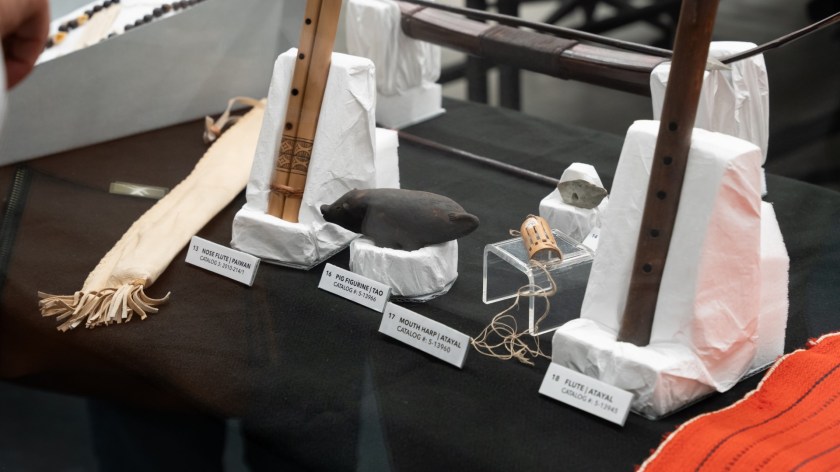
Kuroshio Odyssey: Maritime Memories, Culture, and Landscapes 黑潮漫遊:海洋記憶・文化・地景 (follows as KO) is a mini exhibition held at the Burke Museum in Washington State, USA (Oct 14 – Nov 28). KO focuses on two key themes: the diverse Indigenous cultures and the stunning natural landscapes in eastern Taiwan. As a multi-media exhibition, KO showcases material collections from multiple Indigenous communities in eastern Taiwan and includes an immersive element as visitors can access QR codes that provide images and detailed information about the selected pieces. In addition to the onsite exhibition, two Indigenous Taiwanese guest curators working in Taiwan and New Zealand have chosen wonderful artefacts from the Indigenous Peoples Cultural Development Center collection and converted them into an online exhibition to echo and enrich the KO exhibition content. While the onsite and online exhibits highlight the cultural landscapes, Tateuchi East Asia Library, the other exhibition venue, presents the gorgeous natural landscape with a photo gallery. The photo gallery has also been carefully curated to link with the research resources and curators’ notes that reflect Indigenous self-determination, decolonization, and cultural revitalization. In addition to the static displays, KO also features a series of in-person cultural exchange events, including crafting workshops, movie screenings, food cultural exchange, and an online forum on land rights and justice.
As an archaeologist, my general research interest, or say I am genuinely interested in, is human interaction and adaptation to the surrounding environments. These environments can be natural, artificial, tangible, or intangible (social structure, for example). Hence, in addition to examining the crafting technique and marvelling at the beauty of museum holdings/artefacts, I constantly consider the function and the meaning of those material cultures and the people behind them. Telling the story of the Taiwan Indigenous Peoples via the museum collection is one of the criteria when designing the exhibition. In the recent decade, Indigenous archaeology has been widely practised in Taiwan, emphasizing the community-based research method and decolonized interpretation of the archaeological data. Therefore, the effort of decolonization and self-determination of the Indigenous Peoples in Taiwan is an essential element we want to include in the exhibition and deliver to the audience. In this article, I will share the curatorial journey of KO and my role as a Taiwanese archaeologist in it.
It’s all beginning from a black pot from Orchid Island
Led by Margaret Yun-Pu and I, the KO mini-exhibition is a collective effort by people from multiple institutes, but like every other story, it has a beginning. When I recall, all should be related to a little black pot from Lanyu (Orchid) Island that has been sitting in the Burke Museum for decades. It was 2015, my first teaching assistant job as a graduate student at the University of Washington (UW). The class was Ethno-archaeology, taught by Prof. Sven Haakanson, whose doctoral advisor at Harvard was Taiwanese-American archaeologist Kwang-chih Chang, an important figure in Taiwan and Chinese Archaeology. In a museum tour as the class activity, I searched the database for black pottery and eventually found the existence of the Taiwanese Indigenous collection in the museum. That was not a super surprise to me since all the prominent museums were collecting overseas material culture in the old days. Also, my brain was fully occupied by my doctoral research about black pots and metals in ancient Taiwan, so I did not pay too much attention to the Taiwanese Indigenous collection. However, the fact that the Burke Museum has this collection indeed has its corner in my mind.
The new Burke and coffee time
The Burke Museum moved into its new house and had its grand opening in the autumn of 2019. That was the first time I saw the Tatala, a kind of plank-assembled boat from Orchid Island, in the visual focal point of the Arts and Culture Exhibition. I heard about the Tatala and its story from my doctoral advisor, Prof. Peter Lape, also a curator in the museum. The exhibited Tatala triggered the old memory in the dusty corner of my brain and eventually pushed me closer to the collection in the storage room. From the database and curators, I learned various aspects of the artefacts/holdings, such as quantities and proveniences. Additionally, I referred to a dedicated master’s thesis by Chian-Jin Yeh from 1999, entitled “Research and Documentation of the Taiwanese Collection of the Burke Museum.” There was no clear plan, but I knew I needed to do something to fill in this 20-year gap.
I still remember a warm afternoon in the Off the Rez, the café of the Burke Museum. While we were social media friends for quite a while, I feel that afternoon was the actual moment we got to know each other. Margaret and I exchanged many thoughts about issues and debates regarding Indigenous matters in Taiwan, like traditional territory, cultural revitalization, and identity, from both our personal and professional perspectives. She is an Amis/Pangcah majoring in law, and I am a Taiwanese Hakka with Paiwan affiliation majoring in archaeology. We have developed several research and writing ideas in this short meet-up. And that was when I brought up the Taiwan Indigenous collection at the Burke Museum. While Margaret immediately expressed her interest in the museum collection, we lacked funding support to proceed.
TSP, CAIIS, and kick-off
Things started to get rolling in the spring of 2022. The Taiwan Studies Program (TSP) of the Jackson School of International Studies on campus generously offered me a teaching opportunity for the 2022 spring quarter. As an archaeologist, the most relatable course I can think of for students mostly interested in contemporary issues is ‘Taiwan Indigenous Cultures and Current Issues.’ No doubt, the tour of the Burke Museum was a part of this course.
The real kick-off was the support from the Center of American Indian and Indigenous Studies (CAIIS). Laura Philips, my former supervisor, when working in the archaeology department in the museum as a student, reminded me about a Knowledge Family funding opportunity by CAIIS. Although we learned about this funding opportunity at the last minute, Margaret and I managed to apply on time and were rewarded. Our CAIIS project aimed to re-engage with the museum collection and preserve the history of Taiwan’s Indigenous elders living in the greater Seattle area. Through this Knowledge Family project, we also mentored three undergraduate students from different backgrounds but all passionate about Taiwan’s Indigenous Cultures.
Making connections and pushing further
With the museum researcher roles during the Knowledge Family project (2022 to 2023), we hosted visits and made connections, including Director Mark Chien of the Taiwan Academy in Los Angeles, Representative Bi-khim Hsiao of Taiwan to the United States, scholars who attended the World Congress of Taiwan Studies, and Taiwan Indigenous youths. Those connections became the booster that pushed our Knowledge Family project into a public exhibition. Taiwan Academy in Los Angeles, the primary sponsor of KO, was connected because Director Mark Chien visited Prof. Holly Barker and the museum. The connection with our other sponsor, the Taiwan Studies Program (TSP) at the University of Washington (USA), was established long before the KO exhibition. During the Knowledge Family project, Director Ellen Chang, Arts and Culture Program of the TSP, held several collaborative events with us in the museum, like handcrafting of Amis/Pangcah Alofu bag and Kids Storytime. The last major connection was made during my research trip to the Indigenous Peoples Cultural Development Center (IPCDC) in the Beiyeh 北葉 Village, southern Taiwan. The trip initially sought research collaboration on museum collections but gained more than that. IPCDC has become our partner for the KO exhibition. The online co-exhibition curated by IPCDC is essential to the whole project. Furthermore, with the generous support from Prof. Holly Barker, we were able to have two guest curators, Zuzule Demalalade and Tien-Li Schneider from IPCDC, joining us for the opening ceremony and the following crafting workshops.
Toward the audience and concluding remarks
This exhibition features the Indigenous Cultures in eastern Taiwan and serves as a connection between Indigenous communities in Taiwan and the Pacific Northwest (PNW). PNW region has strong and thriving Indigenous cultures and is famous for its stunning natural land/seascapes in the US. As a city in the area, Seattle was named after Chief Seattle, a Suquamish and Duwamish chief, in the second half of the 19th century. The logo of the Seattle Seahawks, a professional American football team, is also designed with local Indigenous art style. The PNW Indigenous communities are still thriving and have deep connections with surrounding waters and mountains. With those criteria in mind, eastern Taiwan has many similarities with the PNW region regarding both natural and cultural aspects. Hence, we choose to introduce eastern Taiwan’s natural and cultural landscapes to the PNW audience.
With the carefully selected artefacts/holdings from Paiwan, Amis/Pangcah, and pan-Atayal communities, and photos by the curators, the Kuroshio Odyssey mini-exhibition delivers the very first dedicated exhibition of Indigenous cultures in eastern Taiwan to Seattleite and PNW region. We hope to promote Taiwan and foster cultural exchanges across the seas.
This article was published as part of a special issue on Kuroshio Odyssey Part I: A Curatorial Journey between Taiwan and Seattle.
 Taiwan Insight