
Written by Jackson Yeh.
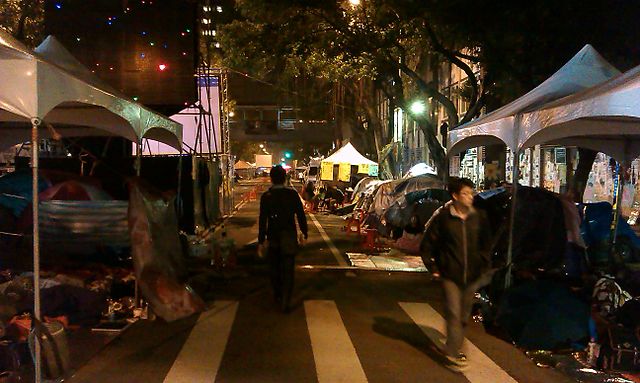
Image credit: Taipei Sunflower Movement Nighttime Tents (13662409284) by Jesse Steele from China/ Wikimedia Commons, license: CC BY 2.0 DEED.
The 2014 Sunflower Movement is the largest civil disobedience in Taiwan since the 1980s. The unprecedented 24-day occupation of the legislature caused intense legal and political debates. The Sunflower Movement also represents a critical watershed in cross-strait relations and impacts Taiwan’s political development. While civil society recently celebrated its 10th anniversary, the Sunflower generation still has an unfinished journey ahead.
The deep-rooted reason for the Sunflower Movement to protest the controversial Cross-Strait Services Trade Agreement (CSSTA) was the worry that Taiwan’s economy and democracy would be damaged by China when the Taiwan-China economic integration speeded up during the time of the Ma Ying-jeou administration (2008-2016). The slogan widely used in the movement, “Repeal CSSTA, Defend Democracy,” represented this deep concern.
The legacy of the Sunflower Movement is influential. Politically, the Taiwan-centered identity has grown and strengthened beyond the turning point. A “naturally pro-independent” generation will continually play an important role in Taiwan’s political participation. In December 2023, the Taiwanese identity of Taiwanese has hit a record high according to a poll conducted by the Election Study Center, National Chengchi University. 61.7 per cent of respondents said they identified as Taiwanese. In contrast, 2.4 per cent identify as Chinese, and 32.0 as both. After the Sunflower Movement, the pro-independence Democratic Progressive Party (DPP) won Taiwan’s presidential election in 2016, 2020, and 2024 consecutively, which decided the direction of the cross-strait relations.
The student-led Sunflower Movement also re-defined the state-society relations. Two judiciary and legal decisions have far-reaching implications. First, civil disobedience and the rule of law were further strengthened. As a new liberal democracy, Taiwanese courts positively responded to the definition and scope of civil disobedience despite its illegal nature. It was reconfirmed that civil disobedience can be legally justified. Considering the significant connection between speech and public affairs, the freedom of speech should be protected.
Secondly, an institutionalised oversight mechanism to supervise future deals with China was finally established. In May 2019, the Act Governing Relations between the People of the Taiwan Area and the Mainland Area was amended. When an agreement involves political issues (any agreement that could cause a constitutional or significant political impact), the Act requires the Executive Yuan to submit to the Legislative Yuan a plan for entering into the agreement and an evaluation report on the constitutional or significant political impact. The Executive Yuan shall also forward the draft agreement with the main text of the referendum and the statement of reasons to the Central Election Commission to hold a national referendum. The destruction or change of the nation’s sovereign status or the free and democratic constitutional order shall not be the subject of a negotiation or an agreement involving political issues. Any negotiations or agreements that violate this amended article are void. This high threshold makes any cross-strait political agreement, such as a peace agreement with China, very difficult. Both civil disobedience and oversight mechanisms strengthen the role and influence of Taiwanese civil society in shaping government policy.
Unfavourable views of China are the reasons why the Taiwanese oppose a closer tie in cross-strait relations. In an interview with German public broadcaster Deutsche Welle in January 2024, the former President of Taiwan, Ma Ying-jeou, said Taiwan has to trust Xi Jinping as far as cross-strait relations. However, the majority of the respondents (75%) opposed this statement, according to a Taiwanese Public Opinion Foundation survey. A similar trend can be found in the Taiwan National Security Studies (TNSS) data sponsored by Duke University and conducted by National Chengchi University (NCCU). Between 2016 and 2020, supporters of “bandwagon” with China by strengthening cross-strait economic engagement but not allying with the USA and Japan to counter China decreased from 48.5 % to 31.72%. Obviously, politicians who believe that the future of Taiwan should jump on the bandwagon of “China’s rise” misinterpret the public opinion in Taiwan. Taiwanese people want to control their fate.
Many observers had already discussed the dynamic interaction between the Sunflower Movement and the Umbrella Movement. Some even argued that the Tsai Ying-wen administration benefited from the social protests in Hong Kong, especially during the presidential elections. However, unlike the Sunflower Movement, the 2014 Umbrella Movement finally did not achieve its goal of genuine universal suffrage in Hong Kong. The Hong Kong government cleared the 79-day non-violence occupation with delaying tactics and court injunction orders. Beijing’s White Paper on “The Practice of the ‘One Country, Two Systems’ Policy in the Hong Kong Special Administrative Region” (in June 2014) and the “August 31 Decision” made by the Standing Committee of the National People’s Congress (NPCSC) reconfirmed that Beijing exercises “overall jurisdiction” over Hong Kong. The Umbrella Movement planted the seeds of political localism in civil society, further strengthening the valiantism and even separation movement in Hong Kong. The protesters had learned the painful lessons from the Umbrella Movement and created a more resilient resistance to the state apparatus in the 2019 Anti-Extradition Law Amendment Bill Movement. When the large-scale violent confrontations were gradually intensified, the movement maintained its leaderless character when facing brutal crackdowns by the authorities.
During the Sino-British negotiations over Hong Kong’s future after 1997, the Chinese government agreed that Hong Kongers would enjoy “Hong Kong people ruling Hong Kong” and “a high degree of autonomy” for fifty years (until 2047) under the “One Country and Two Systems” constitutional framework. The Hong Kong Basic Law also clearly states that the ultimate aim is the election of all the members of the Legislative Council (as well as the Chief Executive) by universal suffrage (Articles 68 and 45). However, democratisation in Hong Kong continued its stalemate and procrastination after the post-1997 political reforms. China even openly deemed that the 1984 Sino-British Joint Declaration, an agreement signed by Britain and China in 1984 to settle the future of Hong Kong, was an expired and invalid historical document. Due to the broken promises of “One Country and Two Systems” and the 1984 Sino-British Joint Declaration, the Hong Kong protests’ experience also worsened China’s image. According to the updated survey conducted by Academia Sinica, about 84% of the Taiwanese respondents disagreed that China is a credible country.
Ten years after the 2014 Sunflower Movement, Taiwan has entered a new phase, and the battle is not over. As a “sovereignty-contested democratic state”, Taiwan’s most pressing issue is protecting its sovereignty, freedom and democracy. Taiwan is not Hong Kong because the Taiwanese people can choose their government through free and fair elections. They can define and defend their interests from external interventions. Whether to resume the CSSTA is still controversial in Taiwan, and China continually seeks military pressure on Taiwan to act according to its interests. The Russian invasion of Ukraine and the Hong Kong National Security Law (2020) and Basic Law Article 23 Legislation (2024) remind the Taiwanese that they still live under the shadow of uncertain China factors. When the danger of armed confrontation over Taiwan grows, the Sunflower Movement and its legacy represent a collective effort to protect a democratic society.
Dr Jackson Yeh is a research associate in the Taiwan Studies Program at the University of Alberta.
This article was published as part of a special issue on ‘Tenth Anniversary of the Sunflower and Umbrella Movements‘.
 Taiwan Insight
.jpg)