
Written by Elizabeth Frost.
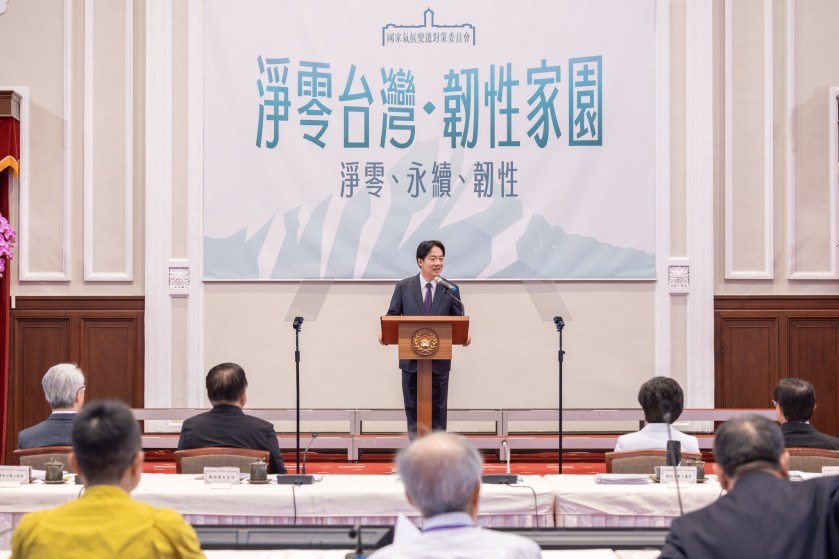
Image credit: 08.08 總統主持「國家氣候變遷對策委員會第1次委員會議」 by 總統府 / Flickr, license: CC BY 2.0.
Taiwan’s voluntary compliance with the UN climate process is unique. Despite not being a member of the UNFCCC, Taiwan has submitted its nationally determined commitments for over a decade. In 2023, the Tsai administration took a significant step by codifying Taiwan’s 2050 net zero target into law. Under Tsai, the Ministry of Economic Affairs also announced a target for 20% of energy generation to come from renewable sources by 2025.
Taiwan’s energy transition is of vital importance to global efforts to decarbonise technology supply chains thanks to the significance of the Taiwanese semiconductor industry. Given Taiwan’s reliance on imports of natural gas and coal and its consequent vulnerability to naval blockades, reducing its dependence on fossil fuels is also a matter of national security. Taiwan has a role to play in both climate change mitigation and adaptation: its per capita CO2 emissions are more than double that of the UK, and the island is already facing the impacts of the climate crisis – from disrupted typhoon cycles to rising sea levels.
Given Taiwan’s exclusion from participation in the official UN climate regime, what motivates its voluntary alignment with the international climate regime?
The desire to gain international support and recognition is a key factor. This can be understood as a process of climate bandwagoning, where Taiwan seeks to strategically link international climate change politics to its political aims: in this case, the quest for increased international legitimacy. Taiwan’s climate diplomacy efforts seek to gain recognition as a responsible eco-citizen and thus strengthen relationships with the global community. Since the Chen Shui-bian administration, successive Taiwanese governments have used the issue of climate change to push for greater UN participation. Late last year, the Ministry of Foreign Affairs published its latest call for Taiwan’s participation in the UNFCCC process, referencing domestic climate governance and carbon trading initiatives. Seven of Taiwan’s official diplomatic allies are highly climate-vulnerable small island states. Through the Pacific Climate Change Forum and a proposed just transition fund, Taiwan is demonstrating its commitment to supporting climate adaptation in several of these countries – the Marshall Islands, Nauru, Palau, and Tuvalu. Outside of state-level diplomacy, Taiwan has adopted a polycentric strategy for environmental governance, utilising a wide range of actors (NGOs, city governments, scholars and so on) and methods (both bilateral and multilateral) to engage with the international community on climate issues.
Newly inaugurated President Lai seems set to continue using climate issues as a key strand of diplomatic relationships. Speaking just before the election, Lai identified climate as an area of cooperation with Europe.
“I will convey to European leaders that Taiwan is very willing to strengthen economic and trade exchanges while jointly facing global issues such as climate change” Lai Ching-te, January 2024
International narratives of Taiwan’s climate action
Given the widespread lack of official international recognition of Taiwan’s sovereignty, gaining support from the global public is critical – and climate action could be a path towards achieving that goal. So far, however, it appears that Taiwan’s climate diplomacy efforts have failed to gain much recognition internationally.
One reason Taiwan’s climate diplomacy efforts have not had significant international cut-through is the gap between its impressive climate commitments and ineffective governance to make these commitments a reality. Taiwan’s climate legislation has been criticised for being a “gesture policy” “characterised by insufficient consideration of policy consequences and, collaterally, ineffective policy implementation.” The Taiwan government’s focus on reputation rather than tangible action is reflected in news articles that critique Taiwan’s climate policies for being insufficient to achieve their stated aims. For example, while Taiwan was previously lauded for offering the most generous set price for offshore wind in the world, recent developments have revealed policy shortcomings, leading to fears that Taiwan’s wind power ambitions are in peril. Furthermore, despite appearing to be a step in the right direction, Taiwan’s proposed carbon tax has been criticised for being too low to have any real impact on emissions.
“A serious problem of Taiwan’s climate actions is the lack of a sense of urgency.”
Building from this, it could be argued that a renewed focus on effective climate governance could cultivate more meaningful international participation for Taiwan. I hope the results of my research will frame tangible climate action – rather than gestures – as the key to achieving Taiwan’s climate diplomacy aims and thus help address the lack of urgency troubling climate action.
A focus on tangible results has proved successful for Taiwan’s other attempts at issue-based diplomacy. Taiwan’s promotion of LGBT rights during the Tsai administration, including the legalisation of gay marriage, “enhance[d] its reputation in the world as a liberal democracy with a sovereign status,” and tongzhi diplomacy has successfully broadened Taiwan’s international space. Taiwan’s stellar performance in healthcare, especially during the COVID-19 pandemic, has formed a compelling part of the “Taiwan can help” diplomatic strategy. Most recently, countries including the UK, France and Germany have called for Taiwan to be included in the World Health Assembly.
China’s attempts to establish itself as a climate leader pose a significant challenge to Taiwan’s attempts to gain recognition in the climate space. The political success of the Paris Agreement in 2015 has been attributed to China’s positive engagement with the UNFCCC climate process. Since then, China has positioned itself as a “torchbearer,” investing heavily in renewable energy technologies and often acting as a spokes-country for the Global South in international climate negotiations. However, China’s climate commitments are receiving increased criticism for being insufficient, especially in the realm of climate finance.
Taiwan could perhaps differentiate itself by finding synergies between climate diplomacy and other forms of issue-based diplomacy where it has already found success. This could include focussing on mitigating the health-related impacts of climate change, such as the spread of diseases to new areas, leading the way in decarbonising tech supply chains, prioritising democratic approaches to climate policymaking, focusing on climate justice, and the inclusion of Indigenous knowledge in adaptation and mitigation efforts. New approaches to climate diplomacy could better appeal to the interests of potential diplomatic partners and help address the problem that “Taiwan’s climate actions are often off climate observers’ radar and difficult to access due to the misrecognition of Taiwan’s status.”
Understanding how the wider world views Taiwan’s climate action can not only help us better understand Taiwan’s complicated and often lonely international position but could also drive stronger climate action domestically while allowing Taiwan to highlight its strengths on the world stage.
Elizabeth Frost is a British Master’s candidate in Climate Change and Sustainable Development at National Taiwan University. The arguments presented in this blog piece will form the basis of her Master’s thesis, research for which is still ongoing. After graduating with a BA in Chinese and International Relations from SOAS, University of London, Elizabeth completed a PGCert in Sustainable Energy Provision and Demand Management while working in the China-Climate space.
This article was published as part of a special issue on ‘SOAS Taiwan Studies Summer School’. Taiwan Insight has recently published a special issue on ‘Taiwan’s Legal Landscapes for Environmental Justice and Climate Action’, please read more relevant articles here.
 Taiwan Insight