
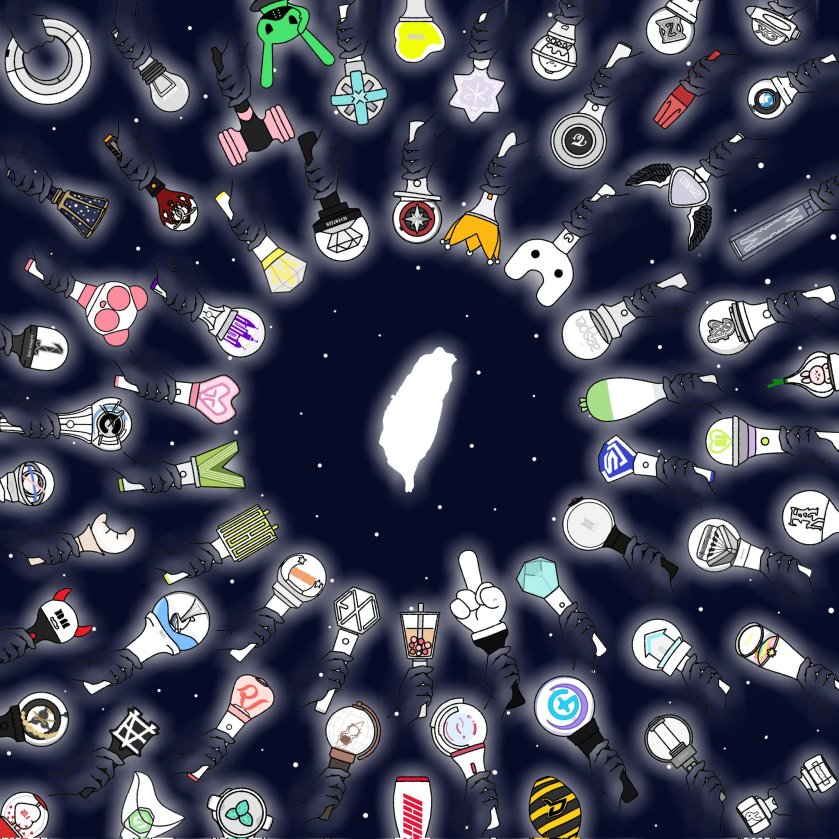
Written by Chee-Hann Wu.
Image credit: @mmm_twlzl / X.
Last year, in May 2024, I wrote an article about how pop culture fans participated in social movements while demonstrating immense creativity. The article was published as part of Taiwan Insight’s June special issue on ‘Bluebird Movement: Legislative Reform Protests in Taiwan’ with critical reflections and responses to the protests against the controversial parliamentary reforms led by Kuomintang (KMT) and the Taiwan People’s Party (TPP), including amendments that empower legislators to summon private citizens, companies or government officials for questioning, with non-compliance potentially resulting in criminal charges. Although the demonstrations appear to have ended in June 2024, the effects of the so-called Bluebird Movement linger.
I was not planning to revisit this topic so soon, merely less than eight months later. This article is both a follow-up to my May 2024 article and a preliminary investigation into the influence of transnational K-pop culture’s involvement in social movements and activism.
On 18 December 2024, the Economic Democracy Union (EDU/EDUnion) called for a rally in front of the KMT’s central party office to protest against the occupation of the legislative podium by KMT legislators to push through amendments to Taiwan’s recall law, along with two other controversial reforms, by preventing ruling Democratic Progressive Party (DPP) legislators from accessing the podium or presenting their proposed versions of the amendments.
This was the first day of the three-day rally by EDU in December, referred to as “Winter Bluebirds in Taipei.” A stage was set up outside of KMT’s central office, where various parties and individuals voiced their concerns and advocacies, while KMT members also brought out loudspeakers and tried to disrupt the rally outside.
What caught my attention the most was a video (2:20:00-2:26:00) of a group of K-pop fans appearing on stage, one of whom gave a memorable speech articulating their advocacy. Below is an excerpt from the speech.
We’re Taiwanese before anything else.
When our rights disappear, it’s often because of our political indifference.
If someone tells you that star-chasing is star-chasing and politics is politics, they are lying to you.
We don’t want the unique and precious support culture, passion, and community of Taiwanese fans to be violated by foreign forces.
We’re not willing to give up our beliefs for the sake of star-chasing.
We don’t want to be deprived of our rights and dignity.
One of the cores of fan culture is identity.
My bias is Taiwan
A few points need to be unpacked to explain the significance of K-pop and other pop culture fandoms’ involvement in the movement.
Prior to the new phase of Taiwan’s Bluebird Movement, Yoon Suk Yeol, the president of South Korea, declared emergency martial law at 10:27 p.m. on 3 December, leading to public panic and over a month of protests that continue to this day. During the waves of protests, K-pop fandoms in South Korea caught the public’s attention for their active participation in calling for Yoon’s impeachment. Lightsticks, which are merchandise sold by K-pop companies to fans for use during artists’ performances, were commonly seen at protests like stars that light up the darkness at night. Popular K-pop songs were sung together by both K-pop fans and the general public, making the protest almost like a concert.
In particular, the 2007 debut single ‘Into the New World‘ by the world-famous girl group Girls’ Generation is considered by many to be a ‘protest anthem.’ The song has been commonly featured in South Korea’s queer parades, activism and the protest by Ehwa Womans University students, which later led to the chain of events that uncovered the corruption of the government under Park Geun Hye. The lyrics read: “In the many unknown paths / I follow a dim light / It’s something we’ll do together to the end / Into my new world. [. . .] There is a rough road ahead of us / With an unknown future and obstacles / I won’t change and I can’t give up.”
It is this grassroots power that has made the song an emblem of the various protests that have taken place since. As well as the song, Girls’ Generation member Yuri showed solidarity with the December 2024 protest by pre-paying for snacks at a restaurant near the protest site, allowing fans to collect meals. She wrote on a fan communication platform: “Make sure you eat ‘gimbap’ tomorrow and fill your stomachs. Stay safe and healthy. Sing ‘Into the New World’ well.”
It would be inaccurate to attribute Taiwanese K-pop fandoms’ involvement in the new phase of the Bluebird Movement to the protests in South Korea since many fans had been present in the protest previously in May 2024, if not even earlier, as discussed in my previous article. Yet, it is true to say that the widespread videos and images of South Korean fans in the protests do incite more Taiwanese fans to replicate and go onto the streets with the lightsticks of their supported artists.
One reason Korean fans went to the protests was to “protect the world in which their favourite artists live”—protecting their spiritual oasis or utopia through actual actions. Similarly, Taiwanese fans refer to themselves (and are referred to) as “star chasers” (zhuixingren). The act of supporting their “bias” (i.e. their favourite artist or favourite member of a K-pop idol group)—star chasing (zhuixing)—although sounding utopic and unrealistic, requires strong dedication and immediate actions. The will is then transformed into a strong motivation to protect not only the world in which their favourite artists live but also protect their rights and dignity and, as mentioned in the above speech, to stop the encroachment of foreign forces that undermine “the unique and precious support culture, passion and community of Taiwanese fans.”
In fact, the fandom’s concerns about losing its rights were sparked by the Taipei-Shanghai City 2024 Forum, held on 17 December, the day before the first Winter Bluebirds rally. At the forum, Shanghai Vice Mayor Hua Yuan pushed for Chinese group tourism to Taipei, which is currently restricted, and Taipei City Mayor Chiang Wan-an showed a positive attitude. Taiwan has been a popular destination for K-pop concerts in recent years, with tickets sold out within seconds for popular artists. Fans were worried about the influx of Chinese fans to K-concerts in Taiwan since China’s ban on Korean culture and products has restricted the activities of Korean artists in China since 2016.
Fans were also concerned that the artists would be censored to not speak certain things, such as mentioning “Taiwan” at the concerts, due to the presence of Chinese fans. For example, after Taiwan’s national baseball team won the Premier 12 in November, very few Taiwanese celebrities had the courage to congratulate “Team Taiwan,” but when Leeteuk, leader of Super Junior, a group often known as the “King of Korean Wave,” attended a press conference for a new Taiwanese TV show he was starring in, he was the first to offer his congratulations to Taiwan instead of “Chinese Taipei.” For fans, this was indeed a utopia that they sought comfort in and would fight to protect.
On 19 December, the second day of the rally, there was a major confrontation between KMT and DPP legislators inside the legislature and tens of thousands of people gathered outside the Legislative Yuan to protest against the KMT’s abuse of power. Meanwhile, KMT members held a counter-protest, and in a live stream, they teased the Bluebird protesters, and especially the star chasers, mocking them and calling them “fake fans” (8:38:30). All of this further mobilised different fandoms and brought them together for collective action. To turn to the speech above once again, while supporting a star may seem personal, the core of fan culture is shared identity, values, and beliefs. Lightsticks somehow become a symbol, embodying these commonalities. Therefore, more and more brought the lightsticks with them to the protests happening across the island, and fanarts of the different fandoms’ lightsticks also circulated on the internet.
Also, on the 19th, South Korea’s JTBC News ran a short clip explaining what was happening in Taiwan at the time and drawing connections between fandom involvement in protests in Taiwan and South Korea.
A day later, a “protest truck,” another commonly seen protest mechanism among the K-pop fandom in South Korea, appeared on the streets of Taipei. In K-pop fandom, dissatisfied fans would rent LED trucks to drive around the headquarters of an entertainment agency, showing messages denouncing the agency’s downfalls and advertising fans’ demands. On the truck in Taipei, the LED screen wrote, “I bought my own lightsticks,” in response to the KMT’s accusation that the star chasers were getting paid by DPP to purchase the lightsticks. Other messages included: “Democracy must be upheld so that star-chasing can be an everyday practice” in Chinese, arguing that democracy is what gives everyone the freedom to like and show support for their favourite artists; and “I’m a Taiwanese fan, and also a FAN of Taiwan” in English, resonating with the other slogans seen in the 2024 Bluebird Movement and in other social movements, such as “my bias is Taiwan” and “we are Taiwanese before anything else.”
Interdisciplinary scholar Suk-Young Kim explains that K-culture is different from Korean culture, as it is essentially built upon a transnational foundation, targeting global consumption. Likewise, K-pop’s universality allows it to gain immense popularity worldwide and develop strong fandom communities whose impacts reach beyond K-pop. In contrast to the false belief that fans are indifferent to sociopolitical issues, they have been seen to intimately interact with each other and often work together for collective causes, such as charity and social activist campaigns. For example, BTS’s fans made a huge donation on behalf of their idols to support the Black Lives Matter Campaign in the US in 2020.
Based on my observations, Taiwanese K-pop fans often express that they do not have the luxury of focusing only on star-chasing without being aware of the political environment around them. In the aforementioned speech by one of the fans, she said, “If someone tells you that star-chasing is star-chasing and politics is politics (and that the two should not be confused), they are lying to you.” This could not be more true when one is reminded of an incident almost a decade ago in 2016 that traumatised Taiwanese K-pop fans. Taiwanese member Tzuyu of the girl group Twice was heavily criticised, scolded and forced to record an official apology for holding a Republic of China flag on a TV show. It continues to haunt Taiwanese K-pop fans as they are reminiscent of the horror on Tzuyu’s face in the video.
The winter rallies of the Bluebird Movement are still ongoing in January 2025, and more K-pop fan-made art, logos, slogans, and collectives are seen both online and in person. While it may be true that many may have been inspired by the protests in South Korea, it is Taiwanese fans’ pride, passion and care for identity and community, both as fans and as Taiwanese, that is mobilising them to action.
Chee-Hann Wu is an assistant professor faculty fellow (postdoc) in Theatre Studies at NYU. She received her Ph.D. in Drama and Theatre from the University of California, Irvine. Chee-Hann is drawn to performance by and with nonhumans including but not limited to objects, puppets, ecology, and technology. Her current book project considers puppetry a mediated means to narrate Taiwan’s cultural and sociopolitical development, colonial and postcolonial experiences, as well as Indigenous histories. Chee-Hann’s most recent work explores video games and VR through the lens of theatre and performance.
This article was published as part of a special issue on ‘Farewell 2024, Fresh start 2025?’.
 Taiwan Insight