
Written by Wei-chi Chen.
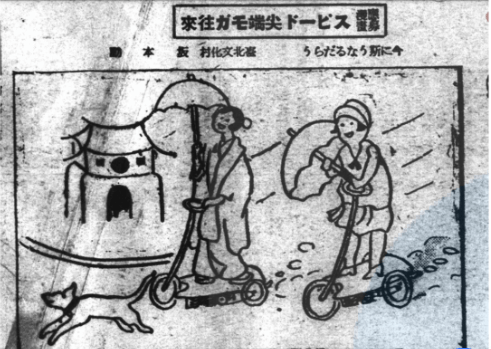
Image credit: 飯本勤〈臺日漫画 第十卷四百十九號 應募漫畫 スピード尖端モガ往來〉,《臺灣日日新報》1930/6/4, Issue 4.
In the late 1920s, two new expressions began to appear in Taiwanese mass media: “Black Cat” (Twn. Oo-niau 黑貓or 烏貓) and “Black Dog” (Twn. Oo-káu黑狗 or 烏狗). These terms originated from Oo-niau oo-káu koa 黑貓黑狗歌 (audio), a popular Taiwanese opera song at that time. This work depicted the tragic love story of a boy and girl barred by their parents from being together due to feudal notions of propriety. Ultimately, the two take their own lives in despair. Before long, Black Cat and Black Dog were used to translate the new Japanese terms moga (モガ) and mobo (モボ), which became popular in the emerging urban culture that arose from Japan’s reconstruction efforts in the wake of the Great Kanto Earthquake of 1923. Black Cat/Black Dog and moga/mobo made their way into Taiwanese mass media, in Chinese and Japanese language publications, respectively, during the 1920s and 1930s. They described emerging gender identities in society. The terms Black Cat and Black Dog, in particular, underwent a shift from having negative connotations to positive connotations that expressed the independent consciousness of gender identity as seen in activities and aesthetics. This change came about as the words gradually became common parlance in Taiwan through the emerging gendered fashion and an urban-centred popular culture developed in colonial Taiwan’s major cities.
The Japanese terms moga and mobo are abbreviations of the English words “Modern Girl” and “Modern Boy.” They were used to describe a form of emerging gendered social entity in urban culture and a new social identity represented in mass media. These expressions pointed to consumption and freedom amid the development of capitalism. This could be seen in the cultural trend referred to as Erotic Grotesque Nonsense (Jpn. Ero guro nansensu エログロナンセンス), which was popular in the emerging urban culture of consumption in the early 20th century. This trend highlighted the liberation of the body, sexual awareness, and gendered social space alongside the freedom to love. In essence, both the Japanese terms moga and mobo, as well as colonial Taiwan’s Black Cat and Black Dog, reflected a new gendered social identity that contrasted with society’s existing gender order.
The Taiwanese opera Oo-niau oo-káu koa, the first instance of Black Cat and Black Dog, was a traditional piece that served as an admonition to the audience. Although the opera expresses sympathy for the love and sacrifice of the young star-crossed lovers, the narrative, nevertheless, was a cautionary tale. The audience was exhorted to respect their parents, cherish life, and refrain from taking one’s own life. This kind of moral persuasion could also be seen in subsequent media representations of the Black Cat as ‘the new woman.’ A series of four poems, entitled Xinnü siyong 新女四詠 (see notes), was published in the Sanliujiu Tabloid (Chn. Sanliujiu xiaobao 三六九小報), a publication for traditional literati. Each of the four poems depicted a different characteristic associated with women of a new kind, including the modern woman (Chn. maoduan nü 毛斷女), romantic woman (Chn. langmang nü 浪漫女), free woman (Chn. ziyou nü 自由女), and vain woman (Chn. xurong nü 虛榮女). These images painted the various characters of the Black Cat as new women as being destructive to society’s gender order.
The second term, Black Dog, was largely a by-product of Black Cat. It appeared more widely later on and referred to delinquent boys. However, the new spirit of pursuing freedom and liberation that these two terms conveyed also attracted attention. There was the poem by Guyuan, Siau Yong-tong, who wrote, “Black Cat and Black Dog are so popular, but we don’t see real change. Without freedom and equality, there’s no use in pretending” (see notes). Such a sentiment suggested there was something beyond trendy appearances; having a spirit of freedom and equality in a new era was of greater importance. Colonial police officers who kept up with the times also took note of the popularity of moga/mobo and Black Cat/Black Dog. There were also reader submissions to columns in newspapers such as Zezehihi 是是非非 in Taiwan nichi nichi shinpō 台灣日日新報 that featured these new terms, which were mainly used in a negative sense, complaining young people’s openly bold acts (see notes). However, such images conversely presented young men and women who dared to pursue love and freedom in public spaces such as parks, three-lined boulevards (Jpn. Sansenro 三線路), theatres, coffee shops, and streets while also expressing the consumer culture of the time.
With the rise of urban cultural media in the form of records and radio, coupled with the development of popular songs, what could better express the avant-garde spirit of the Black Cat seeking liberation than a Black Cat female singer Sun-sun (Chn. 純純) singing “I’m a woman of civilisation and have a desire for freedom that runs east, west, north and south,” as heard in the 1933 hot hit song “The Dance Age” (Twn. Thiàu-bú sî-tāi 跳舞時代)? Many popular songs took the Black Cat and Black Dog as their main theme for such figures to represent something new in seeking happiness, freedom, and sensibility.
During the 1930s, Black Cat and Black Dog also referred to men and women who dressed fashionably. The popularisation of new words reflected the changing urban fashion in colonial Taiwan. Black Cat, as a metaphor for modern women, followed the fashion trends modelled on American popular culture as seen in Hollywood films and other fashion trends imported from Tokyo and Shanghai. Such male and female fashionable figures were still shiny scenes in the streets in the early 1940s.
If Black Cat and Black Dog, as terms in Taiwan during the 1920s and 1930s, did not point to a social group that had already developed, these terms at least demarcated a codified group that stood in opposition to society’s existing gender norms, as can be seen through its social representation within mass media. Depending on one’s societal perspective, intellectuals during that period viewed these terms as pointing to a potential threat or a new social possibility. These terms forced attention onto a new social foundation emerging around young people who were the products of a new education style at that time. They were a group of people who appeared in an emerging urban environment and held an unstable position in society’s relations of production. It is also necessary to take note of the liberating feeling that stems from the modern spirit of freedom that was subjectively expressed by this new social identity.
Pop culture in post-war Taiwan continued to develop. A song related to Black Dog entitled Suann-tíng ê oo-káu hiann 山頂黑狗兄 was a hot hit song, and the Black Cat Singing and Dance Company Oo-niau kua-bú-thuân 黑貓歌舞團 was a popular performance company in the 1950s and 1960s. The term Black Cat also appeared during Taiwan’s democratisation in the 1990s with the Heimao zhuxuantuan 黑貓助選團 (lit. Black Cat Election Campaign Support Group). These groups and elements of popular culture essentially established the new terms Black Cat and Black Dog. They became a linguistic symbol that drifted further from their original social background with the development of popular and consumer culture and are obviously gendered linguistic codes. Black Cat became an expression that described pretty girls, while Black Dog referred to dashing young men. The negative nuance attached to the two terms’ initial appearance gradually became positive. In the development of colonial capitalist production relations, the new social-demographic category became a linguistic symbol that expressed an aesthetic of social-gendered identity, shifting from a socio-economic term to an aesthetic term.
Additional references can be found in the notes.
Wei-chi Chen is an assistant research fellow at the Institute of Taiwan History, Academia Sinica, Taiwan. He studies the cultural and social history of Taiwan and has published Ino Kanori and the Emergence of Historical Ethnography in Taiwan (Extended edition) 伊能嘉矩:臺灣歷史民族誌的展開(增訂版) in 2022.
 Taiwan Insight