
Written by Dr Carla Figueira.
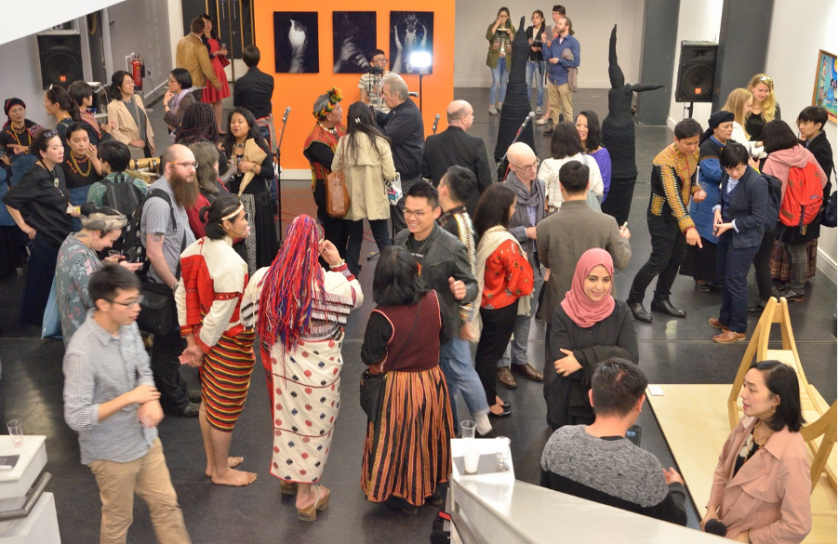
Image credit: Jhy-Yen Lo. Opening of Dispossessions, 21 May 2018, Goldsmiths, University of London.
In September 2013, I was starting to teach the first cohort of the MA in Cultural Policy, Relations and Diplomacy at Goldsmiths, University of London, a programme I designed and would convene for a decade (and which sadly no longer exists) and where I had the most amazing students from all over the world. In that initial cohort, among students from Europe, Africa and Asia, there was an Indigenous Taiwanese student from the Bunun Nation, Biung Ismahasan. That was the start of my personal learning journey on the Indigenous Peoples of Taiwan, which I connected with my scholarly interests in international cultural relations and diplomacy, and that was sustained by a wider network of contacts with and related to Taiwan, which I cherish and maintain to this day.
This is a reflective insight into an important milestone in that journey, when I hosted in May 2018 an exhibition and series of events curated by Biung Ishamasan, by then a Goldsmiths alumnus and a doctoral student at the University of Essex. This experience led to the writing and publishing in 2020 in the International Journal of Taiwan Studies (IJTS) of the article “Indigenous Peoples as Non-State Diplomatic Actors in the Public/Cultural Diplomacy of Taiwan: a Case Study of Dispossessions: Performative Encounter(s) of Taiwanese Indigenous Contemporary Art”, which in 2024 was awarded the IJTS Open Access Award. My aim in sharing this reflection in revisiting my article is two-fold: to highlight the importance of academic writers to discuss the personal and social contexts shaping their research and outputs and to celebrate the growing academic focus on Indigenous Peoples and cultural diplomacy, foregrounding Taiwan’s unique position.
Personal and Social Contexts
Being originally from Portugal, Formosa was a familiar name to designate Taiwan, but I confess my initial ignorance of Taiwanese Indigenous Peoples—they remained invisible to me until the personal encounter with Biung Ismahasan. These sorts of encounters that weave the tapestry of humankind across geographical and other boundaries are at the heart of international cultural relations, and they also shape our thinking and influence our actions. Thus, in the methodology of the article, I present myself as a critical constructivist researcher who understands that knowledge of the world is socially constructed in a particular temporal and cultural context. I believe that researchers need to clearly communicate their positionality – this transparency allows readers to understand their background and perspective.
Analysing Dispossessions, I explore themes of cultural expression, identity, and historical dispossession. By bringing together Indigenous artists, curators, and international audiences, the exhibition functioned as a diplomatic and social space where Taiwan’s Indigenous voices could articulate their histories and struggles. Through the lens of thick description, I illustrate how the exhibition not only created an international platform for Indigenous self-representation but also contributed to Taiwan’s broader diplomatic efforts. Key to my efforts was the generous insights that the curator, artists, other participants, and members of the audience at the Dispossessions event shared with me in informal exchanges and more formal interviews, at times facilitated through the interpretation/translation of others to ease communication.
I could not have accomplished this task on my own (or the article would be less rich) without the support of those engaged in this social learning space: in essence, this article emerged from the encounter of my knowledge and understanding with that of those I engaged with—but I was in charge of the final narrative, later influenced by feedback from a diversity of reviewers. Although this is the established academic peer-review process, I always feel that journal articles, as established academic outputs, do not do justice to the rich worlds we investigate. Thus, in terms of future research, I would like to use, for example, participatory video as a way to convey the diversity of voices involved.
Indigenous Peoples’ Power and Agency
In parallel with understanding how Indigenous Peoples can support Taiwan’s public/cultural diplomacy—the organisers had labelled the event as such—by augmenting Taiwan’s visibility and diversity and its representation in the world, my article also advances a nuanced discussion of Taiwan’s internal politics regarding Indigenous rights. Tracing the historical and political trajectory of Indigenous activism in Taiwan, from the colonial period through democratisation, I highlight how Taiwan’s government has strategically integrated Indigenous identity into national branding. While Taiwan positions itself as a model democracy that respects human rights, I note that Indigenous communities still face challenges, including land rights issues and cultural marginalisation – and others, in the same vein, have also questioned multiculturalism in Taiwan.
My article critically reflects on whether the Taiwanese government’s support for events like Dispossessions is substantive or primarily symbolic. In the case of Dispossessions, Taiwan’s governmental institutions provided funding and logistical support, while Indigenous curators led the narrative. This approach strengthens Taiwan’s diplomatic credibility, as cultural diplomacy led by civil society actors is often perceived as more authentic than state-driven initiatives.
However, a long and intensive learning process is still ahead of all of us to embed inclusive and dialogical practices that bring Indigenous ways of knowing and practices together with other systems. Some have explored the decolonising of decolonisation projects in Taiwan, and I have explored these matters in other contexts. Ultimately, Indigenous Peoples’ power and agency is still limited and oppressed. They continue to face discrimination and commodification, forced to make meaning of their experiences in a world that largely operates according to neoliberal and national security values over Indigenous’ cultural rights and values.
Taiwan’s Uniqueness
In the Dispossessions article, I examine how Taiwan’s Indigenous peoples act as non-state diplomatic actors, enhancing Taiwan’s international cultural and public diplomacy. I argue that Indigenous cultural activism serves as an alternative diplomatic mechanism that reinforces Taiwan’s soft power and distinct international identity. As Taiwan faces diplomatic isolation due to China’s pressures, its governments have sought alternative strategies to maintain international visibility. Indigenous peoples, while historically marginalised, can play a crucial role in shaping foreign perceptions of Taiwan through cultural representation.
In my article, although I focus on a single event, Dispossessions, I also engage with the broader implications of Taiwan’s Indigenous diplomacy. I highlight Taiwan’s Austronesian connections, showing how Indigenous networks extend diplomatic relationships beyond the constraints of state-to-state diplomacy. The inclusion of international Indigenous artists in Dispossessions reinforces Taiwan’s position as a regional leader in Indigenous cultural rights, linking its soft power efforts to wider global movements for Indigenous recognition.
Paying attention to Taiwan’s uniqueness, it has been satisfying for me to see the growing production of academic research on the topic of soft power and cultural / public diplomacy in Taiwan. Examples of this work are the doctoral studies of Dr Chun-Ying Wei on performing arts and Dr Tang-Ling Kuo on art exhibitions, as well as, of course, of Dr Biung Ismahasan on Indigenous curation (becoming the first Indigenous scholar from Taiwan to obtain a PhD in Curating), which add to established research from academics such as Dr Sophie McIntyre or Dr Bi-Yu Chang, and many others.
In conclusion, although my Dispossessions article has limitations issuing from being a small case study, where examples of the audience reception are limited, or that it could not analyse the long-term diplomatic impact of such exhibitions, it still – I would like to think – contributes to Taiwan Studies, offering an innovative perspective on the intersection of cultural diplomacy, Indigenous agency, and national identity. The article effectively illustrates how Taiwan’s Indigenous peoples engage in public and cultural diplomacy, providing Taiwan with a valuable, alternative avenue for international recognition. As Taiwan continues to navigate its diplomatic challenges, fostering Indigenous-led cultural initiatives could be a key strategy in strengthening its global presence.
Looking back at my article and sharing this reflection, I realise that there is still so much work to be done. I look forward to continuing to engage with the topic with other colleagues who equally care to make a difference in Taiwan Studies and Indigenous Peoples’ struggles. Please reach out if this resonates with you!
Dr Carla Figueira is a lecturer, researcher, and consultant in cultural policy, practice, and international cultural relations. She is originally from Lisbon, Portugal and moved to London after a career in arts management. In the UK, she gained an MA in Arts Management and a PhD in Cultural Policy and Management. Follow her work and reach out to her on LinkedIn.
This article was published as part of a special issue on ‘IJTS Open Access Awards‘.
 Taiwan Insight