
Written by Linshan Jiang.
Image credit: author.
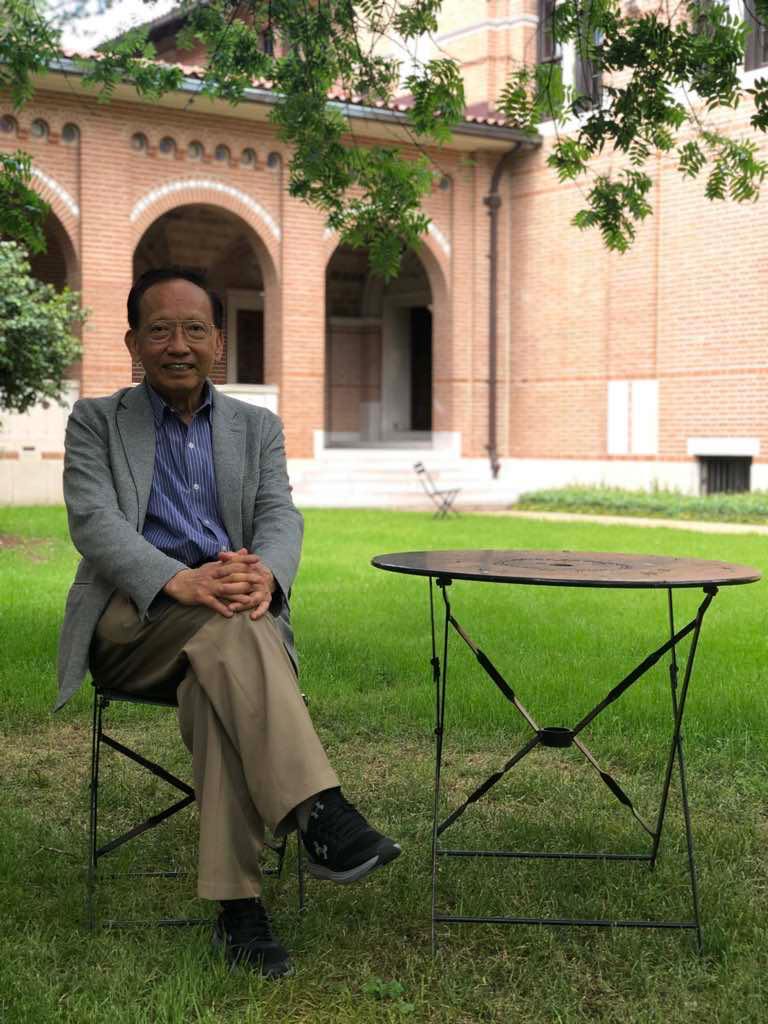
“Professor Tu offered me an academic home and guided me into Taiwan literature, which broadened my understanding of literary geography,” I wrote in the acknowledgement of my dissertation. This sentence encapsulates my relationship with Professor Tu Kuo-ch’ing, who is the founder of the Center for Taiwan Studies and co-chair during my PhD years at the University of California, Santa Barbara (UCSB). To me, Professor Tu was not only a scholar and mentor for my research but also a poet and mentor for my personal journey in Santa Barbara.
At UCSB, I took and/or audited many of Professor Tu’s courses, including the History of Taiwan Literature, Taiwan Humanities and Social Sciences, as well as premodern and modern Chinese poetry. These courses vastly expanded my understanding of Taiwan’s literary and cultural landscapes. One moment that stands out was our discussion of the poet-novelist Chen Ch’ien-wu (1922–2012). During Professor Tu’s poetry course, I got to know more about this writer beyond his well-known contributions to the Bamboo Hat Poetry Society. In class, we discussed Chen’s poetry related to his wartime experience serving in the military of Imperial Japan and working in Southeast Asia. Since my research focuses on the Asia-Pacific War (1937–1945), I was eager to learn more about this aspect of Chen’s writing. Professor Tu introduced me to his short story, “Hunting Captive Women,” which depicts the sensitive topics of “comfort woman” and “Taiwanese imperial Japanese serviceman.” This short story is highly controversial for its portrayal of power dynamics and the intimate male-male relationship between a Japanese military official and a low-ranking Taiwanese serviceman. It also reveals the dire condition of the “comfort woman,” abandoned with no one to rescue her.
While I enjoyed Professor Tu’s class, I was even more intrigued by our one-on-one discussions. I can no longer recall how many times I sat in Professor Tu’s office talking for hours about Taiwan literature, but I remember that it was always a literary feast. I often thought I should record those conversations and turn them into a podcast. Then I thought I should wait for a formal opportunity, perhaps something like the renowned documentary series They Write on the Island. I never imagined that my time with Professor Tu would be so short.
In addition to his teaching, Professor Tu was always enthusiastic about promoting Taiwan literature through academic events and publications. In 2019, he organized a major international conference titled “World Literatures in Chinese: Transnational Perspectives of East Asian Cultures,” which brought together scholars from East Asia and North America to the beautiful UCSB campus to discuss various exciting topics on Chinese literature and culture in the context of East Asia. Additionally, he invited numerous guest speakers to his courses. It was through his invitation that I met many distinguished scholars. I met several times my future colleagues (but at that time, distinguished professors) at Duke University, Professor Leo T. S. Ching and Professor Guo-Juin Hong. I also met Professor Lin Pei-yin from the University of Hong Kong and Professor Letty Chen from Washington University in St. Louis. They all became my academic mentors along the way, thanks to Professor Tu’s invitation.
Professor Tu also supported the initiatives of young scholars. When I collaborated with other UC PhD students, including Chee-Hann Wu, the editor of Taiwan Insight, through the University of California Humanities Research Institute (UCHRI), the UCSB Center for Taiwan Studies—led by Professor Tu—co-sponsored our second workshop, titled “Memory and Mobility: Taiwanese Literature, Film, Music, and Photography,” held at UCSB in February 2020, just before the pandemic hit the U.S.
One major publication that deserves continuous celebration is the Taiwan Literature: English Translation Series. Professor Tu invested tremendous energy and passion into this journal and was always excited to share new ideas and collaborations. There are a total of 53 issues spanning nearly thirty years of continuous publication. I contributed translations to two issues, one on Professor Tu and the other on Professor Pai Hsien-yung. I sincerely hope that this journal will continue to thrive and promote Taiwan literature.
While Taiwan literature appears to be Professor Tu’s major academic endeavour, poetry was equally central to his life. During our literary discussions, he often shared his latest poems with me. I remember how excited he was when his poetry anthology Light Shines Through the World of Dust, Illuminating the Myriad Objects (光射塵方.圓照萬象) was published in 2017 by National Taiwan University Press. But what interested me most, as a PhD student from Guilin, was his earlier collection about mainland landscapes, titled Glimpses of the Mountains and Rivers (山河掠影) (2009). I read this collection when I had just arrived in the U.S., navigating various cultural shocks around race and ethnicity. When I opened the book, I was drawn to his preface:
“Somehow I have a particular feeling for the mountains and rivers in the Chinese Mainland. It is not the homesickness of a wanderer, for I was not born in China but rather, my childhood was spent in Taiwan. Nor is it a craving for exoticisms, as my life is inextricably bound with Chinese people even though I have been abroad most of the time … The urge for poetic creations evoked in me by the landscapes in China may stem mainly from cultural nostalgia.” (quoted from Taiwan Literature: English Translation Series, No. 44 [Special Issue on Tu Kuo-ch’ing], pp. 194–195)
When I researched Pai Hsien-yung’s writing, many scholars described his work as expressing “cultural nostalgia,” shaped by his experience of being born in mainland China and later moving across the Pacific. For Pai, “cultural nostalgia” often means viewing Chinese culture as the “original home”—a typical narrative among mainlanders (waishengren). Yet unlike Pai, Professor Tu was not a so-called “mainlander,” but a typical “Taiwanese” (benshengren). His reflections on “cultural nostalgia” also resonate with his extensive research on the Tang poet Li Ho (or Li He, 790–816). This subtle connection to Chinese cultural heritage was one of the things that made me feel close to Professor Tu when I first met him. Encouraged by him, I also wrote some poems during my PhD years in Santa Barbara. I would share them with him, and he would offer serious suggestions while encouraging me with the words, “At least you are experiencing the ‘poetic’ life” (至少你已經在體驗有“詩意”的生活了).
Beyond literature, Professor Tu was a warm and generous mentor. When I first met him, I was embraced by his hospitality. During the Mid-Autumn Festival of 2016—my first spent abroad—he invited his old friends, his visiting scholar, and me to a Chinese restaurant in town. That same year, I also spent Thanksgiving with his family. Since then, I often had the opportunity to gather with him and his friends. Professor Tu’s house, located on a hill he named “Moon-Gazing Hill,” offered beautiful daytime vistas and moonlit nights. After I graduated from UCSB, I returned several times to visit him. We often discussed literature and life. Although he voiced concerns about his health, I never imagined our time together would be so short.
As the UCSB Department of East Asian Languages and Cultural Studies gathered commemorations for Professor Tu, I wrote in the final paragraph, “I had always thought there would be time—time for more conversations, time for new projects to unfold—never imagining that the day of farewell would come so soon. His wisdom, generosity, and unwavering commitment to literature will be deeply missed.”
Linshan Jiang is a Visiting Assistant Professor of East Asian history and culture at Colby College. She was a Postdoctoral Associate of Chinese Studies at Duke University. She received her Ph.D. in East Asian Languages and Cultural Studies from the University of California, Santa Barbara, where she also obtained a Ph.D. emphasis in Translation Studies. Her research interests include modern and contemporary literature, film, and popular culture in mainland China, Taiwan, and Japan; trauma and memory studies; gender and sexuality studies; queer studies; as well as comparative literature and translation studies.
This article was published as part of a special issue on ‘Cultures and Conversations: Taiwan Studies at UC Santa Barbara‘.
 Taiwan Insight