
Written by Neeraj Mehra.
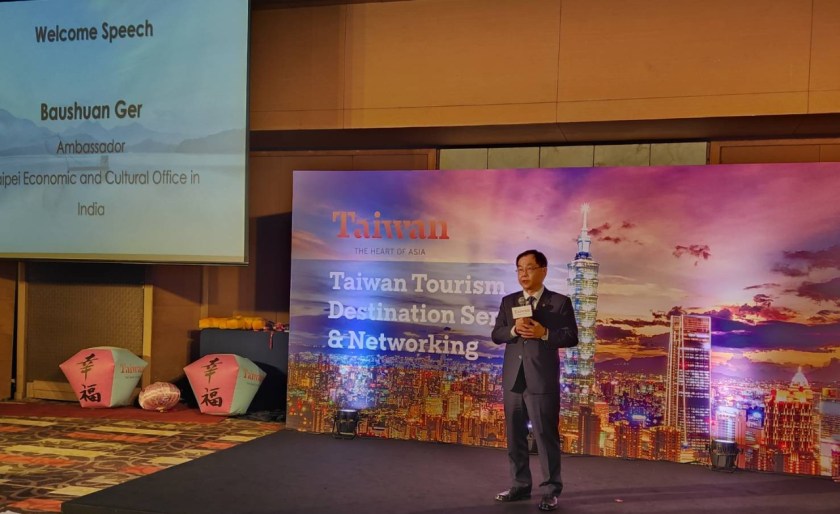
Image credit: 葛大使葆萱出席台灣觀光推廣活動 鼓勵印度遊客赴台旅遊 by Taipei Economic and Cultural Office in India.
The outbound Indian tourism has undergone a significant transformation in the last few years. East, as well as Southeast Asia, have reached out to a much broader range of people. However, even with this change, Taiwan remains a little-known destination to Indian tourists. My argument is that Taiwan has considerable unexploited potential as a destination due to its rich cultural heritage, beautiful natural scenery, and compatibility with democratic ideals. Enhanced engagement with India through tourism could thus function as a valuable mechanism for fortifying informal diplomatic relations while simultaneously supporting Taiwan’s New Southbound Policy (NSP) and the broader development of its soft power.
Looking at the statistics, India has been a quickly developing outbound market due to tourism in the world. By October 2024, Indian outbound travel had exceeded 21.6 million departures, a 152.6 per cent increase over the prior year and the latest in an unbroken upward trend. In 2023, the outbound travel brought in over 28 billion dollars of foreign exchange earnings, emphasising the growing scale and economic impact of Indian travellers. Nevertheless, Taiwan attracts only a fraction of this potential. Indian tourists. In 2018, there were an estimated 41,000 Indian tourists in Taiwan, with a share of less than 0.4 per cent of the approximately 11 million international visitors. The more recent data show a slight improvement: Indian tourist arrivals in January-December 2024 were 38,158, which is 20.81 per cent more than in the previous year but still a rather small number compared to the overall Indian outbound travel.
The New Southbound Policy, launched in 2016 by Taiwan, aims to expand the diplomatic and economic activities of the state beyond the People’s Republic of China to encompass 18 countries, including India. Since its launch, the project has achieved significant improvements in the inflow of travellers to Southeast Asia; the main achievements, mainly due to the liberalisation of visas, educational exchange, and selective tourism marketing, can be traced in various indicators. From 2016 to 2018, in three years, the number of visitors arriving as a result of NSP increased by 58 per cent, and the mobility of students demonstrated an even steeper rise of over 50 per cent. This momentum was significantly contributed to by the visa waivers accorded to Thailand and the Philippines. However, until now, the engagement of India has not been anywhere near the results of other countries.
To achieve complete Indian integration, Taiwan will need to perfect its approach, especially related to visa facilitation, the level of promotion, and connectivity. In particular, the country has to implement the measures that will correspond to the Indian priorities. For instance, the hurdle would be significantly reduced by relaxing entry barriers by means of e-visas or a visa-on-arrival program. An analysis of the performance of the Taiwan tourist industry in comparison with Japan, South Korea, and Southeast Asia reveals the importance of designing visa regimes and promotion programs. Such a temporary policy as the visa waiver policy implemented in 2017 led to a 42.8 per cent increase in arrivals of all NSP (New Southbound Policy) countries combined, with Thai arrivals surging by 170%. These results indicate a possibility that similar actions taken towards Indian travellers may also produce similar results.
Moreover, there are a few direct air connections between Taiwan and India. The potential of the market is a meagre portion of Chennai and, more recently, of Mumbai routes. Accessibility would be improved through the expansion of direct air travel connections outside Chennai and Mumbai to other Indian metropoles.
The second limitation entails the fact that India has a low level of awareness about Taiwan. Though both of them have many common cultural vectors, such as Buddhist culture, sweet food, and a lot of ecotourism possibilities, Taiwan is not a well-known destination among Indian tourists. Inadequate media exposure and marketing further compound this challenge. Advertising has been spotty and, until very recently, not very loud. Promotions like the Waves of Wonder and discrete roadshows in the major cities of India have started to raise the level of awareness, but a long-term, full-fledged programme is necessary to make Taiwan more popular among the Indian travellers with a taste. Taiwan should make investments in India-specific marketing campaigns that create awareness and aspiration and utilise local cultural icons, influencers and online channels.
At the same time, there should be institutional cooperation between the tourism boards, universities and the private travel companies to encourage educational exchanges, language classes and common tourism programs. Such efforts would not just bring forth short-term tourism benefits but also foster long-term cultural and scholarly connections. The recent events, such as the opening of the representative office of Taiwan in Mumbai and the increased level of interaction on the basis of education and media collaboration, indicate an encouraging trend.
Tourism is also an effective tool of soft power, a low-risk, high-return avenue of mutual understanding and goodwill, especially between democracies like India and Taiwan. Bilateral relations can be humanised through cultural tourism and can be used to fill the societal divide as well as reaffirm common values of freedom, pluralism, and heritage. The mutual benefits are massive: Indian travellers receive access to new experiences and broadening horizons, while Taiwan gets more tourism revenues and exposure to a vital South Asian market.
Taking a look at the current trends in outbound travel from India, even a comparatively small diversion of Indian travellers to Taiwan could yield significant economic benefits—on the order of 1 to 2 per cent of total outbound trips. With roughly 50 million Indian outbound trips annually and an estimated per-capita spending of USD 1,500 for travel to Taiwan, diverting just 1% of these trips (about 500,000 travellers) would generate approximately USD 750 million in annual tourism revenue. A 2% diversion (about 1 million travellers) would double that figure to USD 1.5 billion.
These inflows would stimulate local economies, fast-track construction of tourism infrastructure and increase the position of Taiwan in the international tourism scene.
The realisation of this possibility, however, requires coordinated actions by various stakeholders. It should be the Taiwan Tourism Administration that will take the lead in the reformation of the visas and the formulation of the focused promotion campaigns. The cooperation between airlines and travel agencies must lead to an increase in the route systems and the development of attractive travel packages. In addition, academic exchanges and language programs need to be promoted by universities and cultural centres, and Indian tourism boards, as well as the private operators, need to mainstream Taiwan in Indian tourism circuits.
To conclude, Taiwan is an underleveraged destination in the Indian outbound tourism market, but it has potential. By dealing with the existing limitations and embracing a culturally sensitive approach, Taiwan will be able to capture a higher portion of Indian tourists. This would have significant economic payoffs, strengthen informal diplomacy and increase the people-to-people interaction between the two democracies. In the context of the larger dynamics of the changing geopolitics of Asia, grassroots diplomacy nurtured through tourism would be critical in the development of trust, resilience and cohesion in the region.
Neeraj Mehra is a final-year postgraduate student in International Relations and Security Studies with a language specialisation from Rashtriya Raksha University. A recipient of the Huayu Enrichment Scholarship 2024, he is currently pursuing Chinese as a Foreign Language at National Chengchi University, Taipei, Taiwan. He is the author of the book ‘Chandranshu and the Legend of Myth.’ He has also authored books in Webnovel titled ‘A New India’ and ‘Reincarnated: Vive La France.’
 Taiwan Insight