
Written by Yun-Pu Tu.
Image credit: NATSA.
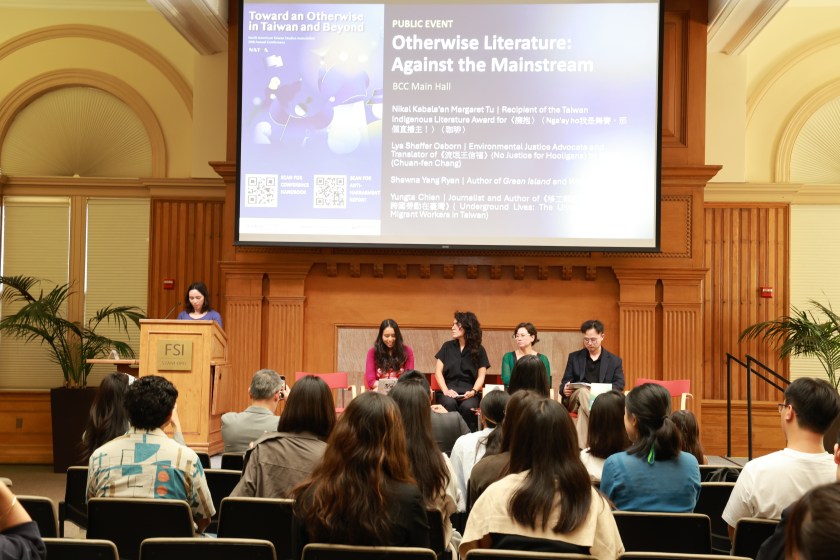
As a Pangcah/Amis Indigenous doctoral candidate in law, before I wrote the invitation email to potential speakers for the panel “Otherwise Literature: Against the Mainstream,” I had never imagined that literature (something I had pursued alongside my legal studies) would one day bring me into a collaboration that bridges a various of people, places, languages, fields of study, and lived experiences. For the first time, the North American Taiwan Studies Association (NATSA) collaborated with the National Museum of Taiwan Literature (NMTL), curating a special session that explores how writers and translators challenge mainstream narratives and reflect marginalised lives through storytelling. This session asks: how can literature, through the power of language, serve as a bridge between cultures, communities, and emotional worlds?
NATSA has brought together young scholars and graduate students in Taiwan Studies for three decades. Each year, the annual conference gathers participants from across disciplines, from political science and history to performance, media, and literature, to rethink Taiwan in global and comparative contexts. This year, my co-organiser, Formosa Deppman from UCLA’s Department of Comparative Literature and I wanted to move beyond academic presentations to create a space for creative and critical storytelling. In early 2025, when I returned to Taiwan and visited the NMTL in Tainan, I still remember the warmth and enthusiasm of the museum staff as we talked about connecting literary creativity with diasporic and Indigenous experiences. It was clear that this collaboration was more than institutional; it was an exchange grounded in care and imagination.
Our goal was to curate a dialogue that brings together multiple literary perspectives, including Taiwanese Indigenous literature, White Terror literature, Taiwanese American literature, and writing on labour and the environment. Together, these threads illuminate how people navigate marginalisation, express resistance, and imagine solidarity through words. Each of our four speakers comes from a distinct background, yet we share a deep connection to Taiwan through language and narrative.
The session opened with a sense of anticipation, as the audience gathered to consider how storytelling might reframe Taiwan’s histories and futures.
Shawna Yang Ryan, a Taiwanese American novelist based in the San Francisco Bay Area and author of Green Island and Water Ghosts, reflected on how literary imagination could make history both visible and intimate. Her reflections connected literary form to political memory, demonstrating how narrative structure can be a form of resistance by emphasising the importance of women’s voices in narrating history and explaining how perspective and focalisation shape storytelling. Her discussion of the White Terror revealed how stories of trauma, when told with empathy, resist the silence imposed by state narratives. Following Ryan’s reflections on history and memory, the discussion shifted from the act of remembering to the act of translation—another way of carrying voices across boundaries.
Lya Shaffer Osborn, a translator and environmental justice advocate who was then translating Chuan-fen Chang’s《流氓王信福》, spoke about how translation itself can be a form of activism, a way for stories of incarceration, wrongful conviction, and class disparity to travel across languages and awaken empathy. Lya approached the theme through translation theory, leading the audience in a small translation workshop. She played a recording of Chuan-fen reading in Mandarin, asking the audience to close their eyes and simply listen to the rhythm and texture of the words before discussing how to translate the term 流氓. Her exercise reminded everyone that translation is not merely technical but deeply emotional.
Yung-ta Chien, journalist and author of Underground Lives: The Untold Stories of Migrant Workers in Taiwan 《移工築起的地下社會》, extended that conversation to the realm of labour, showing how investigative writing could become a bridge between social analysis and human experience. He offered an overview of his book on migrant labour in Taiwan, weaving together data and vivid personal accounts from his fieldwork. His presentation balanced journalistic analysis with compassion, allowing the audience to see the human realities behind the statistics.
And finally, I shared from my own journey as a Pangcah/Amis writer who had received the Taiwan Indigenous Literature Award for fiction in 2023 and 2024. Writing from within Indigenous communities, I spoke about how everyday lives encounter constraints yet continue to endure and to love. By reading extractions of my poems and fictions, I reflected on how my writing intends to deconstruct mainstream notions of “ownership” and reclaim language through multiple identities, in the hope of offering a sense of intimacy and revealing how storytelling can hold both tenderness and critique. For me, literature is a way to speak from the margins without asking for permission to exist.
Another remarkable moment came during the Q&A, when twenty-four high school students from Taiwan participated enthusiastically. This was something quite different from previous years, and it was made possible by the efforts of this year’s leadership team. For us as panellists, engaging in dialogue with a younger generation, beyond our usual conversations with academics or professionals, was both meaningful and refreshing. Their questions and feedback on readership, translation, and the challenge of shifting discriminatory attitudes within Taiwan were genuine and deeply valuable. I want to take this moment to acknowledge how the leadership team, led by President Yi-Ting Chung (Stanford University) and program chairs Ting-Sian Liu (London School of Economics) and An-Ru Chu (UC Irvine), has created a culture of attentiveness and care. From the start, they have been generous with their time and guidance by quick to respond to questions and to support our ideas of curating this Otherwise Literature session; it was through their support that we were able to open up a discursive space to speak Against the Mainstream, echoing the theme of our session. They also made the deliberate decision to design this session as a public event, different from most conferences that primarily serve members of academics. Instead, this one was open to the local community, allowing anyone to walk in and join the conversation.
I keep returning to one thought: storytelling is about relations. Every story told in this panel holds a thread that ties one world to another. Through Shawna’s remembrance of the White Terror, Lya’s translation of injustice, Yung-ta’s documentation of migrant lives, and my own writing from Indigenous communities, we are collectively imagining an otherwise Taiwan: one that is listening, adjusting, and still in motion. It is also a reminder that literature, especially when rooted in care, can transcend disciplinary boundaries and become a bridge: between Taiwan and the world, between those who write and read and those who speak and listen. I imagine, in that moment, a glimpse of the otherwise world we have all been reaching for.
Yun-Pu Tu, also known as Margaret Tu, and by her Pangcah/Amis name Nikal Kabala’an, is a PhD candidate in Law at the University of Washington in Seattle, USA. Her research focuses on Indigenous self-determination and decolonization. She serves as one of the program commissioners for NATSA 2025. Her policy commentaries have been published in East Asia Forum, Policy Options, Taiwan Politics, and Global Taiwan Brief. She has presented her work at academic and community forums across the United States, Canada, and Taiwan.
This article was published as part of a special issue on ‘NATSA: Toward an Otherwise in Taiwan and Beyond‘.
 Taiwan Insight