
Written By Paula Perez.
Image credit: 鄭麗文/ Facebook.
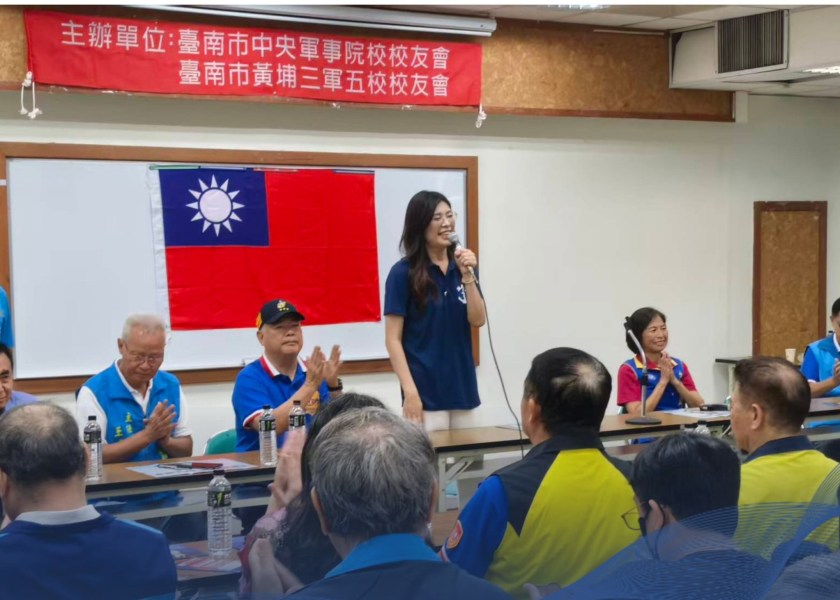
Cheng Li-wun (鄭麗文) was elected chairperson of the Kuomintang (KMT) in October 2025, winning 60,063 votes, or 51.35 per cent, in a race that drew a turnout of just under 40 per cent of the party’s 331,145 eligible members. Her closest rival, former Taipei mayor Hau Lung-bin (郝龍斌), received 34.41per cent, while the remaining candidates – Lo Chih-chiang (羅智強), Cho Po-yuan (卓伯源), Tsai Chih-hung (蔡志弘) and Chang Ya-chung (張亞中) – were further behind.
A former Democratic Progressive Party (DPP) member who later served as Ma Ying-jeou’s cabinet spokesperson and as a legislator, Cheng became the second woman to lead the century-old party after Hung Hsiu-chu (洪秀柱). What Cheng’s victory actually means for the KMT, however, is far from clear. Her campaign mixed calls for renewal in terms of internal reform and unity with the familiar and traditional vocabulary of the party’s China policy – references to the 1992 Consensus, to cross-strait cooperation, and to the Republic of China’s constitutional order.
Promises of Renewal: Transparency, Grassroots, and Unity
Cheng has promised to rebuild a party that has long been divided and disoriented. She called for a return to institutional rules and transparency in nominations, restoring order and credibility to the party’s internal politics. Cheng proposed that nominations for legislative and presidential candidates should be approved through a transparent voting system, rather than through personal appointment or lists drawn up privately by party leaders.
Cheng also emphasised giving a stronger voice to grassroots members. She spoke of reviving the KMT’s local networks and defending rank-and-file members who, she claimed, had faced political persecution under the DPP and had later been abandoned by their own party. She also encouraged broader representation within the party, bringing in figures from business, academia, and other fields to better reflect diversity within the KMT.
One of the most detrimental issues within the KMT is internal divisions. All parties have factions, but the KMT’s divisions run to the very core of its ideology. As Chang Ya-chung put it: “the KMT’s ideology is unclear, its values vague, and its institutions chaotic”. Cheng has called for an end to such divisions and for the party to unite under one spirit, though it remains unclear what that unifying principle would be beyond loyalty to her leadership.
Cheng’s definition of unity extends beyond the KMT itself. She is in favour of cooperation between the KMT and the Taiwan People’s Party (TPP) to defeat the DPP, presenting this as part of a broader effort to “reflect mainstream opinion” across society, implying that the majority of Taiwanese agree with the pan-blue camp but are simply divided. However, while advocating cooperation, Cheng also insisted that the KMT must be – and will be – strong enough to govern alone. This dual message shows her need to appeal to different audiences: on the one hand, to the TPP and its supporters to unite with the KMT; on the other, to reassure KMT members that their party will remain in charge.
Despite the potential electoral advantages of such a coalition, the KMT continues to overemphasise the fallacy that it lost the presidential election because the pan-blue vote was split between itself and the TPP. First, the TPP drew significant support from younger and centrist voters, many of them former DPP supporters rather than traditional KMT loyalists. Second, in past elections, unity among pan-Blue forces has not guaranteed victory: Lien Chan and Soong Chu-yu ran together in 2004 and lost; the combined KMT and People First Party vote in 2016 would still have fallen short of Tsai Ing-wen; and in 2020, with no major split, the KMT again suffered defeat. The problem was not division but persuasion – the party’s inability to connect with an electorate increasingly sceptical of its China policy.
Between Ambiguity and Truth: Identity, the ROC Constitution, and One China
The KMT’s ideology is not only a cause of internal divisions but also of widespread confusion. Cheng Li-wun has taken a stand. She claims that all Taiwanese are – and should be proud of being – Chinese, as in Zhongguoren (中國人), a term heavier than the KMT’s traditional Zhonghua Minguoren (中華民國人), meaning citizens of the Republic of China (ROC). Unlike her contender Lo Chih-chiang, who has also defined himself as Zhongguoren but clarified that China means the Republic of China, Cheng has been tiptoeing around the topic. She prefers to invoke the Republic of China as the representation of One China, reminding Taiwanese that the ROC stands above all as that representation.
Cheng’s argument rests on one truth – the Republic of China Constitution. To the deaf and blind DPP supporters who embrace the ROC as Taiwan, Cheng Li-wun has spoken with clarity: the Republic of China Constitution is a One China Constitution. It has never been amended to give up territorial claims, yet anyone who has read it knows that the ROC Constitution, much like the KMT’s ideology, thrives on ambiguity. It does not directly state territorial boundaries, but through a body of laws, it constructs a territorial imaginary with concepts such as the “free area” and the “mainland area”.
The ROC Constitution claims to be China; it is a One China Constitution, and on that basis, Taiwanese are Chinese. Cheng Li-wen delivered a constitutional lesson not to the KMT, but to those proud Taiwanese who reject any Chinese label while still identifying with the Republic of China. She transforms the question of identity from a political choice into a legal fact. As to the legitimacy of the ROC Constitution to govern Taiwan, she seems to consider it a non-issue: after all, the United States has kept the same constitution for hundreds of years, agreed upon by only thirteen states, and nobody complained. What her constitutional lesson missed, however, was the part on democracy. The ROC Constitution was not founded through popular consent in Taiwan, nor has it ever been revalidated by the Taiwanese electorate. To treat it as an unquestionable truth is to deny the most basic democratic principle of all – that legitimacy must rest on the will of the people. In Cheng’s logic, the constitution defines the people, but in a democracy, it is the people who define the constitution. As for Cheng’s One China, what exactly does it mean – the ROC, the PRC, or some other fantasy? That remains unclear.
Regarding the 1992 Consensus, Cheng brings nothing new. The new chair has not abandoned it as the basis for cross-strait peace, despite the term itself remaining deeply misunderstood. Wang et al. (2021) found that only about one-third of Taiwanese understood the consensus in the way the KMT defines it: the ROC represents Taiwan, the PRC represents China, both sides belong to one China, not yet unified. Another third believed it meant that the ROC and PRC are separate countries, and others thought the ROC was a local government under the PRC. Even among pan-blue supporters, understanding was inconsistent. What Cheng presents as the foundation of peace remains an ambiguous slogan. This disconnect illustrates the broader problem with the KMT’s political language: familiar yet open to interpretation by the very electorate it seeks to persuade.
The Usual KMT Dose of Fear
Cross-strait relations lead to talk of a potential war – a conversation in which the KMT injects fear, despite having had little success with such a strategy. Following the party’s line, Cheng warns of war, this time with a vivid example: Ukraine. Yet, in her narrative, the threat of war exists only as long as the DPP remains in power. She therefore rejects proposals to raise defence spending and insists that she will not send Taiwanese youth to die, promising instead to protect Taiwan through peaceful cooperation with China. The irony is that when asked about Hong Kong, Cheng replied that Taiwan could never become a second Hong Kong because “Taiwan is not Hong Kong” – a circular reassurance without substance. Yet, apparently, it can become a second Ukraine. The argument remains unchanged: with the KMT, peace; with its opponents, death.
The Conversion Narrative: From Apostate to Apostle
Cheng has something the other candidates did not – she personifies the redemption of a generation. Her “youthful mistake” is not something to hide; it is part of her message. She knows she is on the right side because she has experienced being on the wrong one. Cheng began her political career in the DPP and supported Taiwanese independence, only to realise that it was a lie and a dead end. She also knows what people admire – elite education. She presents her time at Cambridge, one of the world’s most prestigious universities, as a moment of enlightenment, where she claims to have broadened her once-narrow worldview and ultimately returned to the true faith.
For Cheng, young people who now support Taiwan independence are not irredeemable but merely misled by a de-Sinicised education system that distorts history. She presents herself as the teacher who has seen both sides and now instructs the next generation to rediscover and embrace their Chinese identity.
Appealing to Who?
Cheng’s message of Zhongguoren and One China – shared by several of her fellow candidates – raises an uncomfortable question: who is she actually speaking to? First, it is well known that if one divides identity into three categories – Taiwanese, Chinese, or both – over 60 per cent of Taiwanese identify as Taiwanese only, around 30 per cent as both Taiwanese and Chinese, and barely 5 per cent as Chinese only. Second, the KMT’s repeated failures in presidential elections reveal public concern about the party’s cross-strait policy. The party is far from dead – it still wins local and legislative contests – but it continues to struggle to convince voters that its approach to China will keep Taiwan safe. The 1992 Consensus remains both unclear and unpopular. During Hou You-yi’s 2024 campaign, he had to repeatedly stress he opposes “one country, two systems” to reassure voters that the KMT would not gift Taiwan to China.
So, who is Cheng appealing to with this speech? How can this be a strategy to mobilise Taiwanese voters – or is her intended audience somewhere else?
Sounds Like No News
Cheng Li-wen speaks with conviction and logic to build her arguments. She may be more outspoken than others in the KMT, but is anything she says really new? Is this a major turning point for the party? Internally, perhaps. Her calls for greater transparency and institutional discipline would be an important shift for a party long defined by hierarchy and opacity. But ideologically, little has changed: the 1992 Consensus and One China remain loosely defined, and the message sounds much as it always has.
Paula Pérez Romero is a PhD graduate from the International Doctoral Program in Asia-Pacific Studies. She holds a bachelor’s degree in Political Science from the University of Barcelona (Spain) and a master’s degree in International Business from the University of Leeds (United Kingdom). Her research interests include democratisation, transitional justice, authoritarianism, authoritarian successor parties, and nationalism.
This article was published as part of a special issue on ‘KMT leadership election: Can Cheng Li-wun save the party?‘.
 Taiwan Insight
Dear Ms Romero,
thanks for pointing out Chen’s ambiguity. Furthermore, what is „unambiguous“ on insisting an an ambiguous constitution? And to compare that with the US consitution is illogical, too. The last was in effect for more than 200 years and nobody complained. But the ROC constitution is in effect for 100 years and PRCh complains.
Best regards from Germany Thomas Hagemann
LikeLike