
Written by Yi-Ping Wu.
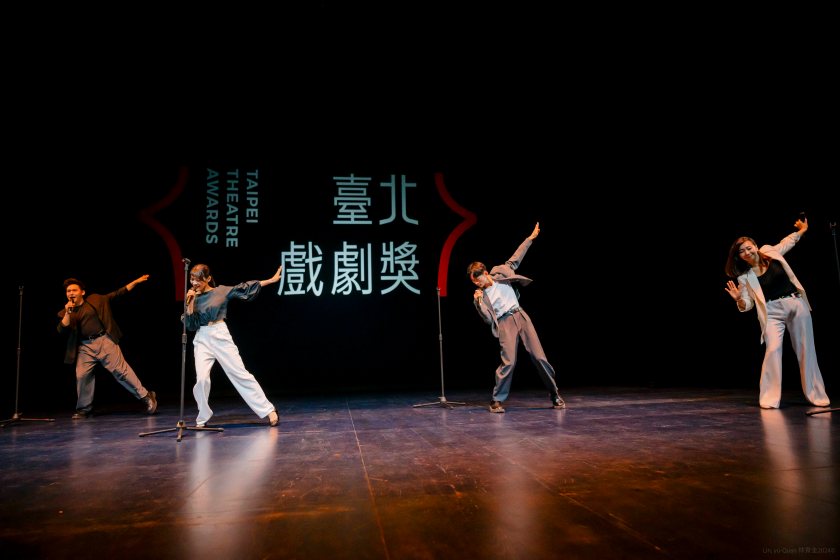
Image credit: Taipei Theatre Awards by the Department of Cultural Affairs, Taipei City Government.
Political Dispute
2025 was a challenging year for Taiwanese in every way, owing to the political turmoil. The “Additional Budget Proposal for the Central Government’s General Budget for Fiscal Year 2025” was passed on the third reading on August 29. The Executive Yuan originally proposed a budget of NT$87.841369 billion, but the Legislative Yuan ultimately cut it by NT$5.92637 billion. Among these, the additional budget of NT$280 million proposed by the Ministry of Culture was eliminated entirely, which included funding for the maintenance of many art venues, plans to promote the development of audiovisual content IP (intellectual property), as well as personnel expenses for the Public Television Service and the Central News Agency.
This move has sparked backlash once again from the cultural sector. The Taiwan Cultural Policy Research Association stated on September 1, criticising the cut of NT$280 million from the budget, arguing that it would infringe upon the public’s right to participate in culture. Legislators should not belittle the nation’s art and culture workers by referring to them as “beggars.” They also emphasised that culture and democracy are essential soft power assets for Taiwan in international exchanges, and cutting related funding would weaken its cultural promotion capabilities. However, this argument is still unable to alter the circumstances. The situation of cutting the cultural budget and referring to culture workers as “beggars” reflects the hidden discrimination against the arts and culture in Taiwan. Still, it also emphasises the development of technology and AI in Taiwanese society. In fact, the political dispute over cutting the cultural budget demonstrates the paradox that the cultural field faces.
The First Taipei Theatre Awards: A Newborn Hope
Although there was political apathy among the legislators, a strong power to continue developing theatre in Taiwan remained, as evidenced by the establishment of the first theatre award in Taiwanese history: the Taipei Theatre Awards in July. 2025. The Taipei Theatre Awards, which were announced by the Commissioner of Taipei City’s Department of Cultural Affairs, Shi-Ping Tsai. Tsai said this award is the Taiwanese version of the Tony Awards, whose goal is “to show how theatre reflects social values and to recognise individuals or organisations that have made special contributions and achievements to contemporary theatre in Taiwan.”
The inaugural awards include Best Work, Individual, and Special Contribution categories, totalling 11 awards and 13 slots, with a total prize pool of NT$2.7 million. Among them, theatre veteran Shih-Chieh Chin received the award for Best Actor in a Drama Series. The Best Independent Spirit Award was nominated by the Theater Observation Group for works that embody a spirit of experimentation, and was given to Time Is Like It Never Disappeared, a work that was written, directed, and performed by Ching-Yen Lin. The Best Drama Award was presented to the Party Theatre Group for its production of Father and Mother. This work interweaves multiple facets of Taiwanese society, including the Taiwanese language, the history of Japanese colonisation and postwar authoritarianism, and identity. Playwright An-Chen Chiu stated, “Father and Mother is not just a story of identity; it is also written for those who continually ask themselves, ‘Who am I?’ Thank you to every audience member who walked into the theatre and made this journey possible.”
Thriving Drama: Moving Towards Internationalisation, Cross-National Cooperation, and the Incubation of Cultural IP
Another piece of evidence to show the flourishing growth of Taiwanese theatre is its continuous contact with the world and its ambition to promote its own IP internationally. An Exciting Event was the Taiwanese original musical Don’t Cry, Dancing Girls, which made its debut at Theatre Row in New York’s Off-Broadway, starting January 23, with four performances over three days. This marks the first time a locally produced original musical from Taiwan has been presented to Broadway audiences. Broadway producer Ken Dingledine is a key driving force behind the development of Don’t Cry, Dancing Girls on New York’s Broadway stage. The current Off-Broadway version was still performed in Mandarin, but it also includes English narration roles. The runtime has been shortened to 100 minutes while still retaining the strong musical style and stories of Taiwanese culture. It is worth expecting to see its adjustment to the Broadway stage in the future.
In addition to Don’t Cry, Dancing Girls going to New York Off-Broadway, and the Ministry of Culture promoted “We TAIWAN in EXPO 2025”, which took place in August in Osaka, Japan. The event spanned four major areas and themes, including the online game of “The Power of Play,” the physical space of “Blended Colours,” the “Creativity that Crosses Over” at the Osaka City Central Public Hall, and the “Dynamic Energy” at Nakanoshima. The plans for the Central Hall featured technological dance, VR performances, films, literature, and more, showcasing the energy of Taiwan’s cross-cultural technology and artistic creation. It is worth mentioning that, related to the previously mentioned political budget cuts, all promotional expenses for the performance at “We TAIWAN in EXPO 2025” in Japan were eliminated, and ultimately, it was funded through private donations.
Moreover, the Broadway musical Les Misérables celebrated its 40th anniversary and made its debut in Taiwan, presenting a total of 52 performances in Taipei and Kaohsiung from June 12 to July 27. This tour featured a carefully selected cast from the original British production, bringing together over 110 actors, musicians, and crew members, along with more than 300 exquisite costumes that meticulously recreate classic characters. The long-term performances demonstrated the extraordinary capacity of Taiwanese audiences to appreciate international musical aesthetics.
The Fight Still Goes on
In summary, due to political turmoil, the budget for Taiwan’s arts and culture sector, including Taiwanese theatre, has been significantly cut. Politicians labelling artists as “beggars” reflects a deep-seated social attitude in Taiwan that prioritises science and technology while undervaluing the humanities and arts. Nevertheless, Taiwan’s theatre field in 2025 continues to demonstrate a high level of growth and vitality, particularly in its efforts to cooperate with the international stage, moving forward to Osaka and New York. This fighting spirit also reflects the ongoing internal reflection within Taiwan’s theatre community on what self-identity and being Taiwanese mean.
While the development of theatre in Taiwan continues to move towards diversification and internationalisation, it is also noteworthy to observe the attempts within Taiwan’s theatre to cultivate younger and interdisciplinary IP pieces. For example, Cartoonist Zong-Cheng Wei’s fantastical work The Apocalypse of Darkness Warfare was known as inspiration for a script, accompanied by traditional theatrical elements that have been incorporated into the existing structure, resulting in the adaptation presented by Ming Hwa Yuan’s Arts & Cultural Group. In addition to adapting Taiwanese IP, Godot Theatre Company’s well-received stage play The Miracles of the Namiya General Store was adapted from the Japanese novel by Keigo Higashino. These attempts to develop interdisciplinary and transnational artistic expressions not only demonstrate a commercial ambition but also validate the flexible creativity of Taiwanese theatre. What can we expect from the 2026 Taiwan Theatre? Stronger connections to international artists, interdisciplinary cooperation in diverse fields, and broader modification for cultural identities are what could be observed. Even with dark clouds overhead, we still look forward to good weather in 2026.
Yi-Ping Wu is an Assistant Professor in the Graduate Institute of Transdisciplinary Performing Arts at National Taiwan University of Arts. Her research interests focus on Taiwan studies, theatre and performance studies, and women, gender, and sexuality studies. She recently worked on research on the development of immersive theatre in Taiwan.
This article was published as part of a special issue on ‘Review Taiwan 2025: Challenges, Continuities, and Change‘.
 Taiwan Insight