
Written by Ming-Yeh T. Rawnsley.
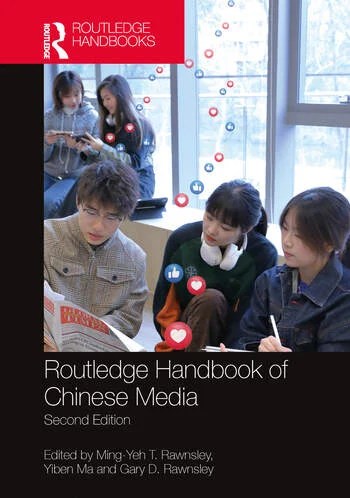
Image credit: Cover of the Routledge Handbook of Chinese Media, second edition (2025).
The publication of the Routledge Handbook of Chinese Media, second edition (2025), offers an opportune moment to reassess how scholars conceptualise and analyse media across the Chinese-speaking world. A decade after the first edition appeared in 2015, the media landscape spanning the People’s Republic of China (PRC), Taiwan, Hong Kong and Macao has been profoundly reshaped by digital technologies, platformisation and intensifying political contestation. Rather than simply updating an established field, the new edition captures a transformed media ecology across what might be described as the Sinosphere or Chinese cultural region—one in which online infrastructures, social media and data-driven governance now structure everyday communication.
Importantly, the handbook does not treat these territories as isolated cases. Instead, it reveals shared themes and parallel challenges across diverse political systems, while remaining attentive to local specificities. Questions of press freedom, state power, market forces, identity politics and technological mediation recur throughout the volume, highlighting both convergences and divergences within the Chinese-speaking world.
Taiwan as a Conceptual and Empirical Starting Point
While the handbook as a whole adopts a broad, comparative approach to media across the Chinese-speaking world, this article deliberately brings Taiwan into sharper focus. Doing so is not simply to position Taiwan as a democratic counterpoint to the PRC, but to highlight its analytical value for rethinking Chinese media more broadly. The Taiwan-related chapters engage directly with key debates on digital governance, misinformation, civic participation and cultural representation, offering insights that resonate well beyond the island itself.
Hsin-I Sydney Yueh’s chapter calls explicitly for a reconceptualisation of Chinese media studies from a Taiwan-centred perspective, challenging PRC-centric frameworks that have long dominated the field. This intervention is reinforced by empirical studies that examine Taiwan’s media environment as both highly digitalised and deeply politicised. Chen-ling Hung’s analysis of Taiwan’s multi-stakeholder approach to combating misinformation—particularly during the Covid-19 pandemic—demonstrates how collaboration between government, civil society and digital platforms can help sustain a relatively resilient information environment, even under intense external pressure.
Taiwan’s media also provide a critical space for negotiating social change. Jens Damm’s chapter on LGBTQ media discourses traces how representations of gender and sexuality have evolved since the 1980s, showing how media have both reflected and propelled Taiwan’s progressive legal and social transformations. Beyond news and political communication, Li-Hsuan Chang’s study of museum collections and literary games illustrates how digital culture in Taiwan merges heritage, play and civic education, underscoring the expanding boundaries of what counts as ‘media’ in the digital age.
Taken together, these Taiwan-focused chapters do more than offer case studies. They foreground recurring themes—disinformation, platform governance, media trust, and cultural negotiation—that resonate across the Chinese-speaking world, while also illustrating how different political contexts shape divergent outcomes.
Media, Power and Digital Governance in the PRC
Moving to the PRC, the handbook documents the consolidation of a deeply digital yet tightly governed media system. Compared with 2015, when only a handful of chapters addressed internet and social media, the 2025 edition reflects a reality in which digital platforms are no longer a subfield but the core infrastructure of communication.
Chapters on cybersecurity, cyber sovereignty and digital labour show how the Chinese party-state has embraced the internet as both an engine of economic growth and a mechanism of political control. The convergence of online and offline governance—accelerated dramatically during the COVID-19 pandemic—illustrates a broader pattern also visible elsewhere in the Sinosphere: digital media are simultaneously enabling participation, surveillance and commercialisation.
At the same time, contributors highlight spaces of negotiation and contestation within this highly regulated environment. Studies of online subcultures, feminist media and counter-memories reveal how Chinese netizens continue to appropriate platforms for expression, critique and solidarity, even as censorship intensifies. These dynamics echo, in different forms, the struggles over voice, visibility and legitimacy seen in Taiwan and Hong Kong, suggesting shared structural tensions between platforms, publics and power.
Hong Kong and Macao: Divergent Trajectories, Shared Pressures
The chapters on Hong Kong offer a stark illustration of how rapidly a media environment can change within a decade. Where the 2015 edition emphasised self-censorship and negotiated autonomy, the second edition documents a far more direct and legalised system of press control following the implementation of the National Security Law in 2020. Studies of journalism, social mobilisation and solutions journalism collectively chart the contraction of press freedom alongside journalists’ attempts to adapt professionally and ethically.
Yet Hong Kong’s experience also resonates with broader regional patterns. The use of social media for mobilisation, the targeting of media organisations through legal and economic means, and the blurring of boundaries between journalism, activism and risk are challenges that, in different configurations, appear across the Chinese-speaking world.
Macao, by contrast, represents a quieter but no less revealing case. Its media development, shaped by colonial legacies, religion and geopolitics, underscores how historical trajectories intersect with digital transformation. While Macao has not experienced the same level of political conflict as Hong Kong, its media evolution highlights shared pressures of marketisation and technological change that cut across the Chinese cultural region.
Converging Themes Across the Chinese-Speaking World
Across all territories examined in the handbook, several common themes stand out. First is the dominance of digital media. From platform governance and online gaming to influencer culture and transmedia storytelling, digital infrastructures now underpin cultural production, political communication and everyday life throughout the Sinosphere.
Second is the persistent tension between control and participation. Whether in authoritarian, hybrid or democratic systems, media actors navigate complex relationships among states, markets and publics. The forms this negotiation takes differ markedly, but the underlying challenges—misinformation, declining trust, commercial pressures and regulatory expansion—are widely shared.
Third is the increasing global entanglement of Chinese media. Chapters on international broadcasting, soft power, platform geopolitics and copyright demonstrate how media produced within the Chinese-speaking world circulate globally, provoking both fascination and suspicion. These outward flows are inseparable from domestic media transformations, particularly the rise of platforms and data-driven governance.
From 2015 to 2025: A Decade of Digital Transformation
The contrast between the first and second editions of the Routledge Handbook of Chinese Media vividly captures the dramatic transformation of the past decade. In 2015, internet and social media research occupied a relatively modest place within the field. By 2025, the digital world can no longer be merely one theme among others but is now the organising principle of media analysis.
This shift reflects not only technological change but also profound social and political reconfigurations across the Chinese-speaking world. Media have become central to how power is exercised, contested and imagined, whether through pandemic governance, nationalist discourse, civic activism or cultural production.
By foregrounding Taiwan, engaging critically with developments in the PRC, and situating Hong Kong and Macao within a broader regional and digital context, the second edition of the handbook invites readers to rethink what it means to study Chinese media today. It demonstrates that while political systems differ, the societies of the Chinese cultural region are collectively grappling with the opportunities and disruptions of a deeply digital age. In doing so, the volume not only updates a field but redefines its core questions for the decade ahead.
Dr Ming-Yeh T. Rawnsley is a Research Associate at the Centre of Taiwan Studies, SOAS University of London and a Non-resident Research Fellow at the Taiwan Research Hub, University of Nottingham. She is also the founding editor-in-chief of the International Journal of Taiwan Studies. She has published widely in both English and Chinese on cinema, media and democratisation in Taiwan.
 Taiwan Insight