
Written by Meng-Hao Li
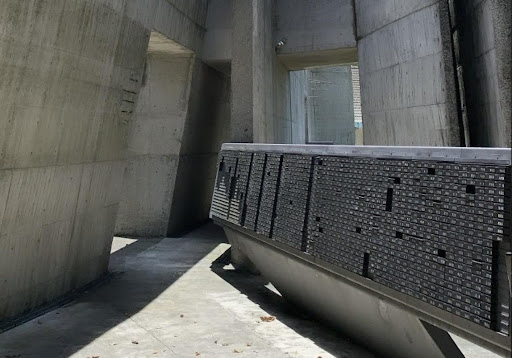
Image credit: Provided by the author. The Jing-Mei White Terror Memorial Park is located at the National Human Rights Museum in Taiwan.
At a press conference during the 76th Berlin International Film Festival, Wim Wenders, the jury president, states that filmmakers “have to stay out of politics, because if [they] make movies that are dedicatedly political, [they] enter the field of politics.” In his view, the real power of cinema lies instead in its capacity to cultivate compassion and empathy—qualities that encourage viewers to reconsider how they live their lives. His controversial comment quickly sparked widespread criticism, particularly given the geopolitical context: the fourth anniversary of Russia’s war in Ukraine and the lingering tensions following the Gaza ceasefire.
Wenders’s statement, however, overlooks a fundamental point: cinema is itself an act of framing reality. Through this process, filmmakers inevitably engage with power dynamics by deciding what to show, what to omit, and whose perspective to centre. The audience, in turn, not only consumes the ideas that cinema seeks to convey but also becomes immersed in a structure of power. To claim otherwise—to assert a “neutral” stance—is therefore not to escape politics, but to obscure one’s position within it.
For this reason, I partly agree with Wenders when he describes cinema as “the counterweight of politics.” Yet the statement itself reveals the difficulty of his claim. A counterweight presupposes an opposing force against which it must balance. If cinema stands as a counterweight to politics, then it necessarily remains entangled with it. Under such conditions, politics cannot be excluded from cinema; it is already embedded in the very struggle that the categorical claim implies.
A “Wendersian” controversy that emerged in Taiwan’s film community illustrates this dilemma. Shortly before the Lunar New Year, the filmmaker and actors of a new production titled The Century Bloodshed (世紀血案) held a wrap-up press conference. According to the production team, the film is adapted from one of the most shocking cases of political violence in Taiwan: The Lin family massacre (林宅血案). The massacre took place in 1980. At the time of the incident, Taiwan Provincial Councillor Yi-xiong Lin (林義雄), a prominent opposition figure in the democracy movement, had been arrested and was standing trial for sedition. During the trial, his mother and twin daughters were brutally murdered in their home, while his eldest daughter survived with serious injuries. The case remains unsolved to this day.
The film quickly provoked heated debate in Taiwan for several reasons, but two points of the controversy are particularly noteworthy. The first concerned remarks made by the actors at the press conference. Among them were statements such as “the script does not carry a strong ideological intention,” “performing in the film felt like experiencing the thrill of Sherlock Holmes and Watson solving a case,” and “after the filmic adaptation, the case no longer felt so serious or horrifying.” Many commentators regarded these remarks as deeply troubling, and the actors were widely criticised for trivialising a traumatic historical event.
Regarding the first controversy, the actors’ claim that the script carries no political intention—an apparent attempt to avoid complicity with the political implications of the case and to assume a neutral stance—can itself be understood as an expression of ideology and a political position. This stance is particularly problematic given that the Lin family massacre was an act of state violence and has been officially recognised as such by Taiwan’s Transitional Justice Commission.
Furthermore, this controversy raises the question of whether historical knowledge can be transmitted through film adaptation, particularly when the story is framed within the conventions of the detective thriller genre. To frame the story as ideologically neutral, therefore, risks obscuring the historical and political conditions that produced the tragedy.
The second controversy concerned the background of the film’s director, Kun-hua Xu (徐琨華). Xu is the grandson of Min-Lin Xu (徐敏鄰), who served as the spokesperson for the Taiwan Garrison Command during the White Terror period. The organisation was notorious for persecuting and torturing political prisoners. For many critics, this familial connection further intensified the debate surrounding the film: can the stories of victims be told by the descendants of perpetrators?
Together, these two controversies point to a deeper issue: the difficulty of representing traumatic history. Questions about the filmmaker’s identity and about the suitability of genre adaptation ultimately converge on the same underlying concern—the limits of representation itself.
One aspect of the debate concerns the role of genre. Can a detective thriller serve as an appropriate medium for representing historical trauma? On the one hand, genre cinema can provide a powerful narrative structure through which audiences engage with complex historical events. The detective genre, in particular, invites audiences to participate in investigation, suspense, and the pleasure of piecing together fragmented clues.
A useful example is the Taiwanese film Detention (返校). The film places its protagonists, Rui-xin Fang (方芮欣) and Zhong-ting Wei (魏仲廷), on an investigative journey that gradually uncovers buried secrets—both personal and national. As they move through a series of encounters, viewers are invited to follow them and collect pieces of the puzzle step by step.
This film’s narrative aligns with detective conventions: clues are partial, sometimes misleading, and never self-evident. Meaning does not simply appear; it must be actively constructed. The burden of interpretation thus falls on both the protagonists and the audience, who are compelled to weigh details, compare accounts, and reflect critically on the narratives being assembled.
However, the conventions of detective thrillers also raise questions when applied to the representation of historical trauma. This genre traditionally promises narrative resolution: mysteries are solved, truths are revealed, and justice is restored. Yet events such as the Lin family massacre resist such narrative closure. When historical suffering is transformed into a narrative puzzle to be solved, the investigative pleasure offered by the genre may risk turning trauma into spectacle.
To explore the difficulty of representation, Kaori Lai (賴香吟)’s short story Fabrication 1987 (虛構一九八七) offers an illuminating example. In the story, the narrator, “I 我,” attempts to reconstruct the life of her deceased classmate Cai-wen Xie (謝彩文) by turning it into a novel. Her motivation is simple yet troubling: she realises that she barely knew Xie before her death, and writing becomes a way of approaching a past that now feels distant and strange.
Yet the past in question is not limited to Xie’s personal life. It also encompasses the broader historical context of the White Terror, a period that shaped both Xie’s and the narrator’s lives but remains utterly unfamiliar to the narrator herself. As the narrator repeatedly revises her manuscript, she gradually recognises that it is impossible to construct a coherent narrative based on the single fact she possesses: the death of her classmate. This recognition eventually leads her to leave the novel unfinished.
The problem is not merely that the narrator lacks information about Xie’s life. Rather, the “fact” is embedded within a much larger historical framework that includes events such as the 228 Incident and the decades-long White Terror. The year referenced in the title—1987—marks the lifting of martial law in Taiwan. Yet knowing the names of these historical events alone does not produce understanding. They remain empty signifiers unless one confronts the historical realities they contain. Through this story, Lai suggests that representation depends on the depth of research, reflection, and ethical engagement with the historical event itself.
This insight recalls the well-known statement by the philosopher Theodor Adorno: “To write poetry after Auschwitz is barbaric.” The point of this statement is not that writing—or art more broadly—after such an atrocity is meaningless, suspicious, or unethical. Rather, it serves as a warning that artistic creation must remain conscious of the limits of representation. Art “bears witness to its own incapacity to represent the unrepresentable.” Only when creators are aware of this limitation and approach such histories with humility, careful research and ethical seriousness can works of art meaningfully engage with the past. It is precisely the failure to recognise this difficulty that often gives rise to the kinds of controversies discussed above.
The controversy surrounding The Century Bloodshed, therefore, reveals more than a dispute over a single film project. It reflects the ongoing tensions that shape Taiwan’s efforts to confront the legacy of the White Terror. For those who have literally lived through the White Terror period, the film may be perceived as an insult to their memory. For those who have not experienced it, however, the film may generate new memories—yet memories that are likely to lead them away from the historical events themselves. Cinema is not obliged to provide audiences with a perfectly accurate or flawless account of history. Nonetheless, the challenge of storytelling lies in how imaginative power can be used to craft narratives of political violence and offer vivid alternative memories that expand our understanding of the past.
Meng-Hao Li is a PhD Candidate at the Institute of Asian and Oriental Studies, University of Zurich.
 Taiwan Insight