
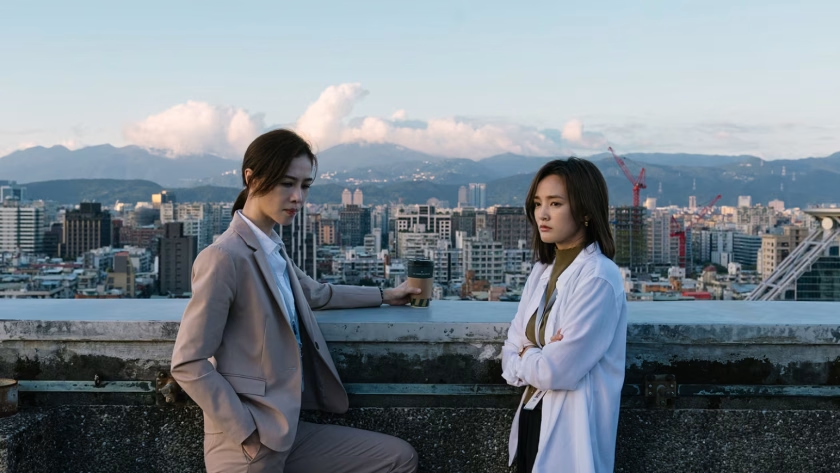
Written by Ming-yeh T. Rawnsley (蔡明燁).
Image credit: Wave Makers by DaMou Entertainment.
“How Badly Do You Want to Win?”
On 16 September 2026, as Taiwan entered another election season, the prominent journalist and political commentator Huang Wei-han (黃暐瀚) used this line from Wave Makers as the theme of his POP Radio programme. Three years after the drama was first released, words written for a fictional election campaign had returned to Taiwan’s real political arena.
I was struck by the timing. Two days earlier, I had interviewed XinLing Li for the New Books Network about his new book, Wave Makers and the Rise of #MeToo in Taiwan: Media, Empathy, and Digital Testimony (Anthem Press, 2026). Our conversation encouraged me to look beyond the familiar question of whether Wave Makers “triggered” Taiwan’s 2023 #MeToo movement. Huang’s reuse of its dialogue suggested another way of understanding the drama’s significance: its stories and language continue to circulate through Taiwan’s public life.
This prompted a broader question: what can a television drama do for us? A drama cannot create a social movement by itself, nor can representation substitute for institutional reform. Television can, however, make structural problems emotionally intelligible, give people language for experiences that have been difficult to articulate, and provide shared cultural references through which a society debates its values.
Making Inequality Recognisable
When Wave Makers appeared on Netflix in April 2023, Taiwan seemed an unlikely place for a delayed #MeToo reckoning. It was widely regarded as one of Asia’s most progressive democracies, with high levels of women’s political representation and legal protections for women and sexual minorities. Yet, as Li emphasised in our interview, legal progress does not automatically confer cultural permission to speak.
The drama exposed this gap through the ordinary language used to minimise harassment: “Just let it go;” “It isn’t that serious;” “You weren’t injured;” “Why are you taking it so seriously?” Such phrases protect institutions and reputations by turning structural abuses of power into private misunderstandings. They also encourage victims to doubt their own interpretations of what happened.
Li’s book is especially illuminating on the idea of the “perfect victim.” A woman is more likely to be believed if she appears morally blameless, modest and passive. Wave Makers challenges this expectation through Chang Ya-ching, who had an affair with Chao Chang-tse, the politician who later exploited her. Because Ya-ching does not conform to the image of an innocent victim, she struggles with shame and self-blame. Yet her earlier choices do not remove her right to justice.
Television makes this argument differently from a statute or policy paper. It allows viewers to spend time with Ya-ching’s uncertainty and see how victim-blaming becomes internalised. The drama shifts attention away from whether she behaved perfectly and towards the unequal relationship that enabled the abuse. It makes a structural argument through character, feeling and duration.
Giving People Words and Models for Action
The series’ best-known line comes when Weng Wen-fang tells Ya-ching: “Let’s not just let it go this time.” Li relates this moment to Sara Ahmed’s idea of the “feminist snap”: the point at which accumulated injustice becomes impossible to bear quietly. Wen-fang has also endured discrimination and the suppression of her own grievances. Her words carry the weight of experiences repeatedly dismissed for the sake of political convenience and social harmony.
The line resonated because it named a feeling many viewers already possessed but had not expressed publicly. Within weeks, survivors across Taiwanese politics, the media, academia and the arts began disclosing experiences of sexual harassment and assault, often invoking the drama. Wave Makers did not give them those experiences. It offered a language through which private suffering could be recognised as part of a shared problem.
Equally important, the drama does more than urge victims to speak. Wen-fang models how somebody should listen. She believes Ya-ching without demanding that she become a perfect victim first. She treats listening as an ethical responsibility and shows that solidarity requires a meaningful response to another person’s vulnerability. Viewers are therefore invited to imagine themselves not only as possible victims, but also as colleagues, friends and witnesses who must decide what to do when someone speaks.
This is one reason fiction can generate a form of empathy that factual information alone may not produce. Viewers encounter harassment not as an abstract social problem but through sustained relationships with characters. The emotional investment built across a series can turn recognition into self-reflection: Has something similar happened to me? Have I dismissed another person’s experience? What would I do differently?
From Empathy to Digital Testimony
Emotionally powerful television does not usually produce a social movement. Timing and media infrastructure mattered in 2023. Wave Makers appeared during an election cycle, when political parties and public figures were especially exposed to scrutiny. Social media then allowed survivors to address audiences directly rather than waiting for journalists or institutions to validate their accounts.
Li describes these online formations as “affective publics,” in which testimony circulates through feeling as well as evidence. A Facebook post can combine dates and factual allegations with shame, anger or fear. Other users can respond, share the account, add their own experiences and transform an apparently isolated incident into evidence of a pattern. The hashtag gives no individual ownership of the movement: survivors and allies alike can participate.
It is therefore more accurate to understand Wave Makers as a catalyst than as the cause of Taiwan’s #MeToo movement. The conditions for a reckoning already existed. The drama supplied an emotionally compelling story and a usable vocabulary; the election cycle gave allegations political urgency; digital platforms enabled testimonies to connect and accumulate. Social change emerged from their convergence.
What Television Cannot Do
This account should not become a comforting story about media automatically producing justice. Social media may remove traditional gatekeepers, but it does not distribute attention equally. Testimonies involving politicians, celebrities and media personalities are more likely to circulate widely. Those without established networks or the ability to make their experiences publicly visible can still disappear from view.
Li draws particular attention to migrant domestic workers, whose employment, residence and immigration status may depend on the households in which they work. Public disclosure could cost them their jobs or their right to remain in Taiwan. Language barriers, restricted mobility and the isolation of domestic labour make the apparently simple instruction to “speak out” both inadequate and potentially dangerous. A movement cannot be judged only by the voices that algorithms make most visible.
Nor can a drama provide a formula for future mobilisation. In our interview, Li resisted claiming that artists can engineer social movements. Cultural works enter social circumstances that producers cannot control, and most dramas, however moving, do not generate collective action. Drawing on Raymond Williams, Li instead suggests that art can give form to emergent feelings that have not yet been publicly recognised. It can also offer words that may become useful when historical conditions change.
Huang Wei-han’s return to Wave Makers in September 2026 demonstrates this continuing cultural life. “How badly do you want to win?” now speaks to a new electoral contest, but its reappearance also reminds us that television dialogue can outlive its original plot. A drama’s political work does not end with its final episode. Its language can remain available for later arguments, memories and moments of recognition.
What, then, can a television drama do for us? It cannot guarantee justice or tell us how to organise a movement. Its contribution is modest but important: helping a society recognise what it has normalised and hear what people have been encouraged to suppress. At its best, drama rehearses better responses. Sometimes this is enough to help people decide not to let things go.
Ming-yeh T. Rawnsley (蔡明燁) is a Non-Residential Research Fellow at the Taiwan Research Hub of the University of Nottingham. She is also Editor-in-Chief of the International Journal of Taiwan Studies. Her contact email is mytrawnsley@gmail.com.