Co-Listening as Defiance: The Facebook Soundscape of Taiwan’s Sino-Myanmar Gen Z and the 2021 Myanmar Spring Revolution

Written by Tasaw Hsin-Chun Lu. After Myanmar’s 2021 coup, Taiwan’s Sino-Myanmar Gen Z created a nightly revolutionary soundscape through Facebook Live. By co-listening to the clang of pots and pans, revived protest anthems, and newly sharpened hip-hop, they transformed distant violence into shared urgency. These circulating sounds stitched together a fragile yet insistent counterpublic, allowing young listeners in Taipei to grieve, rage, and imagine with those in Myanmar. Through this quiet, collective listening, they claimed a sense of belonging that crossed borders and defied the junta’s enforced silence.

Beyond Voices of Ethnicity: Post-Global Conditions in Taiwan’s Hakka Popular Music

Written by Hsin-Wen Hsu. Since the 2000s, Taiwan’s Hakka popular music has moved beyond themes of rural nostalgia and ethnic affirmation to engage the complexities of post-global conditions. Musicians respond to ecological precarity, translocal migration, shifting borders, and digitally mediated relationships while experimenting with new linguistic and collaborative forms. Hsu traces how Hakka communities navigate socioeconomic changes and evolving identities. In doing so, Hakka popular music becomes a crucial way of hearing Taiwan’s contemporary entanglements and imagining new modes of communal life.

Listening for the Songs of Home: Tracing the Unheard Vietnamese Soundscape in Taiwan

Written by Kuo Ta-Hsin. This piece introduces the Vietnamese presence in Taiwan, through different sonic performances, to link Vietnamese students and/or migrants closer to their home. It is just for instance, In the karaoke rooms and Vietnamese eateries of Taichung, memory meets reality. Voices turn into acts of belonging, and to sing is to remain Vietnamese, even far from home.

Singing for the Mountain Lands: A Pivotal Indigenous Music Concert in Taiwan

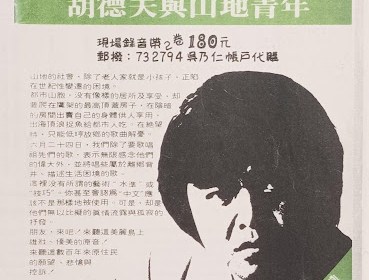
Written by Eric Scheihagen. The author illustrates the 1984 Singing for the Mountain Lands concert in Taipei, organised shortly after the Haishan Coal Mine Disaster, which killed mostly Amis miners. It details how Indigenous musicians and activists, led by Hu Defu, used the concert to raise funds and publicly address discrimination, harmful stereotypes, and political issues. The event became an important milestone in Taiwan’s growing Indigenous rights movement and helped catalyse later organising efforts, including the formation of the Taiwan Association for Promoting Indigenous Rights.

(Re)Writing Taiwan Studies History​

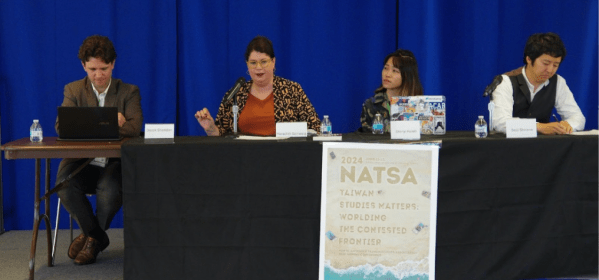
Written by Yu-Han Huang and Li-Ting Chang. This article is about the 30th NATSA Conference’s closing forum, which discussed the historical development of Taiwan Studies as a field, particularly emphasizing its interdisciplinary nature and growing significance in global scholarship. The forum featured four experts who presented their perspectives on Taiwan studies, exploring its evolution through various disciplines such as history, anthropology, ethnomusicology, and medical history. It highlighted the increasing importance of understanding Taiwan within a global context, emphasizing the need to connect its history and experiences with broader international dialogues and discussions.

Toward Antiracist Taiwan: A Short Fieldnote in Studying Racism through Punk and Metal Musical Performances by Indonesian Migrant Workers 

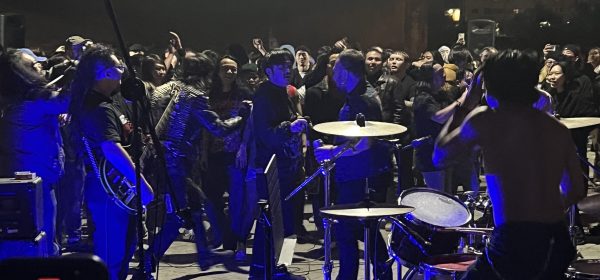
Written by Mark Hsiang-Yu Feng. Drawing on field notes on punk and metal musical performances by Indonesian migrant workers in Taiwan, this article reveals racism and stereotypes in the music scene. The author calls for a critical examination of multiculturalism to address the structural inequality and racial hierarchy in Taiwanese society.

Beyond Mayday’s Lip-synching Investigation: Taiwan’s Music Freedom Questioned Under PRC Influences 

Written by Chen-yu Lin. On December 28, 2023, Reuters and CNN​ reported a disconcerting incident involving Mayday, a Taiwanese rock band, who found themselves entangled in a request from Chinese authorities to make pro-Beijing statements. As reported by CNN, the authorities demanded a public statement affirming the unity of China and Taiwan as a single nation. The band’s refusal to comply resulted in consequences related to alleged lip-synching, which is referred to as “deceptive singing (假唱)” in Chinese. This accusation carries the potential for fines or even performance bans under Chinese law. These developments stemmed from their December concert in Shanghai and are potentially connected to Taiwan’s presidential election in January 2024, prompting an ongoing investigation.​ 

Reflections on the Identity at Indigenous Popular Music Training Camp in Taiwan 

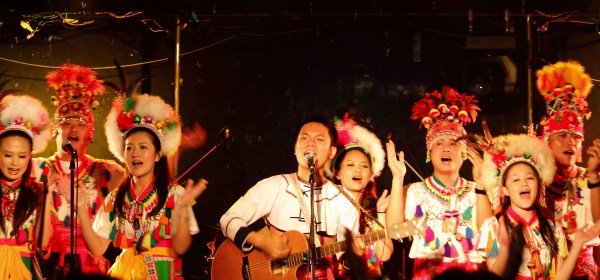
Written by Kuing, Guo-Ting Lin. In recent years, there have been various Indigenous popular music creation and cultivation programmes in Taiwan. For example, the music training camp “Psiwali School” at the Pasiwali Music Festival in Taiwan with the purpose of discovering Indigenous musicians. Another example is the “MINETJUS Electronic Music Production” Programme, which is held by Dark Paradise Records (派樂黛唱片), an independent record label based in Taipei. This initiative blends electronic music and Indigenous culture to help younger musicians turn cultural marginality into unique cultural assets. Most training camps in Taiwan still rely on government support, aiming to strengthen the unique cultural identity of contemporary Indigenous youth and regard this as a catalyst for promoting ethnic diversity. This article examines the meaning of Taiwan’s Indigenous popular music creation and cultivation programmes.

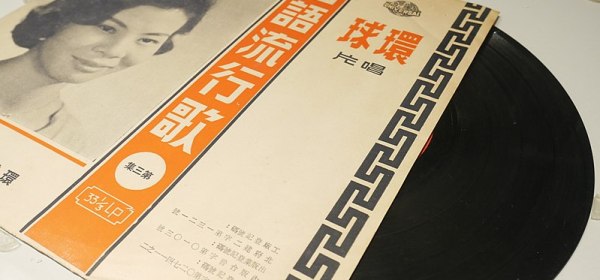
The Search for a Shared Script: A Very Brief History of Writing Lyrics in Taiwanese 

Written by Cheng-Ting Wu. Imagine you are trying to write a song in Taiwanese Southern Min (hereinafter “Taiwanese”). After creating a soulful melody and heartfelt lyrics, you wonder: How should I write them down? You can choose any of the music notations you prefer for melody, from staff to numbered system. For lyrics, regardless of whether you are a native speaker or a learner of Taiwanese, you also have a choice. This brief article discusses this choice or the different strategies in the history of writing music in Taiwanese.

1 2 3 4