The Changing role of Laotian Coffee in Taiwan 

Written by Chen Szu-An, Translated by Sam Robbins. According to data from the Lao Coffee Association, Taiwan was one of the earliest to enter the Laotian market and invest in coffee production after the government allowed foreign investment in the year 2000. There was even a period where some in Taiwan dreamed of becoming a major player in the development of Laotian coffee. In contrast with the Laotian beans that were first imported to Taiwan as cheap goods, as Taiwanese consumers became more accepting of the idea of “specialty coffee”, Taiwanese business people started to repackage Laotian beans.

TAKING A LEAF OUT OF TAIWAN (AND VIETNAM): HOW “TAIWANESE” IS TAIWANESE BUBBLE TEA? 

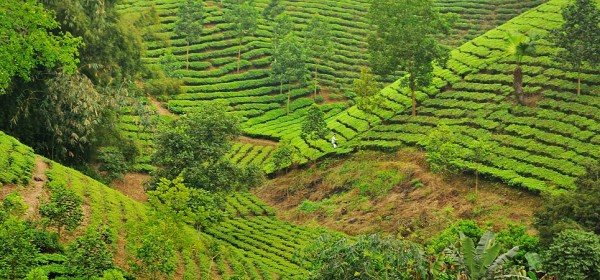
Written by Kuan-Ren Yun (雲冠仁), translated by Sam Robbins. As Bubble tea has taken over the world and increasingly become a symbol of Taiwan, this unique Taiwanese flavour has only been possible by importing large qualities of tea leaves, including the Vietnamese tea leaves that so many Taiwanese have grown sceptical of. Taiwanese people have felt pride in the success of bubble tea sales, but they also continue to reject foreign tea leaves and see them as only authentic when only Taiwanese tea leaves are used.

Taking a leaf out of Taiwan (and Vietnam): How “Taiwanese” is Taiwanese bubble tea? 

Written by Kuan-Ren Yun (雲冠仁), translated by Sam Robbins. When I was in Vietnam from 2016 to 2018, there was a time of immense market transformation underway that raised a very interesting question: The now-famous “Taiwanese bubble tea” had become reliant on Vietnamese tea leaves in Taiwan, and it was only after the transition to Vietnamese tea leaves was made could Taiwanese bubble tea be produced at such a scale to become a global phenomenon.

Pondering the Pacific: One of the Moons Version II

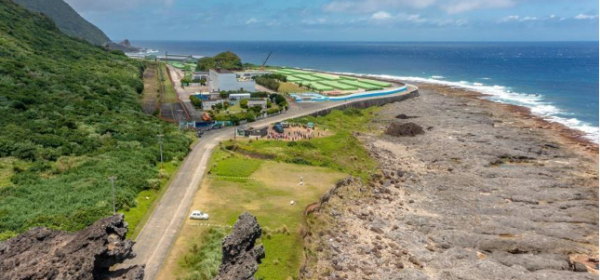
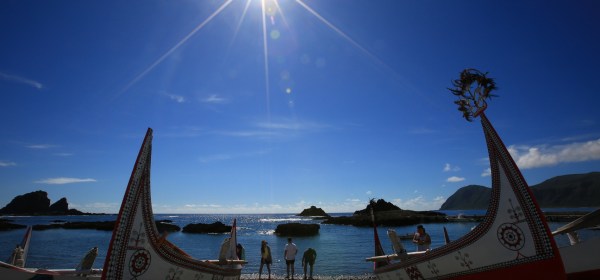
Written by Ysanne Chen, Ilin Tsai, and Shih-Hao Huang. In “Pondering the Pacific,” we conceptualise the Pacific as an oceanic highway or a contact zone. The vast ocean connects Pacific Islands. We travel from the island of Taiwan (we are reluctant to call it main(is)land) to Pongso no Tao to recover and explore this connection. When on the island, we further learn about Tao people’s connectedness to other Pacific Islanders. Upon our return, we wrote these poems to celebrate the Pacific. Along with other Pacific Islanders writers and poets, we praise the Pacific for its abundance and ability to connect people. We also join Pacific Islanders in voicing out against nuclear contamination and all forms of environmental injustice.

Pondering the Pacific: One of the Moons Version I

Written by Shih-hao Huang, Chiahua Lin, and Robinson Pinghao Liu. Employing “the Pacific” as a contact zone, this poetry collection explores the dynamic and shifting relationship between land and sea, allowing Indigenous culture and history in the trans-Pacific context to engage in spatial and historical complexity. This journey triggers memories and connects the present with the ancestral past. When seeing the constellations in the sky, one is reminded of the stories about stars. However, we were reminded that we often forget Taiwan is also a part of the Pacific. Therefore, we authored poems to represent, substantiate and celebrate the connection: the LOST connection between the Pacific Ocean and us.

Placing Relationship over the Project: Filmmaking in Oceania

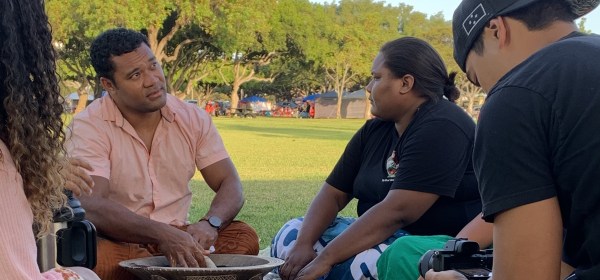
Written by Cheng-Cheng Li. My filmmaking story in Oceania started with the Re/presenting Oceania course at the University of Hawai‘i. My Kumu (professor) Tarcisius Kabutaulake, who comes from the Solomon Islands, has been teaching and researching across the region for decades. His course invites me to critically engage with and discuss how the Pacific Islands have been represented in scholarly and other mediums. He brings me onto the ‘voyage’ across the ‘storyscapes’ of scholars, artists, performers, poets, and filmmakers to understand the politics of representation. This article will first discuss my filmmaking experience in Hawai‘i with the Pacific Island community. In the second section, with an increasing number of Indigenous Taiwanese wishing to connect with Oceania, I will address the interconnection story between Taiwanese Indigenous filmmakers and the Oceanic community. The theme of ‘relationship’ as ‘Priority’ will be interwoven into the stories. 

A Possible Cultural-Political Alliance to Address Concurrent Struggles between Taiwan and Oceania: Music as a Means

Written by Chun Chia Tai. For many Indigenous peoples in Taiwan, music is a lively cultural medium that facilitates allying with other Austronesian peoples residing in Oceania. Such a musical way of fostering cultural diplomacy has currently been popular in Taiwan, especially after the release of the album Polynesia in 2014, emphasising the shared cultural genealogy of Austronesian under the collaboration of an Amis singer Chalaw Pasiwali and a Madagascar musician Kelima. In the same year, another project called the Small Island Big Song aimed to establish a network between Pacific Islands and Taiwan through music and film. Musicians in this project released their 2018 album Small Island Big Song and a sequential album named Our Island in 2021. Moreover, all these musical works focus on fusions of traditional folk music(s). Positive public perception reflects Taiwanese people’s rising demand for establishing a cross-Pacific Austronesian community between Taiwan and the Pacific Islands.

A Proposition of Indigenous Diplomacy for Taiwan-Australian Indigenous Peoples

Written by Suliljaw Lusausatj. Although Australia’s Indigenous Peoples are not Austronesian language speakers, with direct historical links to Taiwan’s Indigenous Peoples, they share a broadly similar experience of colonial histories, national governance, social and economic environments, and most importantly, reliance on traditional subsistence practices and the importance of ancestral territories. Both peoples have experienced a gradual process of formal recognition. For example, the Prime Minister of Australia and the President of Taiwan issued formal apologies for the injustice done to Indigenous communities in 2008 and 2016, respectively. Despite these similarities, the Indigenous Peoples of Australia and Taiwan have not yet opened a constructive dialogue due to geographic distance, national policies and approaches to academic studies. This also applies to educational disciplines and uneven historical memories of colonialism. Therefore, perhaps it is important to think about the possibility of using new forms of diplomacy to build these relationships drawing on the traditional practices of Australian and Taiwan Indigenous Peoples.

Indigenous/Islander Fanaticism Across the Pacific: A Perspective from Films

Written by Yawi Yukex; translated by Yi-Yu Lai. A type of Taiwanese is extremely fond of anything about the Indigenous peoples of Taiwan. They are captivated by all the totems and material cultures associated with Indigenous peoples, yet they frequently only believe what they already know about Indigenous cultures. Besides, they usually turn a deaf ear to Indigenous peoples’ enormous burdens and struggles. I call these individuals “Indigenous fanatics.” In the early 2000s, a series of Taiwanese films, such as “The Sage Hunter” (2005) and “Fishing Luck” (2005), portrayed Indigenous communities as shelters for those wishing to escape reality and contrasted cities with the communities. People believe that the expansion of civilisation causes problems, whereas mountains and forests represent the solution.

Representing Taiwan’s Pacific Connections

Written by Chuahua Lin. How are Trans-Pacific connections remembered and maintained in the literary works of the Tao people, one of the 16 officially recognised Indigenous tribes of Taiwan? In this article, I will read Syaman Rapongan and Yung-chuan Hsieh’s works, and I will discuss how they exemplified the ways in which Tao people endeavour to revitalise the navigation tradition of their people and maintain the connection to the ocean. As I argue in this article, Tao people, as well as other Pacific Islander writers, represent the centuries-old navigating traditions of their people and thus keep these Trans-Pacific connections alive. 

Shinzo Abe: A True Friend of Taiwan? “Post-”colonial Critique on Taiwan’s National Identity Forming

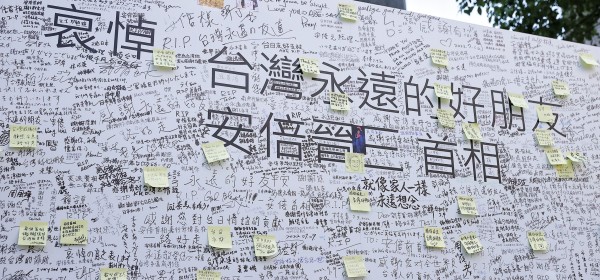
Written by Ti-han Chang. 11:30 am on the 08th of July in Japan, unexpected news of Shinzo Abe 安倍晉三 being shot during his public speech travelled quickly on the international news media. However, the very fact of this happening has profoundly shaken societies in the East Asian region. For Japan, it appears there is a need to reflect deeper on the homogeneous nature of its internal political structure; for other countries in the region, on their indissociable geopolitical dynamics with their close neighbour over the last few decades.

How Democracy Boosts Taiwan’s National Security

Written by Jie Chen and Ratih Kabinawa. Taiwan has become widely regarded as an exemplary consolidated democracy, albeit with some defects. In Freedom in the World 2022 report, Freedom House gives Taiwan a 94 of 100 ratings, meaning the country counts as fully free. Freedom House also notes that “Taiwan’s vibrant and competitive democratic system has allowed three peaceful transfers of power between rival parties since 2000, and protections for civil liberties are generally robust”. Taiwan’s democratic standing has become more pronounced considering the rapid mainlandisation of Hong Kong under the repressive National Security Law.

1 3 4 5 6 7 14