Whose stratified reproduction? Disparities in Taiwanese gay men’s quest for overseas surrogacy

Written by Jung Chen. This article begins by examining the current Assisted Reproductive Act in Taiwan. Its exclusion of Tongzhi couples’ leads many to seek transnational surrogacy services. Recognising the controversy surrounding the services in LGBTQ+ community, the author argues for ‘flexible moral boundaries’ to distinguish between ‘problematic’ and ‘ethical’ surrogacy practices.

How Will 2023 Gains in Transgender Rights Fair after the 2024 Elections?

Written by Yo-Ling Chen. 2023 was a big year for Taiwan’s transgender rights movement. This article traces important legal cases regarding transgender rights in 2023, and explores how the growing public visibility of transgender issues and legal consensus around the need to abolish compulsory surgery for changing one’s legal gender play in the aftermath of the 2024 elections.

The Procrastinating Progress of Transnational Same-Sex Marriage Rights in Taiwan

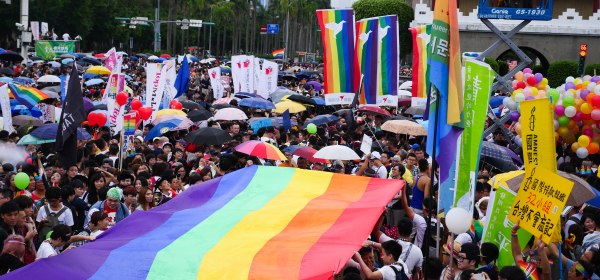
Written by Annie Huang. One historical human rights progress Taiwan made happened in 2019 when the government legalised same-sex marriage. It was a rainy morning, and hundreds of LGBTI groups and activists were standing outside the Legislative Yuan waiting for results. When the president of the Legislative Yuan announced the legalisation of same-sex marriage, the rain stopped, and a rainbow appeared in the sky. People hugged and wept with joy for this historical first in Asia. However, at the same time and in the same plaza, a group of Taiwanese same-sex people burst into tears not because of happiness but because of sadness and discrimination. Transnational same-sex couples are left out of the legalisation content in the same-sex marriage bill without much reasonable reason.

An Unlimited Future: How Do We Get There? 

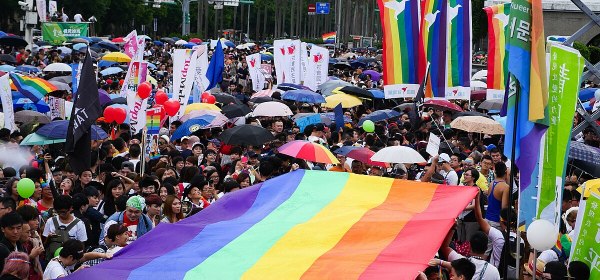
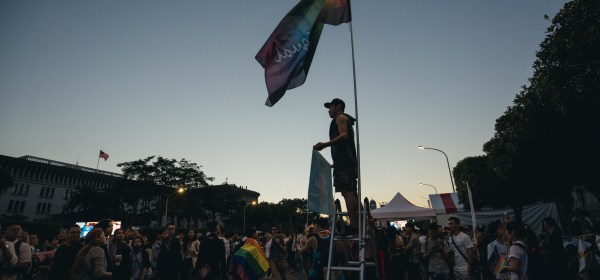
Written by JhuCin Rita Jhang. The year 2022 marked the 20th anniversary of the pride parade in Taiwan. It is a feat worth celebrating, and its theme, “An Unlimited Future,” adumbrates directions we are, or ought to be, heading toward.        

The host of the pride parade, Taiwan Rainbow Civil Action Association, explained, “this year’s theme, An Unlimited Future, heralds our long-term goal—to liberate all oppressions against sex and all stereotypes, allowing endless possibilities for everyone’s identity. The ultimate goal is that one day, no one needs to announce their identity in any way but can be anyone they want without judgment.” However, to arrive at the future depicted in this statement, we need first to understand what were, are, and may remain the limits, who put these limits and on whom, what are the consequences of the limits, and more importantly, the results of removal of these limits.

With What Difficulty Indigenous LGBTQ Groups Struggles in Taiwan

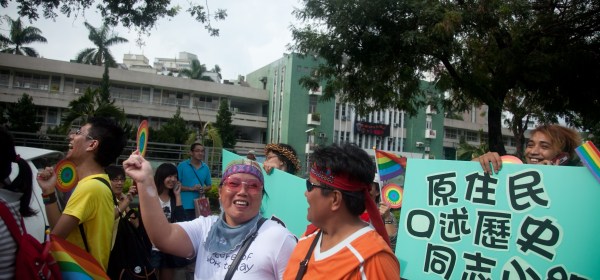
Written by Remaljiz Mavaliv. Translated by Yi-Yu Lai. Taiwan is a beautiful country with diverse cultures, the Indigenous peoples of which are often viewed as significant worldwide highlights. Currently, sixteenth Indigenous groups are officially recognised in Taiwan. However, this does not protect them from discrimination and unfair resource distribution. After successive colonial regimes arrived in Taiwan one after another, colonialism and imperialism profoundly influenced the Indigenous population, and the political repercussions have persisted to the present day.  

Chemsex, digital writing, and changes in sexual practice in 21st century Taiwan 

Written by Poyao Huang. Almost parallel to the development of Taiwan’s LGBTQ+ history is a chapter on gay men’s lived experiences with drugs—a taboo chapter that many tend to ignore. In Taiwan, it is reported that young drug users are the most vulnerable population affected by HIV/AIDS and drug abuse as we see increasing numbers of young people getting involved with drugs and HIV. Drug use among bisexual and gay men is often understood in the illegal vs recreational debate. In other circumstances, the issue of drug use is associated with health concerns (HIV/AIDS or other sexually transmitted diseases), thus becoming a moral threat to social well-being.

“I’m on PrEP, hbu?” – The Meaning and Influence of PrEP among Taiwanese Gay Community 

Written by Yu-Chuan “Daniel” Lin. Although PrEP medication solves the HIV epidemic, research has found an inadequate number of MSM receiving it. For example, a 2015 U.S. CDC report has indicated that at least one of four gay men should be taking PrEP daily to effectively avoid more extensive HIV transmission, requiring the participation of roughly 1,200,000 MSM nationwide. However, its data showed that no more than 50,000 MSM are doing so, which translates into a poor execution rate (around 3%) of the government’s PrEP project designated to combat the HIV epidemic.  

Worldpride 2025 and Taiwan’s Place in Global Queer Politics 

Written by Ting-Fai Yu. Unquestionably, the global visibilities of Taiwan’s recent human rights achievements, such as the legalisation of same-sex marriage in 2019, must have contributed to the voting members’ confidence in having WorldPride held there. However, while Taiwan’s LGBT development has served as an exemplar to which many non-Western countries, especially those in Asia, aspire, it is essential to note that progressive legal changes are not necessarily representative of how queerness is lived culturally.

‘Queer’ Film and Representation at the Taiwanese Box Office: A Post-2019 Post-COVID Sinophone Dialogue 

Written by Elliott Y.N. Cheung. “Queerness is that thing that lets us feel that this world is not enough, that indeed something is missing,” says José Esteban Muñoz. So, if these resisting narratives defy the regulation of an all-encompassing narrative and seek to entice viewers to recognise what is not yet there — might we call them queer? Moreover, if a country that not only enables such views but can actively and constructively engage with them, struggling to hold them in all their difference — might we also call it queer? 

Asexuality and LGBTQ+ Activism in Taiwan 

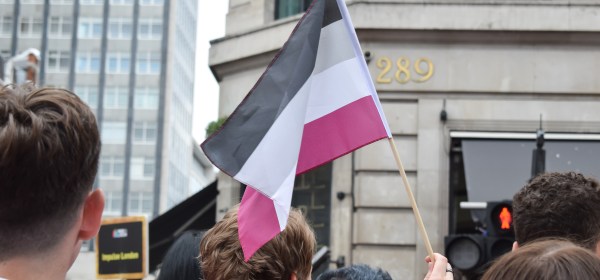
Written by Daniel Yo-Ling. In 2021, the Taiwan Asexual Group conducted a Taiwan Asexual Community Survey to increase asexual visibility and provide a resource for aspec (an abbreviation for asexual/aromantic spectrum) people in Taiwan. The 2021 Taiwan Asexual Community Survey consisted of 70 questions covering basic demographics, gender identity, sexual and romantic orientation, sexual behaviour and attitudes, ideal living situation, and views on legal initiatives. It received a total of 397 valid responses, making it the largest dedicated dataset on Taiwan’s asexual community to date.  

Taiwanese Gay Bear Culture in a Grizzly Area of Taipei 

Written by Yu Dung Shiu. Once, I spoke with a man who looked like a bear; he was shocked that I called a man sitting about two meters away from a “bear.” That man was bigger than anyone else in the café and was eating a lot of food (a large size dinner box, two loaves of bread and a whole bunch of grapes) for his dinner. “I think you’re too naïve to recognise who is a bear and who is …it may be harsh but…a pig,” said the bear-man smoking with me. So, I asked him if he could teach me how to recognise who is a bear and who’s not.  

1 2 3 4