
Written by tanivu yasiungu and Aaron Valdis Gauss.
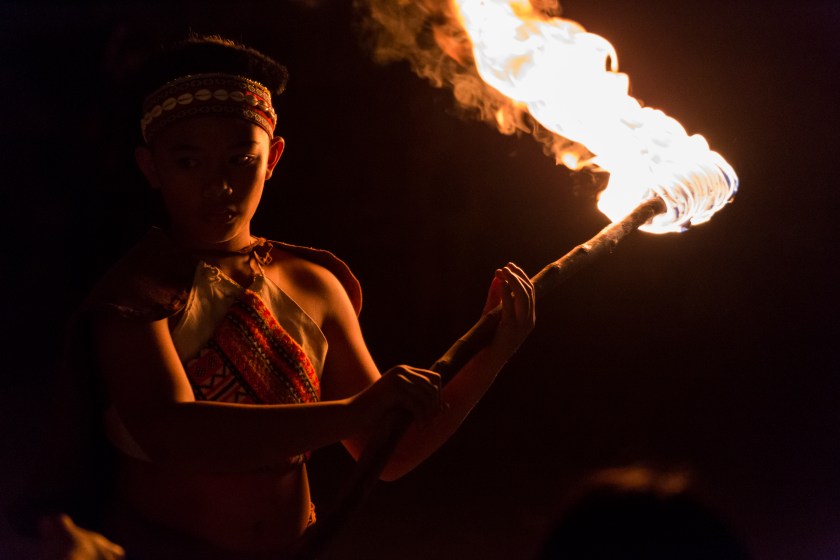
Image credit: 阿里山鄒族生命豆季_來吉村 by Chen Tao Liao/ Flickr, license: CC BY-NC-ND 2.0.
When my mother was a child, there was an old woman who was often seen sitting on the edge of a cliff near the outskirts of the village. As she sat there, the old woman continually muttered to herself. My mother said that the old woman was actually a shamaness who sat on the edge of the dangerous cliff in order to communicate with the spirits. This “cliff shamaness” was none other than the famous Granny Wang of the Tsou. Granny Wang was so powerful that everyone in the tribe would go to her to solve their problems, and she was willing to give people guidance and blessings. Tsou people believed that Granny Wang would live a long and healthy life, but the reality turned out to be the opposite.
Living high up in quiet Ali Mountain, the Tsou shamans intimately connect with the earth and the ancestral spirits. But, of course, they are also connected with the most beloved god of the Tsou tribe––Hamo. Another important role of the Tsou shamans is to preserve, perpetuate and affirm Tsou myths, thereby maintaining a connection with the ancestors. Tsou shamans believe that working with nature is the most suitable way for everyone to live. We, the Tsou people, have always believed that being simple and pure in our beliefs is the only way to maintain the closest relationships with our god Hamo.
The Burden of Fate for Tsou Shamans
Being a tribe’s shaman is not a simple matter. On the surface, Tsou shamans may appear just like ordinary people, but not all Tsou are qualified to be shamans. My grandma said two conditions must be met for someone to become a Tsou shaman. One condition was the occurrence of strange dreams. When strange dreams afflict someone, they seek guidance from a shaman who can interpret them. Shamans can analyse whether one’s dreams indicate that a person is destined to become a shaman. Another more direct method is for the shaman to judge whether one has a shaman’s constitution.
I heard from my grandma that Granny Wang asked her if she wanted my mother to become a shamaness. Granny Wang saw great potential in my mother to take on the role of a shamaness. Fortunately, my mother did not become a shamaness, otherwise, I probably would not be able to share this story. That is because becoming a shaman means focusing on the sacred practice. Therefore, shamans must be wholly dedicated to their sacred duties. This does not mean that Tsou shamans cannot marry, but partners and children can be weaknesses for Tsou shamans. As for the reason why Grandma refused Granny Wang, it was because she did not want her child to take on the heavy duties of a shamaness and live a humble life keeping a low profile. Moreover, if a shamaness uses her talents to do bad things, their lives will only be shortened.
The heaviest burden for shamans is dealing with desire. Since Granny Wang’s prophecies were so accurate, even city dwellers went up the mountain to petition for her counsel. She received generous rewards from the urban people, including delicacies and treasures she had never seen before. Granny Wang became greedy and began to desire more money and material wealth. This caused her health to decline rapidly. She died of illness within a few years. That is, because of the temptations brought by the new age, modern shamans no longer live long lives.
The Challenges Faced by the Cultural Inheritance of the Tsou
My grandma said that the shamans of the previous generations were very powerful. When the Tsou ancestors fought battles against the Atayal tribe, the Tsou shamans not only used their mana, which is the spiritual power, to steal enemy weapons but also to grant magical blessings. Mana is a sacred power wielded by Tsou shamans to heal disease, pray for blessings, predict the future or perform other rituals. Shamans usually improve their abilities by helping others. In the past, shaman’s blessings and spells had always been simple, so spring water and endemic plants from Ali Mountain were sufficient for them to create maximum energy out of seemingly trivial items and elements.
Now everything is different, as the advancement of technology has filled all of us with many desires. Even shamans find it difficult to avoid temptation. Rather than looking to the ancestors’ traditions, young generations are tempted to look outside for sustenance and fulfilment. As a result, an increasing number of Tsou are finding solace in foreign religions rather than relying on the blessings of their ancestors and Hamo.
Shamans influence the tribe with far more than just blessings and exorcisms. They are responsible for condensing the consciousness of Tsou culture.
We, the Tsou people, do not simply pray for peace, but we also pray for the spirit of our ancestors to be passed down to future generations. The old ways embody the purest and strongest Tsou faith.
Now there are only a few shamans left in the Tsou tribe. This is because Tsou shamans are not only the spiritual sustenance of the tribe but also bear the pressure of cultural inheritance. Fortunately, in this era of continuous progress, Tsou still deeply recognises the importance and urgency of preserving and continuing our core values.
Passing on the Tsou Heritage
The diminishment in the social role of shamans is undoubtedly a great loss to the Tsou. For many Tsou, nothing is more painful than the fading of traditional knowledge and culture. My grandma worries that the shamans’ culture and wisdom will soon disappear. As a result, she always wears clothes representing the Tsou totem and also carries amulets blessed by shamans. I know she does not want to lose her culture and wants her children and grandchildren to pass on the Tsou spirit.
When my conversations with my grandma came to an end, she hummed the old Tsou tunes that I had heard a thousand times. At that moment, as a Tsou person, I was acutely aware that our culture needs to be preserved. Our family members are all concerned about the loss of shaman culture since it cannot be overlooked as it affects the religious, cultural, social, historical and spiritual aspects of the tribe. It is the core figure of Tsou traditional culture and plays an irreplaceable role in the stability and development of all Tsou society. Nevertheless, my mother and grandmother are still optimistic about preserving our cultural heritage. It reminds me of my mom’s description of the Tsou people as tough and persistent. In the past, it was unclear to me why she said this. Now I finally understand what that means. As long as our cultural heritage remains in our blood and in our souls, we can continue to preserve our own culture.
We do not know when the first shaman was named, but this precious aspect of Tsou culture cannot end. I hope that the Tsou will raise up shamans who are willing to shoulder the mission in the future. It may be the time to convince my mother to become a shamaness first.
tanivu yasiungu, a Tsou girl from the high mountains of western Taiwan. As she was about to leave her hometown to pursue her studies, her mother gave her an amulet (voyu) blessed by a Tsou shaman and encouraged her not to fear, but to embark on her journey with the blessings of the shaman (yoifo). This small amulet holds a profound connection between the Tsou people and the spirits, serving as the foundation of their Tsou culture. She is dedicated to carrying forward this culturally significant spirit, under the guidance and blessings of the Tsou shaman.
Aaron Valdis Gauss is the assistant professor at the Department of English, National Taitung University.
The narrators of this storytelling are tanivu noacachiana (78), yinguyu noacachiana (48).
This article was published as part of a special issue on Indigenous storytelling in Taiwan.
 Taiwan Insight