
Written by Yi-Cheng Sun; translated by Yi-Yu Lai.
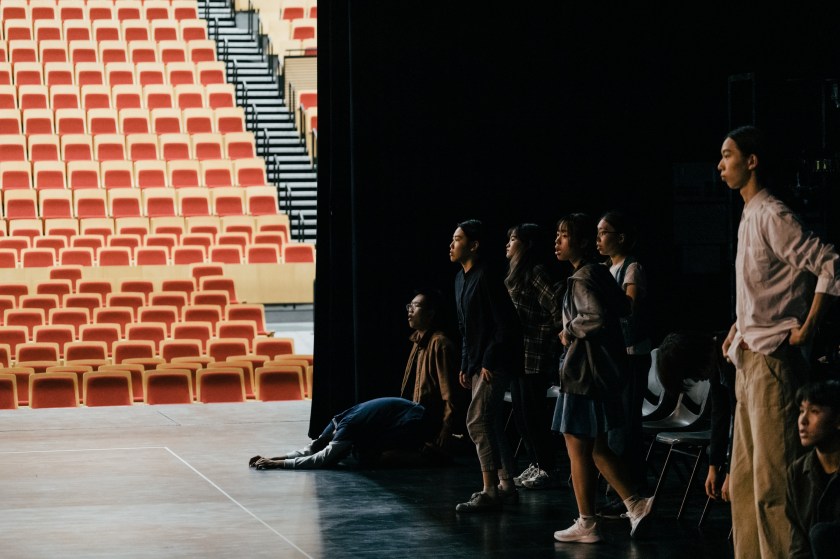
Image credit: Taoyuan Youth Theatre Project in 2022. Photo courtesy of Wen-Qi Yu.
Before starting the interview, during lunch, Rei-Tzu, the production coordinator of Flying Birds Theatre Group, told us about the “earliest university.” In English, “University” is derived from the word “universe.” In Latin, “universus” is composed of “unus” (one) and “versus” (towards a particular direction), giving it the literal meaning of “towards a specific direction.” According to our limited knowledge of history, the University of Bologna, established by students in 1088 in Italy, is the first university in Europe, earning it the title “mother of universities.” The “earliest university” topic quickly sparked our discussion about knowledge and the essence of education, with art being the primary focus.
“The most important aspect of art is to teach people to think, but what we often observe today is education controlling people’s thinking,” Rei-Tzu stated.
Since 2019, the Flying Birds Theatre Group has partnered with the Taoyuan Art Facilities Management Center to launch the “Taoyuan Youth Theatre Project.” They aspire to explore and express themselves through the power of theatre and confront the changes and challenges of their external environment alongside teenagers. Over the past few years, they have built strong teacher-student relationships with high school and college-age students by teaching them about Taoyuan’s culture, history, stories, and theatre. This is why universities have become a highly discussed topic during our discussion, as the universities are either where these young people, who are the most significant to Wen-Qi and Rei-Tzu, are profoundly involved, or the near future they are about to confront in their decision-making.
Learning through Creation: The History of Theater, the Theater of History
Wen-Qi Yu, who is now the artistic director of a theatre troupe, a theatre director, a youth theatre educator, and a columnist, attended the same high school as I did as my senior. After graduating, she pursued her passion by enrolling in the Department of History at National Chengchi University. She later entered the realm of theatre and developed a strong belief in youth theatre education. I am curious about how Wen-Qi has transformed into who she is today.
As she recounts, wen-Qi’s earliest theatre experience was in a high school music class requiring students to collaborate and create a production. She still vividly remembers the production, “Peter Pan: The Boy Who Never Grows Up,” which depicted the adventures of the forever-young protagonist, Peter Pan, in Neverland. While preparing for the performance, the teacher gave Wen-Qi and her classmates much freedom to explore and incorporate ideas. They had to manage everything independently and ultimately present the entire production to the audience.
Wen-Qi cannot recall why she became the director of that production, but the experience of creating it made her feel as though she was “learning something new, and it was something I voluntarily chose to learn. Before that, I was a passive learner during my junior high and elementary school years. It’s as if you have proactively acquired skill and independently discovered your own capabilities, which I found quite admirable.” This was her first encounter with “learning through creation.” Before that, she felt more like a passive recipient of knowledge from others.
In her university years, Wen-Qi struggled to adapt to the traditional teaching methods of her Department. However, her life took a turn when she encountered experimental theatre at the College of Communication. As an intern at the theatre, she and her peers were responsible for administering the theatre space and finding their own lecturers to satisfy their eager creative spirits and desire for knowledge.
During this period of “self-education” in the theatre, she not only acquired insights into teaching and learning, but she also discovered a connection between the play she directed, “The Glass Menagerie,” and the historical context of Taiwan. This connection served as an “interface” between the past and the present. It made her realise, “That is history, and I must bring those theatre things back to the discussion of Taiwan’s history and seek out what we have in common.” In Wen-Qi’s experience, theatre education is related to history, and history education could be related to theatre education. These experiences later became the basis for her empathy and sensitivity in the youth theatre.
Flying Birds Theatre Group and Youth Theatre Education
The “Taoyuan Youth Theatre Project” (renamed as the “Taoyuan Iron Rose Youth Theatre Project” in 2023) aims to guide young people in learning various facets of theatre through the expertise of mentors from different professional backgrounds, including text analysis, acting guidance, lighting, stage design, sound, costumes, and more. The ultimate objective is to present their work annually on the Center’s stage. Throughout the process, the project aspires to cultivate critical thinking in the context of theatre and to encourage genuine self-discovery and authentic interactions with others.
As I listened to Wen-Qi’s description of the “adolescent stage” during the interview and casual conversation, an image of a rainy highway with flashing oncoming vehicle lights came to mind. Transitioning into maturity, the spirits of the young individuals swayed and wavered amidst the turmoil, changes, and fleeting moments. Even in their uncertain state, they are “intelligent, perceptive, and may not need us to teach them many methods, but perhaps they need adults willing to explore and contemplate together.” In the context of youth theatre, the teachers play a role comparable to that of J.D. Salinger’s The Catcher in the Rye: “Standing by the edge of a dangerous cliff, my job is to catch them if they start to go over the edge. If they are running and don’t look where they’re heading, I must come out of hiding and catch them.”
Wen-Qi frequently emphasises “facilitating communication” among the students in more specific teacher-student relationships. In youth theatre, she demonstrates how to express oneself, respond to others, and initiate and sustain meaningful conversations. The teacher creates a two-way interactive learning environment by instilling confidence in the students and fostering a relationship of trust. In such an environment, the students teach one another.
However, theatre is a realm that ultimately involves people and art creations. Faced with rapidly growing adolescents, Wen-Qi reminds herself that “it’s not your own creation; it’s the students’ creation. You must therefore learn to disregard your perspective, aesthetic experiences, and artistic convictions. The focus should instead be on how to ‘walk through’ this journey with them.”
In addition to abandoning her artistic convictions in a familiar theatre, she must continually adjust to the student’s circumstances by relying heavily on the adaptability of her teaching and experience, as “the teacher must guide according to the students’ characteristics and level of acceptance.” Since creativity frequently requires students to incorporate their personal will and ideas into their creations, the educational process must be reconfigured as a complex journey that allows students to establish their creative circuitry. This type of innovation in the classroom is crucial for Wen-Qi because it maintains knowledge and student-teacher relationships “vibrant.”
The Undefined Creativity
In the series of interviews with “Artist-Teachers in Taiwan,” I avoid defining creativity even when discussing the topic of creation because the interviewees are all experienced creators. Instead, I find it more valuable to hear the creators’ thoughts on creativity.
During my interview with Wen-Qi, she initially did not discuss her artistic pursuits and beliefs in the context of teaching, as she perceived the accomplishments in youth theatre as the students’ rather than her own. However, towards the interview’s conclusion, she stated, “At first, I appeared to limit creativity to what I finally ‘created.’ But I believe that a portion of my enjoyment and adjustment in working with students is also a form of creation. I modify what I consider based on them, which is also a form of creation for me.”
“That sense of creation is important; I believe it is a fluid aspect of teaching and learning. It may not necessarily refer to the ‘produced’ works or the conventional forms of art that are commonly perceived,” she explained. From the students’ perspective, the creative outcome might be a theatrical performance with a predetermined form. In contrast, from Wen-Qi’s perspective, “form undetermined” may best represent how creativity operates effectively in the teaching process.
Theatre is Something that Requires Companionship to Move Forward
After experiencing so many years of youth theatre, Wen-Qi believes that one of the most important values in youth theatre is finding companions on the journey. “Companionship” allows young people who are ready to pursue art to find like-minded partners and enables them to have more real connections with others in the theatre context through the process of creation, performance, dialogue, reflection, anxiety, and self-breakthroughs.
This kind of “real connection” and “companionship” experience are all essential preparations for young people before facing the real world. Wen-Qi considers adolescence a precious period of transformation and believes every young person should have at least one chance to participate in youth theatre. However, such opportunities are limited in Taiwan, which has motivated Wen-Qi and her colleagues to continue cultivating the field and making contributions.
If the “earliest university” were to be resurrected according to the vision of Wen-Qi and her companions, it would unquestionably be a theatrical journey where they embark with young people, immersed in the spirit of creativity!
Yi-Cheng SUN, born in 1990, lives and works in Taipei, Taiwan. She is an independent curator, community contributor and lecturer at NTUH. Her recent interests include cross-disciplinary (Art & Science) collaborative approaches, critical pedagogy and artist-teacher.
This article was published as part of a special issue on The Artist-Teachers in Taiwan.
 Taiwan Insight