
Written by Chen-Yu Lin.
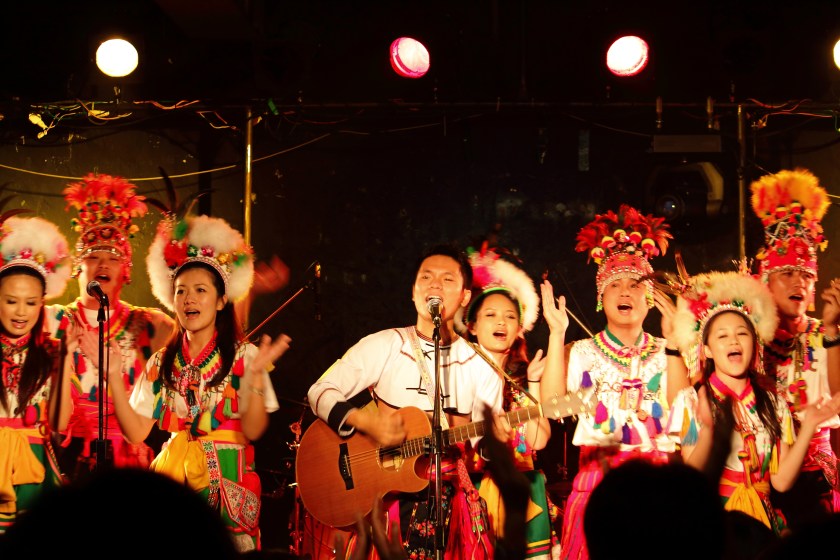
Image credit: Suming @ The Wall by square(tea)/Flickr, license CC BY 2.0 DEED.
Henry Wadsworth Longfellow famously wrote, “Music is the universal language of mankind.” However, in the field of music studies, this assertion has been heavily contested due to the unique social and cultural meanings produced in local contexts, often diverging from universality. Nonetheless, music, languages, and politics are frequently intertwined in complex ways. In many countries, top-down projects, such as music curricula in schools, actively shape how people relate to musical styles or predominant languages in songs.
In Taiwan, after the arrival of the KMT, languages other than Mandarin Chinese, including Taiyu (Taiwanese 台語), were restricted due to cultural policies under martial law (1949-1987). However, in recent years, there has been a growing number of musicians in Taiwan, such as Collage (珂拉琪), 阿爆 (A-Bao), ChuNoodle (春麵樂隊), and 桃子A1J, emerging and receiving critical acclaim for exploring linguistic possibilities outside of Mandarin.
Language Policies and Music in Taiwan: Past and Present
As Taiwan undergoes democratisation, efforts have been made to democratise both music and languages. The former involves the lifting of music censorship regulations; the latter includes promoting other national languages in Taiwan through education. To ensure the sustainable transmission and development of at-risk languages and cultures, the Taiwanese government declared indigenous languages and Hakka to be national languages in 2017, and in 2019, it further stipulated that the natural languages and sign languages used by the different ethnic groups in Taiwan are all considered national languages.
One unique aspect of Taiwan is how languages are intertwined with the perceptions of musical genres, especially for popular music, reflecting imbalances in resources and power within the music industry. The politicisation of languages affects the canonisation of music, as the Kuomintang (KMT) favoured Mandarin Chinese in education and media broadcasting. Mandarin Chinese was referred to as “the national language” (Guoyu / 國語), giving Mandarin popular music an advantage in industrialisation compared to music in other languages.
For instance, the history and changes of the Golden Melody Awards (GMA), originally established by the Governmental Information Office (GIO) in 1989 to recognise musical talents, have witnessed shifts in policy towards languages with its changing categories. The awards category for “The Best Guoyu Album” and “The Best Guoyu Male/Female Singer,” which stood for naming Mandarin as the sole national language, existed until 2021. Since then, the categories of Guoyu have been renamed as “Mandarin.” Additionally, categories such as “the Best Hakka Singer” were added in 2003, and “The Best Taiyu Album” was introduced in 2005. Even today, the GMA still categorise music in languages, including Mandarin (Huayu / 華語), Taiwanese (Taiyu / 台語), Hakka (客家), and Indigenous languages (原住民語).
Mandopop and Its Advantage in Industrialisation
Unsurprisingly, among various music genres and languages, Taiwan’s Mandopop has generated the most impressive sales as local repertoire and has become prominent in the PRC. Taiwan’s Mandopop dominated the PRC market from around the 1980s to 2000s. Many key artists influential in the Chinese-speaking communities worldwide since the 1990s were from Taiwan, including A-Mei Chang (張惠妹), Jay Chou (周杰倫), and Mayday (五月天), and all these megastars were signed by local record labels as they began their music career.
However, not only local record labels have contributed to local repertoires; transnational labels such as Sony Music have also recorded substantial sales. Artists such as Coco Lee or LA Boyz have had diverse experiences residing in multiple nation-states, and their audience spans regions. LA Boyz, also known as a successful Hip-Hop group, write, speak, and sing in Taiwanese.
From Indie to Multilingualism?
Indie music in Taiwan has a distinctive meaning and development from its origins, notably in the UK. The term “independent” or “indie” originated after the punk movement in the UK, when small record labels produced music proclaiming authenticity and alterity differing from “the mainstream.” “The alternative,” intertwined with “the independent,” is still powerful in invoking the notion of a more democratised cultural production. In Taiwan, where alternative distribution and expression of artistic freedom were limited during martial law, the term “indie” carries multiple layers of meaning. While signifiers of indie-ness include practices in smaller labels, spatial attributes, alternative sound, or ethos, what it means to be indie may be slightly vague but still functions as a prevailing term or marker employed by various stakeholders, from policymakers to industry workers to music audiences.
In recent years, the choice of languages has become more intertwined with indie narratives in Taiwan. While praised for representing Taiyu songs in the new era, the lead singer of the band Lilium (百合花) I-shuo expressed in an interview that he “does not pay attention to eras.” Common themes addressed by these musicians when speaking about their music include intending to connect with global audiences. The notion of reconnecting with local roots and innovatively crafting music that embodies both cultural and economic significance in international markets is not exclusive to Taiwan. Nations are engaging in widespread initiatives, including the creation of music export offices and offering subsidies for music production in local or minority languages. These efforts are aimed at balancing the cultural importance of music with its potential for export.
While the Taiwanese government actively supports popular music production, there has been criticism regarding how music funding in Taiwan now mainly centralises on governmental funding. While this may contradict some versions of independent ethos, the policy encourages the production of minority language music and creates space for further acknowledgement. Additionally, debates persist on how the GMA categories are arranged mainly according to music rather than genres and how this contributes to the canonisation of Taiwan’s music.
As streaming technologies and social media become ubiquitous, an aspect of the recording music industry has inevitably become transnational. Nevertheless, as the agenda of forging a national identity collides with the neo-liberal agenda promoting creative economies and their export against other nations and markets, key questions arise not only regarding the effectiveness of these policies but also how their effectiveness should be valued.
Placing Taiwan’s relevant music policy in the context of minority languages, one can discern notable intersectionality between that of Iceland and Wales. Music is not a universal language. In today’s Taiwan, however, languages are essential parameters of policymaking, identities, and categorisation in popular music. What is more universal, or perhaps more prevalent at least, is the choice of languages embodying cultural and political values. This choice signifies a positioning within the market, potentially opening gateways to opportunities, resources, or limitations.
Dr Chen-yu Lin is a Lecturer of MA Creative and Cultural Industries in the School of Journalism, Media, and Culture at Cardiff University. She is also a Non-Resident Fellow at the Taiwan Studies Programme, University of Nottingham.
This article was published as part of a special issue on “2023 to 2024: Looking Back, Thinking Ahead.”
 Taiwan Insight