
Written by Junwei Yu.
Image credit: 李洋/Lee Yang/ Facebook.
The ROC (Republic of China) in Taiwan had enjoyed two decades of international support as the government of “Free China” before 1971. This came to an end with complete victory for the Communist-ruled PRC (People’s Republic of China), which was officially recognised by the United States as the sole legitimate government of China in 1979. This shift had a domino effect on the International Olympic Committee (IOC), which had endorsed the Taiwan-based government.
Under the leadership of the IOC president, Juan Antonio Samaranch, the “two Chinas” problem became an important issue that needed resolution. Eventually, the executive committee of the IOC passed the “Nagoya Resolution”, through which the PRC would compete in the Games under the name “Chinese Olympic Committee”, while the ROC would use the name “Chinese Taipei Olympic Committee.” This so-called “Olympic Formula” not only stipulated the official name they used but also laid restrictions on Taiwanese athletes and spectators. Accordingly, ROC’s national anthem was replaced with the national flag anthem, and the delegation flag superseded the national flag. Today, international sports bodies adopt the Formula in matters concerning cross-strait relations.
The IOC has very explicit rules on athletes, venues, and official outlets, yet the regulations for spectators are relatively vague. In the 1983 World Taekwondo Championship, for instance, one Taiwanese athlete even had her gold medal cancelled because she waved the ROC flag in awards ceremony. Taiwan participated for the first time as Chinese Taipei, a nation that practically does not exist, at the 1984 Sarajevo Winter Olympics. At the 1997 Asian Baseball Championship, the first Chinese team sport took part in a Taiwan-held competition. Excited Taiwanese fans spontaneously hoisted national flags that drew protests from the PRC delegation leader, Wu Shaozu, who claimed Taiwan was in breach of the Formula. Subsequently, China suspended all national baseball teams coming to Taiwan.
However, Taiwanese politicians also interpret the Formula differently regarding fans in the stands. In 2001, Taipei mayor Ma Ying-jeou ordered citizens not to carry ROC national flags to the stadium where the Women’s Soccer Asian Champion was held, lest it violate IOC rules. Opposition parties and the public heavily criticised Ma’s decision. The Olympic Charter also states that political, religious or racial demonstrations in the Olympic areas are forbidden. Pro-independence supporters backed by Democratic Progressive Party politicians, who resent anything related to the ROC, prefer using Taiwan’s logo and image, which is seen as an act of violation of IOC rules. For example, the Asian Football Confederation fined the Chinese Taipei Football Association USD 5,000 in 2016 for allowing Taiwanese fans to hang a flag containing a map of Taiwan in Kaohsiung.
Handling the Formula regarding Taiwanese Fans in various Olympics
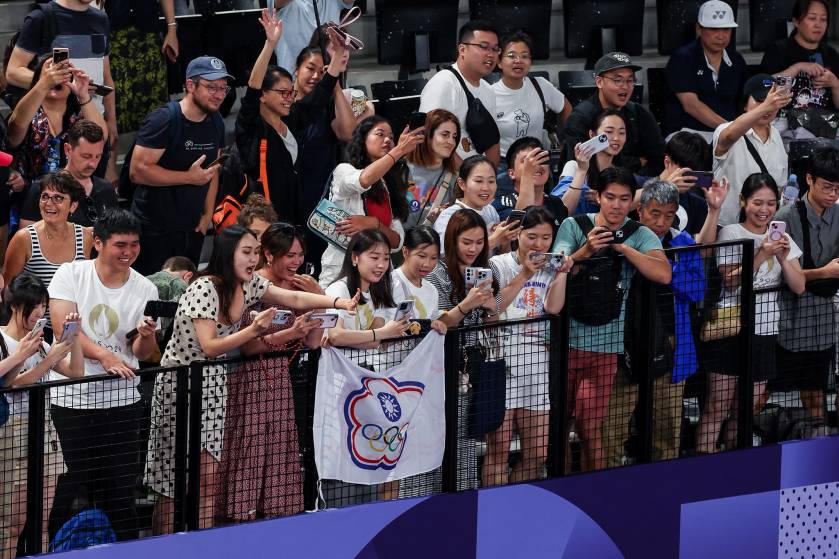
Reading between the lines of the Formula, Taiwanese, Chinese, and host countries have difficulties dealing with Taiwanese spectators’ improvised actions. Mayors and officials, regardless of ideological differences, in Taiwan have reached a consensus that national flags are allowed to be waved in the crowd at all international competitions held on the island; on the other hand, political wording and images that imply Taiwan will first receive warning from staff, and if persuasion fails, all related materials will be confiscated. The compromise allows the expression of Taiwanese identity while keeping Chinese Taipei’s membership intact.
The most extreme case occurred in the 2008 Beijing Olympics, where the officials exercised iron-fisted policy despite détente between the ROC and the PRC after pro-unionist KMT (Nationalist Party) candidate Ma Ying-jeou was democratically elected President. For instance, Beijing customs rejected the entry of one baseball diehard, Yang Hui-ji, who had been an avid advocate of Taiwanese awareness. One Taiwanese fan instead waved the national flag of Myanmar, which looked highly similar to that of the ROC, in the stands in order to circumscribe the Formula. Although Beijing police took notice, they could do nothing since the display of the Myanmar flag was entirely legal.
The Formula was handled quite differently in more neutral venues depending on security guards or enforcement officers. The most famous incident occurred in the 1996 Atlanta Olympics, where excited Taiwanese fans waved national flags during the table tennis gold finals. They were carried off by a security guard and spent a night in a police station for their actions. The Taiwanese government was very upset, calling for a public apology from the Organizing Committee for the Olympic Games, which was later rejected. Consequently, one person paid a USD 100 fine, and the other was released on a USD 800 bond.
Recent Incidents in the Paris Olympics
After a zero-spectator Olympics in Tokyo, the Taiwanese now have a perfect platform through which national identity can attract worldwide attention. Several crowd disturbances erupted, especially in the games of badminton that involved the eventual gold medalists Lee Yang and Wang Chi-lin. Meanwhile, Chinese fans were also fully prepared to counter Taiwanese actions.
A video that occurred during the semi-finals went viral. One Taiwanese fan who held a towel with the English word ‘Taiwan’ on it was confiscated by security staff, and another Taiwanese girl’s Taiwanese-shaped poster was forcibly snatched by an alleged Chinese national. A similar incident also happened at badminton’s awards ceremony. Those images certainly sparked an outcry among the Taiwanese public. Outraged by rude and barbaric behaviours, the ROC Ministry of Foreign Office issued a stern statement saying, “This violent act is not only ill-educated but also seriously violates the spirit of civilisation represented by the Olympics Games.” François Wu, Taiwan’s representative in France, also filed a complaint and reported it to the police.
However, the Organizing Committee still offered lukewarm and standard answers that stated, “Only flags of countries and territories participating in the Games are allowed.” The IOC and its endorsed international organisations have always adhered to the one-China principle, a stance that is unlikely to change in the foreseeable future.
Epilogue
Even though the compromise allows Taiwan to compete in the Olympics, it is increasingly starting to rankle among Taiwanese, who are more assertive of their identity and autonomy. The notion of Taiwaneseness is obviously on the rise after a series of Chinese oppression. Take the Chinese Professional Baseball League as an example. The championship finals were called the “Chinese Series” starting in 1990. It was changed to “Taiwan Series” in 2003. Today, the population of Taiwan overwhelmingly views itself as Taiwanese, not Chinese. Shortly after the Paris Olympics, one Taiwanese agency conducted an opinion poll, showing most people (39.9%) preferred using the name “Taiwan”, followed by “Republic of China” (22.8%), “Republic of China, Taiwan” (20%), and “Chinese Taipei” (8.8%), regarding the participation of Olympics. Taiwanese fans will continue finding creative ways to express their identity despite the straitjacket of the Olympic Formula.
Junwei Yu is a Professor at the National Taiwan University of Sport.
This article was published as part of a special issue on ‘Sports and Identity’.
 Taiwan Insight