
Written by Chieh-Ting Yeh.
Image credit: 戴資穎/ Tai Tzu Ying/ Facebook.
The spectacle of the Paris Olympic Games is just behind us, but what a summer it has been for Taiwan. Taiwan won two gold medals and five bronzes in the Paris Olympics; Taiwan also won two silvers and five bronzes in the Paralympics. But more dramatic than the wins are the controversies that Taiwanese athletes and fans had to contend with. Taiwan’s women’s featherweight boxer Lin Yu-ting faced malicious, unfounded allegations that she was a man. Taiwanese spectators in Paris routinely had their signs and cheering items confiscated or dragged out of the arena by security personnel. Not to mention that Taiwan cannot compete in the Olympics under either Taiwan or the name “Republic of China” nor fly its national flags. These occurrences are not simply the natural consequences of Taiwan not being widely recognised by the international community as a state. They are specifically designed by China as indignities to the Taiwanese people and nation, to stamp out anything that would make Taiwan seem like the country that it is. And international sports events, to China, are the perfect battleground to squash Taiwan’s national status.
International sporting events and China
The Olympic Games have always been a paradox in terms of what it means for the intersection of sports and politics. The modern Olympic games were, from the start, rooted as a movement to promote international peace and friendship—itself a goal as political as it gets. Baron Pierre de Coubertin, the co-founder of the International Olympic Committee, believed that when people from different nations come together to compete and bond over sports, it promotes mutual understanding and reduces mutual conflict. There is the “Olympic Truce”: a concept that calls for nations within a conflict to halt hostilities when they both compete in the Olympics. Furthermore, sports competitions can foster the noble notions of fair competition, excellence, and sportsmanship as values on which different people can build common ground.
However, these values do not come automatically. Global sporting competitions that group contestants into national units naturally invite nationalism and a primal instinct to compete with other nations. These sporting competitions can serve as simulated wars between states, as one state triumphing over another brings national pride and superiority to the victors and shame to the defeated. Therefore, while the Olympic Games can foster international goodwill and brotherhood, they can also amplify national conflicts and douse oil on a world that is already on fire.
That is what China has done with the Olympic Games. China’s outsized clout in the international community is widely recognised, but in recent years, China has increasingly used that influence to turn international fora and events for its national gain above fostering international values of freedom, equality, and human rights. The root cause is that China inherently does not believe in international values, which they label as “Western” and inherently at odds with Chinese-ness. China also sees the West as hypocrites, espousing their values as “universal” while carrying out subjugation and exploitation of peoples around the world, most importantly, of China in the 19th and 20th centuries. China uses this deep-rooted hatred and cynicism to rationalise its own behaviour: “If they can say one thing and do another, so can we.” This is in the service of seizing power and wealth from the West as a form of “retribution.” From this fundamental perspective, it is hypocrisy for the Olympic Games to proclaim the values of sportsmanship and global goodwill; China instead feels as if it must turn the Games into an arena for conflict where any way China can exploit can and should be exploited.
This is why China’s international sports programmes remain a relic of Soviet-era training that maximises gold medal count to “glorify” the mother nation at the expense of the athletes’ own well-being. Chinese athletes who fail are often derided as an embarrassment—gymnast Su Weide was accused by the Chinese social media as a “traitor,” even after Su’s apology. The Olympic Games enforce an unusually strict policy that prohibits any display of Taiwan in any form—not even allowing signs that depict the island’s shape. This has led to situations where some Chinese nationals have felt justified in harassing fellow spectators, even going as far as forcibly seizing their hand-made signs.
Taiwan in contrast
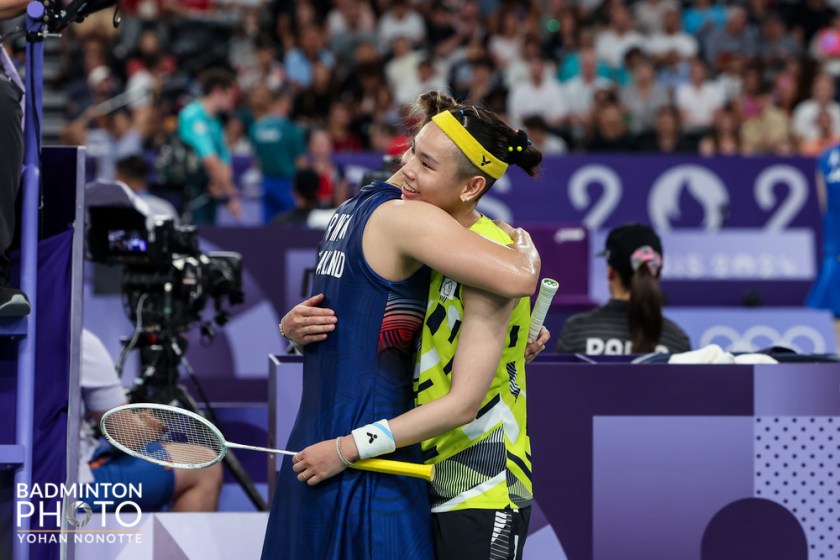
Fortunately, Taiwan stands as a stark contrast to China as to how a nation that also had been indoctrinated in the past as a victim of colonisation and imperialism can build a nationalism from the ground up that is quietly confident, tolerant, and aspires to the better instincts of humankind. When Taiwan’s reigning badminton star Tai Tzu-ying lost in Paris during the group stage, Tai and her opponent, Ratchanok Intanton of Thailand, congratulated each other in a tearful embrace in an exemplary show of sportsmanship. Taiwanese fans also reacted to Tai the opposite way of how the Chinese gymnast Su Weide was treated, with thousands of messages of encouragement and applause on Taiwanese social media. Taiwan’s main sports broadcaster commented, “Don’t cry, Little Tai, rest well and heal. We will support you to the fullest whenever you play.”
With the allegations of gender alterations against the boxer Lin Yu-ting, Taiwanese fans expressed their outrage indignantly but confidently, befitting a nation that elected a woman twice to the presidency with the highest total number of votes in history. Taiwan’s modern identity and nationalism were built on the foundation of freedom, equality and human rights, the exact values that China has cynically rejected. These are the values that also give rise naturally for a nation to aspire to sportsmanship and to resolve conflict through mutual understanding, the values that the Olympic Games were created to embody.
It is more important now than ever for the international community to condemn China’s ongoing behaviour and stand with Taiwan. This is especially true in the world of international sports, where China is driving the situation to a new low by transforming global sporting events into tools for advancing its political objectives. These actions undermine the integrity of international competitions, making it critical for the global community to push back against such tactics.
Robert Skidelsky, a member of the British House of Lords and Professor Emeritus of Political Economy at Warwick University, argued in a piece for Project Syndicate that the Olympic Games should actively tout the values that the Olympics claim to stand for. Taiwan is doing just that simply by existing.
Chieh-Ting Yeh is a venture investor in Silicon Valley and a director of US Taiwan Watch, an international think tank focusing on US-Taiwan relations. In addition, he is a co-founder and the editor of Ketagalan Media and an advisor for the Global Taiwan Institute and National Taiwan Normal University’s International Taiwan Studies Centre.
 Taiwan Insight