
Written by Yixin Xu.
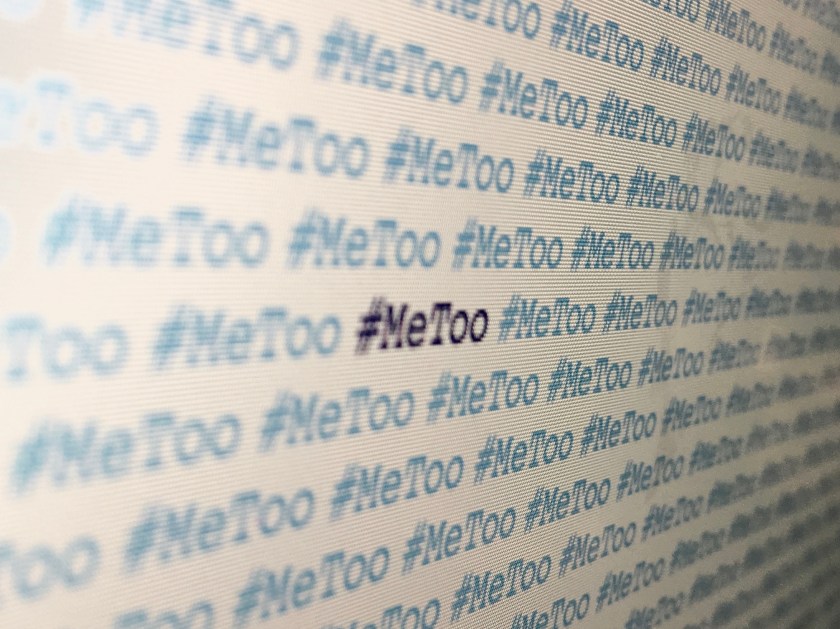
Image credit: Hashtag #MeToo (digital text pattern on RGB screen version 25) by Wolfmann/ Wikimedia, License: CC BY-SA 4.0.
It is never easy to introduce the novel Fang Si-Chi’s First Love Paradise to anyone. Even just summarising the book—a novel about “a girl falling in love with her abuser”—is heartbreaking. Adding to this tragedy is the fact that the story is almost autobiographical, and the author, Lin Yi-Han, ultimately committed suicide due to her own traumatic and torturous experiences. Yet, despite the pain it evokes, I cannot help but introduce this novel to others because it is a heroine’s work.
The novel was published in Taiwan in February 2017, and two months later, Lin Yi-Han was found hanged in her home. The novel and Lin Yi-Han’s reality are so deeply intertwined that it sparked vital discussions about how power inequity leads to sexual violence, how patriarchy as a systemic institution contributes to gender-based abuse, how East Asian cultural norms prevent victims from speaking out, and how the educational and legal systems fail to protect minors from sexual abuse.
The novel also played a significant role in inspiring the #MeToo in mainland China, Hong Kong and Taiwan. Many women who came forward to report sexual harassment in their workplaces or schools have expressed their gratitude to Lin Yi-Han, saying that her novel articulated and validated their experiences of suffering. For these survivors, Lin Yi-Han’s writing not only introduces their trauma to those who have not experienced it but also gives voice and legitimacy to their pain.
One of the reasons Lin Yi-Han wrote this novel was to let others know what had happened, to bear witness. Through the voice of the character Hsu Iwen, the author reflects on the act of writing, saying, “Writing isn’t for salvation, sublimation, or purification; it’s for the readers who won’t even need to experience anything to learn this world has a dark side.” In this way, the novel stands as an important contribution to the global #MeToo movement. As one of the first significant works in Chinese literature to expose the “dark side” of teacher-student relationships, the novel garnered widespread attention by addressing the often overlooked issues of sexual harassment and assault. These topics were typically dismissed with the excuse that rape is caused by a lack of control over male sexual desire.
After the publication of Lin Yi-Han’s book, survivors of sexual abuse began to refer to themselves as “Fang Si-Chi” and to their abusers as “Lee Guo-Hua.” This allowed them to speak about their trauma indirectly, finding it easier to use these names as proxies rather than recount their own experiences directly. In this way, Fang Si-Chi’s First Love Paradise became a reference point for survivors, offering them a language through which to express their suffering.
This is why I believe that with the recent publication of the English translation, “Fang Si-Chi” might replace “Lolita” as the literary symbol for a young girl involved with a much older and more powerful man. Vladimir Nabokov’s Lolita is narrated from the perspective of Humbert, a man who harbours sexual desires for his stepdaughter, Dolores, whom he calls “Lolita.” The story is about his self-defence, as he has already been arrested by the time the narrative begins. Lolita manipulates the reader into sympathising with Humbert by immersing them in his internal justifications and immoral desires.
In contrast, Fang Si-Chi’s First Love Paradise tells the story from the perspective of a wounded but deeply subjective young girl. Fang Si-Chi is not merely an object in someone else’s narrative; she is a complex individual with her pain, agency, and voice. Lin Yi-Han strips away the romanticised veneer of abuse seen in Lolita and instead reveals the raw emotional trauma of the victim. Through this portrayal, Lin Yi-Han dismantles the glamorised image of the predator and exposes the devastating reality of sexual abuse.
In recent years, we have seen more works that describe sexual abuse from the victim’s perspective, such as Know My Name by Chanel Miller in the US, Consent by Venessa Springora from France, and Black Box from Shiori Ito in Japan. These authors bravely share their traumatic experiences and expose systemic inequalities that enable the wrongdoing. Fang Si-Chi’s First Love Paradise achieves a similar goal, but it distinguishes itself by using a fictional narrative rather than a memoir.
While the works above employ a first-person perspective to recount the victim’s experiences, Lin Yi-Han’s novel presents sexual violence through multiple narrative voices: the perpetrator, the victims, and bystanders. This multi-layered narration sheds light on various facets of sexual abuse. Through Lee Guo-Hua’s internal monologue, we see the predator’s cold manipulation. Through Si-Chi’s thoughts, we understand how the abuse shatters her views on love and literature. And through the cram school manager, who facilitates Lee’s exploitation, believing it to be a necessary sacrifice to allow him to “teach” more students, we grasp how rape is more than a personal crime—it is a social murder.
The shifting narrative voices allow readers to maintain a certain distance from the characters while still engaging with their individual agency, prompting readers to make their judgments. In doing so, the novel challenges Lolita through a different storytelling approach, offering an alternative perspective on sexual abuse. With the recent English translation, Fang Si-Chi’s First Love Paradise enters the broader literary and academic discussions on trauma and memory writing. Whether examined through a sociological or literary lens, the English version offers a new way of understanding sexual abuse, providing a more balanced narrative to counter the previously one-sided portrayals. The English translation expands the novel’s reach, allowing readers outside Taiwan to recognise the global relevance of its themes of patriarchy, sexual violence, and societal silence. By addressing these universal issues, Fang Si-Chi’s First Love Paradise bridges cultural divides, bringing Taiwanese literature into dialogue with global feminist discourse.
I believe this was Lin Yi-Han’s intention—to engage in dialogue with other literary masterpieces. She described the rape of Fang Si-Chi as “the largest-scale massacre in human history” instead of Auschwitz, as Primo Levi proposed. By comparing the dehumanisation of sexual violence to that of war crimes, Lin Yi-Han evokes what Levi called the “grey zone,” where prisoners are often coerced into collaborating with the Nazis.
One of the most heartbreaking moments in the novel is when Fang Si-Chi persuades herself to love her abuser:
“After thinking for days, I’ve figured out the only way forward. I can’t just like Teacher Lee, I have to love him. Your lover can do anything to you, right? Thoughts are such powerful things! I’m a counterfeit of my past self. I have to love Teacher Lee or I’ll be in too much pain.”
“想了這幾天,我想出唯一的解決之道了,我不能只喜歡老師,我要愛上他。妳愛的人要對妳做什麼都可以,不是嗎?思想是一種多麼偉大的東西!我是從前的我的贗品。我要愛老師,否則我太痛苦了。”
To live with the shame, Si-Chi has to convince herself that she is in love with Lee Guo-Hua. Only by doing so can she maintain some sense of internal consistency. Thus, the “massacre” metaphor refers to the total dehumanisation of Fang Si-Chi; the rape shatters her moral compass and destroys her beliefs in love, beauty, and truth. In other words, she lives in a “grey zone” where moral judgments cannot be made based on simple binaries. The victim’s submission to the perpetrator is far more complex than it appears—it is a combination of guilt, self-denial, loss, and a desperate attempt at self-preservation. This complexity is universal; it saves the victim but also destroys her.
As readers, it is easy to conclude that complexities are part of human nature. However, for Lin Yi-Han, writing about rape dismantled her belief in literature and language. The novel’s elegant style, which not only includes poetic reflections on Si-Chi’s thoughts about love, sex, and desire but also Li Guo-Hua’s embroidered words and detailed descriptions of the sexual abuse, struck Yi-Han as deeply immoral. She saw her own writing as disgraceful. In an interview, she asked, “Is literature just wordplay?” For her, writing about evil in such an aesthetically pleasing manner felt like a betrayal of language and literature.
This dilemma is reminiscent of a recent controversy involving Nobel laureate Alice Munro. It was revealed that Munro’s second husband, Gerald Fremlin, was accused of sexual abuse, and Munro herself was criticised for not standing up against him. This revelation shocked many readers who had long seen Munro as a feminist writer. It reminds us that while language can be beautifully woven, it cannot always guarantee moral integrity. But if we cannot fully trust literature or language, how should we read? This question goes beyond discussions of gender, violence, and culture—it challenges us to reflect on the role of literature in an ever-evolving society and the moral ambiguities of both writing and reading.
Literature may not provide a definitive answer to these questions. However, if our souls still resonate with Fang Si-Chi’s suffering, then literature continues to tell us something vital.
The English translation of Fang Si-Chi’s First Love Paradise, translated by Jenna Tang, was published by HarperVia in May 2024. Translator Jenna Tang is currently holding a fall book tour in North America. Please see the tour schedule here.
Read another article on Fang Si-Chi’s First Love Paradise published on Taiwan Insight on 10 July 2024 here.
Yixin Xu is a PhD candidate in the Department of Comparative Literature at the University of California, Riverside. Her research areas include 20th-century Chinese literature, Taiwan cinema, and modern Chinese culture. With a focus on feminist theories, emotion studies, and medical humanities, her interdisciplinary approach delves into the intricacies of Chinese literature and cultural discourse.
This article was published as part of a special issue on ‘Global Taiwan Literature’.
 Taiwan Insight
.jpg)