
Written by David O’Brien.
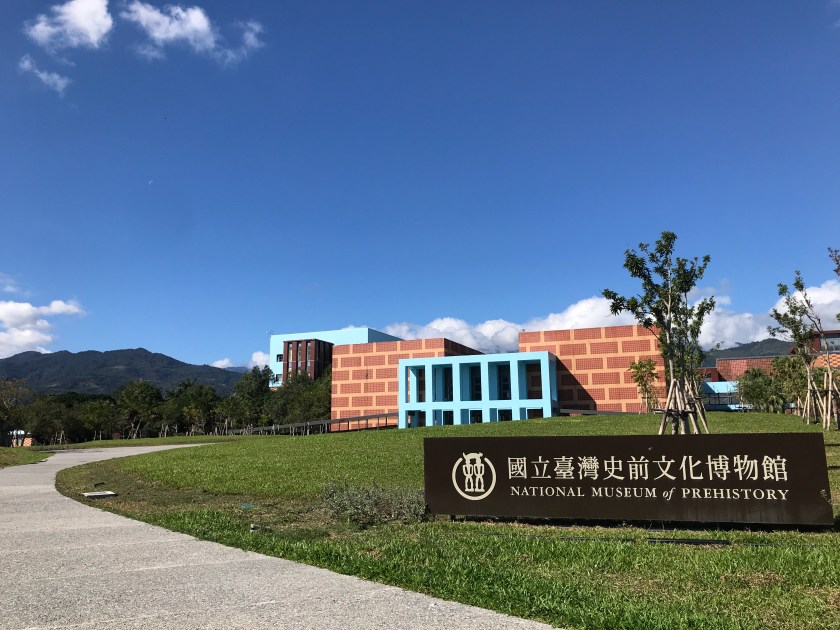
Image credit: The building exterior of National Museum of Prehistory, Taiwan (2023) by AnthroCC / Wikimedia, license: CC BY-SA 4.0.
Some years back, my wife and I spent a few days in the lovely city of Taitung on Taiwan’s dramatic southeast coast.
There is much to recommend in this place where the mountains sweep down to the sea, and huge waves crash onto rocky shores.
Taitung’s Museum of Prehistory is well worth a visit, fascinating for many reasons, not least the exhibition on Taiwan’s indigenous people. As two academics working on ethnic minority identity in the PRC, in particular, how official narratives of ethnic otherness are created and controlled by the CCP, we could not pass up on a visit.
Any exhibition of ‘Indigenous people’ will always be problematic in some ways, and such an exhibition housed in a “museum,” especially one devoted to “pre-history,” obviously raises lots of questions. That said, we found it fascinating in terms of how the Indigenous peoples and culture were depicted, especially in how it differed from the PRC, where the complexity of history has been rendered into a simple story of happy minorities expressing their joy and delight at being part of the great Chinese nation. A simple, happy, and grateful people.
Certainly, the Taitung museum attempts a more complex narrative which at least acknowledges some of the darker side of Taiwan’s past. That said, much of what we saw emphasised music, culture, and costume.
After the exhibition, we stopped for lunch at the small museum restaurant, which advertised “Indigenous food.” It was delicious, and the dishes, beautifully flavoured and presented, were described in detail by the friendly waitress who told us she was Amis and seemed keen on sharing her culinary traditions with these two foreigners. As we were the only two people in the restaurant, she had time to chat.
My wife and I had lots to talk about over our roast boar and bamboo-tube rice, not least the power of food to both unite and divide. I have spent many years in Xinjiang, where every aspect of life, even the time on the clock, is politicised and divided by ethnicity. In Xinjiang, Han people use Beijing time and Uyghurs use local time. Han people eat Han food, and Uyghur people eat Uyghur food. The joys of sharing food are rare; in fact, dietary habits and religious rules are often given as reasons for not interacting with ‘the other.’ In Xinjiang, food is absolutely political, it divides rather than unites, a small but real tragedy in a heartbreaking region.
Yang Shuang-zi’s food tour in Taiwan Travelogue reminds us of the deep and complex relationship between food and colonialism. It’s a relationship visible the world over. In the city I live in, Krakow in Poland, huge numbers of British tourists on weekend breaks flock to excellent Indian restaurants because they are familiar, they are a taste of home. British customers are always the majority in these Polish Indian places. Perhaps not so surprising when we think of how the Chicken Tikka Masala – which was invented by a Pakistani chef in Glasgow – has long held the position of national dish in Britain.
In the PRC, there is hardly a city that does not have a Uyghur restaurant, where alongside delicious grilled lamb kebabs, pulled noodles and huge plates of mutton and rice polo, you can watch dancing Uyghurs twirl and swirl under pictures of camels and far away mountains.
Such places are complex, challenging, and, for many Uyghurs, insulting cultural appropriations. They are also, however, places of agency. Many, though certainly not all, are Uyghur-owned. They are businesses where people are trying to make a success of their lives, navigating a system where being Uyghur is complex, fraught, and dangerous.
There are just as many, if not more, Taiwanese places in the PRC, from cheap noodle joints to high-end dining. These are also complex sites of adaptation and contestation where the fraught question of authenticity often arises.
Was our meal in the Taitung Museum of Prehistory authentic? The little restaurant wanted you to think it was. The waitress wanted us to think it was. Did that make us feel better, more cultured, more knowledgeable? It probably did. Did it make the food nicer? Hard to say. I used to eat in a ‘Uyghur’ restaurant in the coastal city of Ningbo that served fresh sea fish. Being thousands of kilometres away from the nearest ocean, Xinjiang is not known for its seafood, but that is what Ningbo people want to eat, and it has to be said that the food there is great.
The Oxford English Dictionary added the term ‘Spice Bag’ to its latest update. What’s a Spice Bag? Well known in Irish Chinese takeaways, it is a delight of chips, fried chicken covered in chilli powder, usually served with curry sauce. It should not be confused with the other great Irish Chinese standard, the celebrated “three in one” – egg fried rice, chips, and curry sauce.
I grew up in a small town in rural Ireland that had a population of 3,000 people and five Chinese takeaways. It might be a simplification to say that the “three in one” set me on the road to being an anthropologist in China, but it certainly played a part. I have been trying to understand authenticity ever since.
That’s before we even start to discuss the “five in one” – fried chicken, chicken balls (whatever they are), fried rice, chips, and curry sauce. It does go down easier than it sounds after a few pints of Guinness.
My wife and I were talking about all this as we walked around Taitung. Stopping on the beachfront promenade, we noticed a compass star laid into the ground of a pavilion that included arrows pointing to Fiji, Japan, Australia, Indonesia and so on. Politics on the boardwalk, that’s for sure. Austronesian Taiwan is as problematic as any other historical generalisation but is certainly an interesting counterpoint to RRC historical narratives.
Food for thought as we walked through Taitung’s night market before stopping to have what we both agreed was the best Japanese meal we have ever had outside of Japan.
Dr David O’Brien is a Marie Skłodowska-Curie Fellow at the Centre for International Studies and Development, Jagiellonian University in Krakow, Poland. He was formerly at Ruhr University Bochum in Germany and at the Chinese campus of Nottingham University. His work explores ethnic identity and ethnic policy in the People’s Republic of China and Taiwan.
His research has appeared in China Quarterly, International Politics, Journal of Current Chinese Affairs, and Asian Ethnicity, among others. He is co-author with Melissa Shani Brown of People, Place, Race, and Nation in Xinjiang, China: Territories of Identity. Palgrave Macmillan, 2022. He is also a frequent contributor to international media. He has appeared in The Diplomat, Financial Times, Reuters, Washington Post, AP, Deutsch Welle, Irish Times, RTE Radio and Television (Irish national broadcaster), Global and Mail, among others.
This article was published as part of a special issue on ‘Mapping Taiwan: Literary Paths and Real Journeys‘.
 Taiwan Insight