
Written by Lorraine Pan.
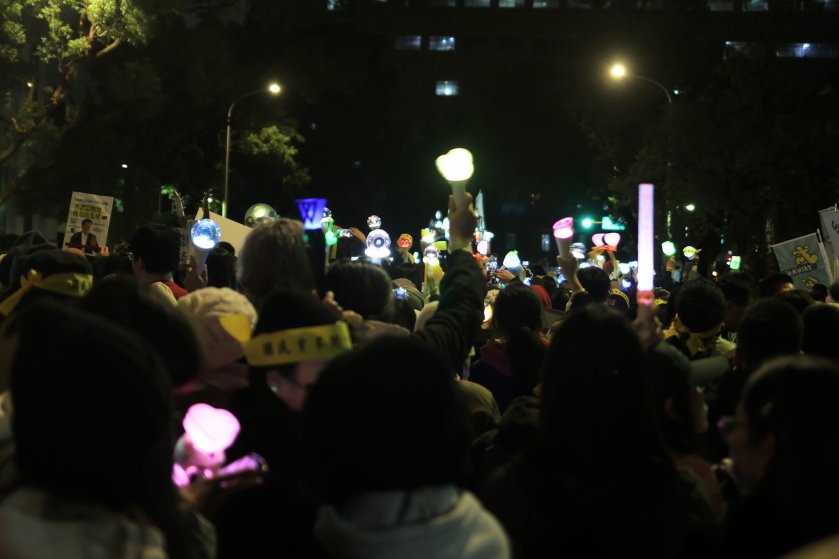
Image credit: Sophie (@Sophie_22JAN on X).
‘One core of fan culture is identity,’ said a march participant with a lightstick on stage.
In May 2024, a large-scale protest broke out in Taiwan against several bills in the Legislative Yuan and the unconstitutional deliberation process. The movement became known as the ‘Bluebird Movement’ (青鳥行動, Qingniao Xingdong). In December of the same year, to protest against the opposition Kuomintang and Taiwan People’s Party’s forced amendments to bills, raising the threshold for removal from office, revising the budget, and constitutional litigation, Taiwanese people gathered outside the Legislative Yuan in Taipei for another large-scale protest and march. This continuation of the May Bluebird Movement has been dubbed the ‘Winter Bluebird Movement’ (冬季青鳥行動). Unlike the Bluebird Movement in May, many lightsticks represented K-pop fans’ identities in the winter procession.
Lightsticks are one of the characteristic symbols of Korean pop culture, often used to support Korean idol artists and groups. In the early days of idol fandom, specially designed lightsticks were not available, and fans often used basic coloured glowsticks at concerts to show support for their favourite idols. However, in recent years, entertainment companies have developed custom lightsticks specifically designed for individual idol artists and groups, serving as symbols of fanbase unity and group identity at concerts. This practice of custom lightsticks has gradually spread beyond its origins, influencing idol culture throughout Asia, particularly in neighbouring countries such as Japan. The trend continues to grow in popularity, becoming an increasingly significant element of the modern fan experience across the region. As the influence of K-pop culture rises, fans in other countries also use specific lightsticks to show their support for their idols. Outside of concerts, the lightsticks have become an important identification and memento among the fans’ community.
The lightstick culture is now being applied to the Bluebird Movement. K-pop fans are using a culture of support for their idols to express their fight for democracy and their opposition to authoritarianism on the streets. ‘One core of fan culture is identity,’ said a march participant with a lightstick on stage. Fan groups in Taiwan post photos and videos of lightsticks in the protest march online, and it has become a hot topic on social media platforms. People use the tag #TaiwanIsMyFavourite (我的本命是台灣) to show their support for Taiwan with the slogan of supporting their idols.
Fan Culture and Democratic Movement
During the Bluebird Movement in May 2024, large groups of people did not widely use lightsticks. Before the Winter Bluebird Movement, there was a martial law crisis in South Korea when then-President Yoon Suk Yeol imposed martial law on December 3. After members of the National Assembly called an emergency meeting and voted against martial law to resolve the crisis, people spontaneously organised an impeachment meeting to demand the impeachment of the President. As a pop culture power nation, South Koreans have come out in different groups and identities to express their opposition to President Yoon Suk Yeol. Among them were many K-pop fans who used lightsticks to express their political views at the gathering. At the same time, people played and sang songs by different pop bands and artists, expressing their voices through the music.
This culture of resistance influenced the Winter Bluebird Movement, which also took place in December. The Bluebird Movement took place in Taiwan, a country geographically close to South Korea, close in time, and both countries have large communities of K-pop fans. K-pop fans in Taiwan saw the power and possibility of expressing themselves as fans in Korea and took to the streets with lightsticks. In some media, this has been called the ‘K- resistance culture.’
As the fans mentioned above, one core of fan culture is identity. Support for an idol comes from recognising the fans’ identity, whereas support for democracy shows a recognition of the nation’s identity. Fans – who love their idols – want to use their voices to express their support and love for their idols, and citizens who use lightsticks to fight for democracy also wish to defend their country’s democracy in this way. People appeared as a unified and organised group and took to the streets with lightsticks as symbolic identity objects to show that they had a common national identity. Another implication is that the lightsticks are a memento to be treasured by fans. Except for special occasions such as concerts, lightsticks are often well-preserved at home. People’s use of the lightsticks is a sign of the seriousness of the situation and the importance they place on the march and political expression. It is a genuine and sincere expression of support for democracy that people use their most cherished objects.
In addition, it has been suggested that love will become a force. People love democracy, so they show their defence of democracy with their love lightsticks. People who come together for love come together to show their care and support for each other with slogans and lit lightsticks. To a certain extent, the atmosphere’s warmth dissolved the political depression, and the expression of love has become a positive force.
Impressive Appeal and Community
Even though no single authoritative organisation published a specific campaign, there was still a high concentration of people on the streets using lightsticks, a decentralised movement. The fans raised money in just a few hours to buy an LED truck that was used to broadcast images and show support for democracy as a fan group. In the idol culture, using the video playing on the LED truck to show support for the idols is also part of the support. In the Bluebird Movement, the fan community is demonstrating an innovation in the use of support culture to express political views. Moreover, the speed of the fundraising also demonstrates the strong financial, organisational, and cohesive power of the fan community.
In the past, there has often been a bias against the K-pop fan community, with the perception that fans are childish, irrational, or unconcerned with actual serious issues. In this movement, the political expression of K-pop fans is a powerful break from this prejudice. People even explained why the bill was harmful to the public from the fans’ point of view. This kind of identity-specific political expression not only shows that the fan community has mature insights and powerful actions on the issues but also refutes the bias beyond the community and makes people pay attention to the fan community and take them seriously. In this way, the visibility and voice of the fan community was enhanced in this movement.
On social media platforms, K-pop fans who participated in the march proudly shared photos and images of the rally. Some fans even wrote posts about it in Korean to express their tribute and respect for the K-pop community.
Although the Bluebird Movement was mainly held in Taipei, people also took to the streets in other cities in Taiwan, such as Taichung, Taoyuan and Tainan, to support the Bluebird Movement. Many K-pop fans also showed their support by using lightsticks, which were lit up, placed together, photographed, and expressed their opinions. In addition, there were also some derivative paintings to record these touching scenes.
Domestic and International Reactions and Media Coverage
In December, the opposition Kuomintang, one of the main supporters of the bill and a target of public outcry, called the fans who took to the streets ‘psycho/mad people.’ This statement was heavily criticised. In the past, stigmatisation and discrimination against the fan community were common. In this case, the discrimination against the fan community was linked to politics. Other people not from the fan community also expressed their support and praise for the fan community. This breakdown of discrimination has brought people together.
In Taiwan, the news media have noticed the K-pop fan community in the march and have reported on them many times. In some pro-march political programs, the hosts even conducted interviews with lightsticks to show their support for the K-pop fan community participating in the marches.
Not only that, but JTBC News, one of the biggest news media outlets in Korea, also reported on K-pop fans at the Taiwanese march. Under the headline ‘ “Korean Resistance” Spreads in Taiwan,’ it claimed, ‘This is a force for protecting democracy.’
Some Korean netizens noticed the social ecosystem in Taiwan and reposted some of the posts on Korean forums, leading to some discussions. In the Korean discussions, many Korean users expressed their support for Taiwan’s democracy. For example, in the comments section of a video about Taiwan’s democracy movement uploaded by JTBC News on YouTube, there were many messages in Korean expressing support for the Taiwanese community.
Among the discussions in Korea about the Bluebird Movement in Taiwan, there is also some confusion among the people. For example, why do Taiwanese people choose to use lightsticks that support Korean idols instead of their own country’s lightsticks? This question comes from language barriers and cultural differences. Korean pop culture has a huge influence throughout Asia and the world, including Taiwan. In recent years, more and more Korean artists have been going to Taiwan for concerts. K-pop fans in Taiwan are gradually growing and becoming a huge community and market. K-pop fans in Taiwan are one of the most important groups of the Taiwanese population. Their collective and iconic presence in this movement shows they are an important part of Taiwan’s civic and political concerns. In addition, the lightstick culture is mainly targeted at Korean idols, and there are not many idol groups using lightsticks in Taiwan, not like in Korea. As a result, the lightsticks that appeared in the procession mainly supported Korean idol groups, while other communities in the march did not have such a symbolic item.
There is a misconception that the ruling party in Taiwan, the Democratic Progressive Party (DPP), supports martial law in Korea and that by using lightsticks to support the ruling party, Taiwanese people indirectly support martial law in Korea. The notion that Taiwan’s ruling party, the DPP, supports martial law in Korea comes from a post on Threads by a DPP caucus. In the post, the editor of the caucus incorrectly made an analogy between the situation in Korea and Taiwan, which led to the misinterpretation that the ruling party supports martial law in Korea. As a result, the post received a lot of criticism from DPP supporters. Afterwards, the caucus deleted the post and made clarifications. A few DPP politicians made public statements to correct this mistake and made clear their firm opposition to martial law. As the country with the second-longest period of martial law in modern history, Taiwan has gone through a painful history during the White Terror, and the vast majority of its people are against martial law. In fact, we can see that before the Winter Bluebird Movement, there were many K-pop communities in Taiwan who translated news, wrote posts, and drew pictures to show their support for democracy and the impeachment rally in Korea.
K-pop fans are a force to be reckoned with in the march of resistance. The K-pop fans’ lightsticks not only light up the voices within the community but also warm the hearts of everyone in Taiwan during the march.
Lorraine Pan (they/them) is currently a student specialising in Women and Gender Studies at the University of Toronto. Beyond being a student, they are also a transnational feminist, activist, and writer with a focus on racial and gender equity. They can be reached at 1lorrainepan@gmail.com.
 Taiwan Insight