
Written by Elaine Chung and Qipeng Gao.
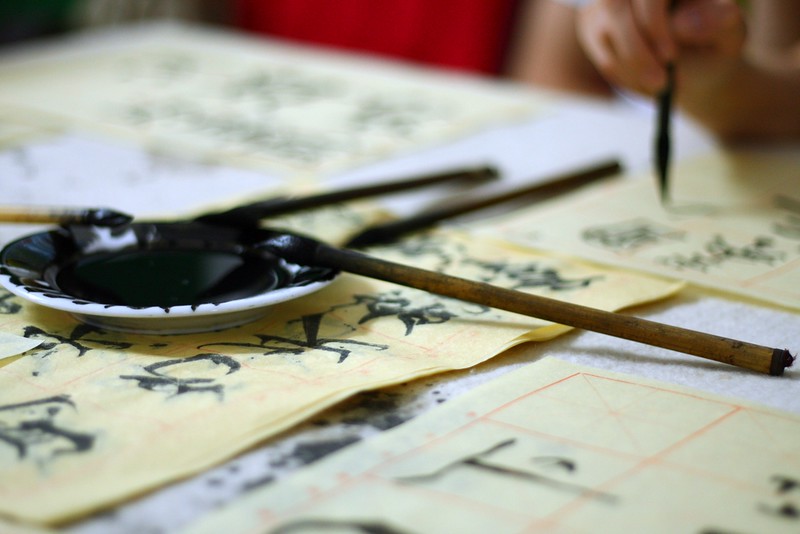
Image credit: Chinese Caligraphy Lesson by Matt/ Flickr, license: CC BY-NC-SA 2.0.
Introduction
Recent years have seen Taiwan’s turn to cultural diplomacy to assert its international presence as a de facto state with limited formal diplomatic recognition, facing mounting geopolitical pressure from China. Under Tsai Ing-wen’s presidency, the promotion of Mandarin education abroad has become overtly politicised and key in Taiwan’s cultural diplomacy. With a specific focus on Europe and university-level collaboration, the launch of the Huayu 2025 initiative (華語教育2025計畫) bore the aim to portray Taiwan as an open, liberal and democratic society in contrast to the authoritarian China, particularly among students from Western democracies. This aim clearly signals Taiwan’s shift from simply expanding its Mandarin education industry to actively using language education as a vehicle for soft power.
Taiwan’s emphasis on Mandarin education abroad is accompanied by the growing distrust of European universities towards Confucius Institutes, the Chinese government-backed centres for Mandarin language teaching, seeking to replace them with Taiwan alternatives. Similar efforts are seen in the United Kingdom, a main source of European students enrolling in university-affiliated Mandarin language centres in Taiwan, with 584 UK students registered in 2023. Members of Parliament have held discussions with Taiwanese officials about bringing Mandarin teachers from Taiwan to British schools, as part of broader efforts to phase out the Confucius Institutes. In response, Taiwan has widely offered several programmes and scholarships, e.g., the Taiwan-Europe Connectivity Scholarship, to UK students, encouraging and supporting them to study Mandarin in Taiwan.
But how effective is Taiwan’s approach to promoting soft power through international language education? Longitudinal research conducted by the authors suggests a complex picture. We conducted in-depth interviews with thirty UK university students majoring in Chinese Studies about their attitudes toward the Taiwanese variety of Mandarin, including traditional Chinese characters, and their perspectives on studying in Taiwan. Notably, twenty-two of them had either already spent their Year Abroad, an integral part of their degree programme, in Taiwan or were preparing to do so. Some of them chose Taiwan rather reluctantly during the Covid-19 pandemic, primarily because China’s borders were closed then. We explore how their views evolved over time, particularly before and after their Year Abroad experience in Taiwan.
The Democracy Paradox
Taiwan’s soft power strategy hinges on projecting itself as a democratic and liberal society distinct from China, with the hope that shared political values will attract students from Western democracies. To some extent, this narrative resonates. Many UK students associated Taiwan with openness and freedom, often citing legalised same-sex marriage and the absence of the Great Firewall as markers of a liberal society. However, these impressions are typically formed before students engage with Taiwanese Mandarin or spend time in Taiwan, shaped more by broader media and political narratives than actual language learning experiences.
Paradoxically, Taiwan’s democratic image sometimes undermines its appeal as a Mandarin language learning destination. The association between democracy and “Westernisation” leads some students to expect Taiwan to feel familiar—modern, English-speaking, and culturally aligned with the West. This familiarity is largely perceived to lessen the “authenticity” of the language-learning experience, with many students, while recognising Taiwan as distinct from China, questioning its relevance to their study of Chinese language and culture. Despite concerns about China’s human rights record, students frequently described China as the more “natural” learning destination—a perspective reflected further in how China, when its borders reopened after the COVID-19 pandemic, immediately resumed its position as the overwhelmingly favoured Year Abroad location.
A Questioning of “Chineseness”
Notably, students often enter their programmes with essentialist views that conflate Mandarin Chinese exclusively with the geopolitical entity of the PRC. However, these perspectives often shift after studying in Taiwan, particularly through exposure to traditional characters, which many students come to associate with a deeper and more nuanced understanding of Chinese cultural history. Despite this linguistic appeal, Taiwan’s current cultural diplomacy has largely overlooked it. As a result, students tend to recognise the richness of the Chinese language and culture in Taiwan only after their Year Abroad. This indicates a misalignment in Taiwan’s soft power strategy. While students ultimately appreciate Taiwan’s ability to offer a pluralistic and historically grounded perspective on Chinese, this unique strength has not been effectively communicated or leveraged early enough to influence their choices of study abroad destination.
These observations point to the contested and often inconsistent framing of “Chineseness” within Taiwan’s own identity politics. While both Kuomintang (KMT) and the Democratic Progressive Party (DPP) see democracy as central to defining “Taiwaneseness”, they diverge on the question of cultural representation. The KMT has historically portrayed Taiwan as the guardian of traditional Chinese culture, preserving what was lost under Communist rule, whereas the DPP has positioned Taiwan as a multicultural society encompassing Chinese culture. The students’ questioning of Taiwan’s relevance to Mandarin learning thus reflects the nation’s self-questioning of Taiwaneseness vis-à-vis Chineseness—and Taiwan needs a clearer and more consistent articulation of the latter to embrace both its cultural continuity with the broader Sinosphere and its distinctiveness as a democratic, pluralistic society. Only by reconciling these elements can Taiwan project an equally compelling destination for Mandarin education as the currently dominating China, with its relevance to and enrichment of Sinitic culture more effectively conveyed to foreign learners.
Soft Power Meets Hard Reality
While Taiwan seeks to promote its political values through Mandarin education, the impact of this approach on UK students is limited. Decisions between Taiwanese or mainland Mandarin, or studying in Taiwan versus China, are often shaped by more pragmatic considerations, such as perceived academic or career advantages, than by ideological recognition. Many students remained critical of China’s political system, yet still preferred to learn mainland Mandarin, often with a simple rationale: as China is a global superpower and the world’s second-largest economy, proficiency in mainland Mandarin and experience living in China could open up better career opportunities.
This pragmatic take on Mandarin learning reflects a deeper challenge in Taiwan’s soft power strategy, namely that its limited hard power inevitably constrains its ability to project soft power. While Taiwan works to brand its Mandarin education as a progressive, liberal alternative, it struggles against the gravitational pull of China’s global economic and political dominance. To better address students’ practical concerns and overcome this continuous structural limit in the global educational market, Taiwan’s language promotion efforts could shift to highlighting specific, tangible career pathways in Taiwan’s own industries.
The Marginalisation of Taiwan in Local Curricula
Underlying students’ essentialist and pragmatic approaches to Mandarin learning is a structural bias within UK higher education, where curricula remain overwhelmingly centred on mainland China. Simplified characters and mainland Mandarin are the default, while traditional characters and Taiwanese Mandarin are marginalised, if included at all. Consequently, students lack awareness of Taiwanese Mandarin and rarely consider Taiwan as an ideal, or even possible, destination for studying the language. Even among those who developed an appreciation for Taiwanese Mandarin during their Year Abroad in Taiwan, few sustained this interest upon returning to the UK. Faced with final-year courses that exclusively use simplified characters and mainland Mandarin in the UK, students feared that navigating both systems might negatively affect their grades.
The dominance of mainland Mandarin in UK higher education not only limits students’ choices but also weakens Taiwan’s broader soft power efforts. More coordinated outreach efforts beyond scholarships are needed, ones that work with university departments, curriculum developers, and teachers to increase the visibility and accessibility of Taiwanese language and culture in UK Mandarin classrooms. Introducing Taiwan-related content early in the learning process can help ensure that students are informed enough to see Taiwan as a viable and meaningful study destination. Taiwan’s soft power strategy must include not just language education promotion, but deeper engagement with local education systems and non-state actors.
Concluding Remarks
Taiwan’s active promotion of Mandarin reflects its ambition to mobilise the language as a cultural resource that projects value-based soft power, emphasising its democratic and liberal identity as distinct from China on the international stage. Yet, this approach faces complex challenges. While Taiwan’s appeal to Western students as a fellow democracy resonates, it paradoxically creates expectations that clash with the “foreign” language immersion experience many learners seek. Taiwan’s limited hard power relative to China also renders the nation less appealing to UK students, who often prioritise practical benefits such as career and academic prospects over political values. Moreover, the long-established mainland-centric curricula in higher education restrict students’ exposure to Taiwanese Mandarin, limiting Taiwan’s visibility and ability to attract learners. To fully realise its soft power potential, Taiwan must balance value-driven appeals with a clearer and more consistent articulation of its Chineseness vis-à-vis China’s, offer clear practical incentives, strengthen partnerships with educators abroad, and advocate for curriculum reforms that give Taiwanese Mandarin a more prominent role in foreign language education.
Acknowledgement
We thank Xiaoli Wu and I-Ting Kao for their valuable contributions to the research that informed the findings presented in this article.
Authors
Elaine Chung is a lecturer in Chinese Studies at Cardiff University. She holds a PhD from the School of Oriental and African Studies, University of London. Her research focuses on cultural politics in East Asia, with interdisciplinary work exploring the intersections of cultural production, identity, and geopolitics. Contact: ChungE@cardiff.ac.uk
Qipeng Gao is a lecturer in Translation Studies and Chinese Studies at Cardiff University. He holds a PhD from the School of Modern Languages, Cardiff University. His research focuses on video game localisation and storytelling, with an interest in media products and their societal impacts. Contact: GaoQ6@cardiff.ac.uk
This article was published as part of a special issue on ‘Taiwan Research Hub Early Career Scholars Workshop‘.
 Taiwan Insight