Small Step from You, A Great Leap for Migrant Workers: Documentary, ‘Civil Society’ and ‘And Miles to Go Before I Sleep’ (2022) 

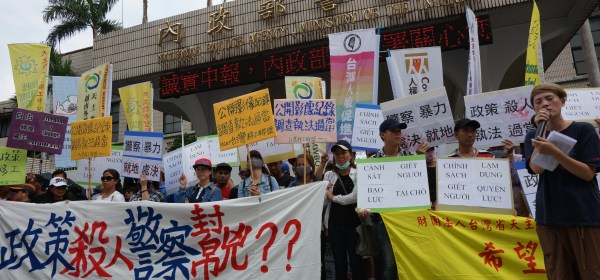
Written by Hsin-Chin Evelyn Hsieh. The award for the best documentary feature at the 59th Golden Horse Awards held in November 2022 in Taipei, Taiwan, went to And Miles to Go Before I Sleep (2022), directed by Tsung-Lung Tsai. At the ceremony, film producer Kim Hong Nguyen, dressed in the Vietnamese traditional garment áo dài, read out a message from Quoc Phi Nguyen’s family expressing their grief and hopes. It was the first time a documentary on migrant workers was presented with the Golden Horse Award, thereby creating a platform for voiceless migrants and drawing attention to the related issues in mainstream society. 

Her journey to the Best Actor award: Taiwanese Opera performer Chen Ya-Lan made the history 

Written by Jasmine Yu-Hsing Chen. October 22, 2022, outside the Sun Yat-sen Memorial Hall in Taipei, ​Taiwanese Opera performer Chen Ya-Lan (陳亞蘭) astonished audience members on the red carpet for the ​57th Golden Bell Awards (GBA). This annual award honours excellence in television and radio programs created in Taiwan. As a female performer, Chen broke records with her Best Leading Actor Award nomination.

The Long and Unfinished Fight: The Constitutional Court’s Decision on Pingpu Recognition in Taiwan

Written by Wei-Che Tsai; Translated by Yi-Yu Lai. The case of Indigenous status for Siraya people has challenged Indigenous peoples’ composition and boundaries. Currently, around 580,000 Indigenous peoples are legally recognised in Taiwan. It is estimated that the population of the Pingpu peoples will increase the total number of Indigenous peoples to as high as 980,000 if the Act is declared unconstitutional, although this number may be inflated for political purposes by Taiwan’s Indigenous authorities. As a result, the authorities are worried about this judgement.

An Insider or Outsider? Lessons from the Recognition of Mixed-Background Indigenous and the Pingpu Peoples in Taiwan 

Written By Nikal Kabalan’an (Margaret Yun-Pu Tu). Regarding identity formation in Taiwan, the historical context of colonialism plays a crucial role because the arrival of each foreign ruler has resulted in varying degrees of assimilation. Such a theme has inspired numerous Taiwan Studies scholars who have produced a great number of pertinent works, including “Is Taiwan Chinese?” by Melissa Brown,“Becoming Japanese” by Leo Ching, and “Becoming Taiwanese” by Evan Dawley. One of the contestable issues in this field is the Indigenous status and recognition.

Unsettled Transitional Justices: Indigenous Sovereignty and the Limit of Democracy

Written by Yu Liang (Leeve Palrai). The justice revealed in Siraya’s ruling is in response to the national project of Indigenous transitional justice. Specifically, it responds to the promise of President Tsai Ing-Wen in her 2016 presidential apology that Pingpu groups shall be granted the equal rights and status as fellow Indigenous Taiwanese have. Yet, influential as it is, the idea of indigenous transitional justice in Tsai’s account remains unclear: Who should be held accountable for the erasure of Siraya and other Pingpu groups’ identity and status? When and how did it happen in the first place?

A sketch of Taiwanese Christianity

Written by Wen-Hsu Lin. According to statistics from 2017, about 6% of the Taiwanese populace are Christian. Despite having a history dating back several centuries, Taiwan’s Christian community remains largely understudied and rarely discussed. Scholars have tried to better understand this group using survey data. Through the data, we first reveal the demographic characteristics of Taiwanese Christians. More importantly, under the well-documented trend that the country  has become more secularized, we further investigate whether Christian faith still matters to Christians’ behaviour and attitude toward social issues.  

Visualizing Transnational Christianity in Cold War Taiwan: Traces and Possibilities 

Written by Joseph W. Ho. Visual cultures – distilled in materials as granular as individual photographs or as broad as cross-cultural ways of seeing war and peace – mediated relationships between image-makers, subjects, and audiences. In the process, people and images constructed modern imaginations of the present while looking toward uncertain futures existing between nations and Christian groups as well as local and international histories.  

Spiritual Nationalism and Christianity in Taiwan 

Written by Gareth Breen. In the controlled confines of the Local Church, Brother Huang, notwithstanding, Taiwan enjoys greater recognition than it generally does on the international stage outside them. For example, thirty thousand ‘brothers and sisters’ gathered for the church’s ‘Chinese-speaking international conference’ at the Taipei arena in 2015 and again in 2018. For church members, this places Taipei, and not Beijing, at the heart of the Chinese-speaking world that really matters.

Sight and Sound: Conversations on Death Penalty between Taiwan and Southeast Asia

Written by Kar-Yen Leong. In an article by Franklin Zimring and David Johnson, we are reminded of the importance of studying the death penalty in Asia as it is the site of “…at least 85 per cent and as many as 95 per cent of the world’s execution.” The authors add that the region is a key battleground as to whether this practice will continue or become a remnant of a less civilised past. This struggle is no more intense than in East and Southeast Asian states, where the death penalty is not only an indelible part of only their legal systems but also their very societies. The decision to retain or abolish the death penalty has become a matter of intense soul-searching among states such as Taiwan, South Korea, Singapore, and Malaysia, navigating landscapes replete with ghosts of colonial and authoritarian pasts. For these countries, the state’s power over life and death is a direct extension of its sovereignty. Giving up this power is to lose that sovereignty, but it also means the loss of a weapon of last resort forged to keep the forces of chaos at bay.

Roots and Routes in the Malay World and Beyond: Dialogues Between Singapore and Taiwan

Written by Doris Yang. In 2021, five artists/researchers from Singapore, Malaysia, and Taiwan gathered to present their project, The Malay World Project: Roots & Routes, in an online event held by Taipei Performing Arts Center. This event was inspired by a research project asking, ‘Where do the Malays originate?’ Not only did the project study the diaspora of Malay peoples around the Asia-Pacific, but it also created a space for dialogue between Taiwan’s Indigenous people and Malay in Singapore and Malaysia on the issues of identity and belonging. This article compares the advocacy experiences of Malay people in Singapore and Indigenous people in Taiwan. I argue that there is space to foster additional connections and collaborations between the civil societies among these two groups.

Why Should Taiwan’s Civil Society Raise Its Focus on Southeast Asia and Forge Concrete Collaborations?

Written by Liang Liang. Like most once-colonised countries, Taiwan has experienced a chequered history. However, the unique part of Taiwan, which may not be so similar to the rest of the world, is that the historical remnant has resulted in its awkward (but de facto independent) status, hence making Taiwan a coveted land to China. As a result, Taiwan has been identified as the “canary in the monetary coal mine” globally when China’s sharp power grows unprecedentedly. While Taiwan gradually receives interest from all over the world, including Southeast Asia, “the world” used to signify only China and the United States to the Taiwanese government and society. Located at the crossroads of Northeast and Southeast Asia and frequently using the slogan “The Heart of Asia” in its global tourism advertisements, it had, however, rarely shared the same interests and consciousness with its southern neighbours.

What Are Taiwanese Comics?

Written by Adina Zemanek. It can be argued that the above are examples of creativity driven by state-led ideological aspirations, which cannot find a wide readership in Taiwan. However, they are intensively promoted to international audiences and may shape their perception of Taiwanese comics. At the same time, the number of such works and the state-encouraged discussions may ultimately lead to a shift in local audiences’ expectations.

1 21 22 23 24 25 55