From WTO to CPTPP: What Makes the Consideration of China and Taiwan’s Accessions Different?

Written by Jacques deLise. In 2000-2001, China and Taiwan entered the World Trade Organization (WTO). Their admittance to the central institution of the international economic order was, in effect, a package deal that became possible with the assent of the United States, which had been a last principal obstacle to Beijing’s long-sought membership. Two decades later, China and Taiwan have applied to join the Comprehensive and Progressive Agreement for a Trans-Pacific Partnership (CPTPP). This arrangement emerged from the larger Trans-Pacific Partnership after the US opted out. The two bids face major challenges, including those born of changes in the international stature and posture of each of Taiwan, China, and the United States.

How Vital is the CPTPP Membership to Taiwan?

Written by Yun-Chieh Wang. On September 22, 2021, six days after the Chinese government submitted its application to the Comprehensive and Progressive Agreement for Trans-Pacific Partnership (CPTPP), the Taiwanese government handed in its application to the depository in New Zealand. According to World Trade Organisation (WTO) data, Taiwan ranks as the top 15 goods export and the top 18 goods import economy in 2020. However, Taiwan has only signed a few trade agreements with its trading partners and cannot join critical regional trade agreements such as Regional Comprehensive Economic Partnership (RCEP). Therefore, participating in CPTPP is expected to promote Taiwan’s trade ties with the trade partners effectively.

A Comprehensive and Progressive Agreement for Trans-Pacific Partnership (CPTPP): A Game of Go? Or Three-dimensional Chess?

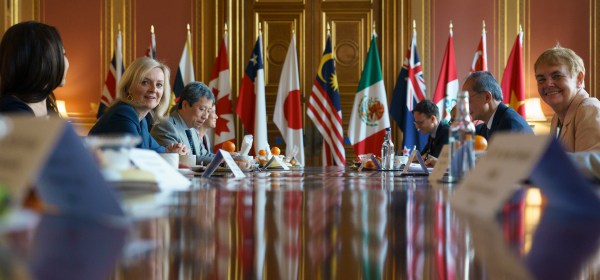
Written by Chun-Yi Lee and Michael Reilly. The CPTPP is an ambitious, wide-ranging free trade agreement (FTA) signed between Australia, Brunei Darussalam, Canada, Chile, Japan, Malaysia, Mexico, Peru, New Zealand, Singapore, and Vietnam in March 2018. The CPTPP was originally named as the Trans-Pacific Partnership and comprised twelve members. However, after the Trump administration withdrew the USA from it in 2017, the remaining eleven countries reorganised and renamed it. After leaving the EU, the UK applied to join in February 2021, followed by China and Taiwan in September. South Korea has been considering joining but has yet to do so. Countries seeking to join the bloc must negotiate tariffs and other market access conditions with each of the eleven original members. 

Ukraine War and Conscripts: Lessons Taiwan Should Not Learn

Written by Shih-Yueh Yang. By preserving the Chinese identity, Taiwan can mitigate its political differences with the Mainland and thus be the sustenance of the whole Chinese people for a free, democratic, and equally prosperous China. With such a great and just cause for the future of the Chinese nation, Taiwan will get its strongest defence, and the danger of wars will also be minimized in the first place.

Changes and Continuity in Support for Self-Defence Among Taiwanese Following the Russia-Ukraine War

Written by Kuan-chen Lee. Following Russia’s ongoing invasion of Ukraine, many observers have pointed out that Kyiv’s ability to mobilise the entire population to resist the invasion is one of the main reasons why it has been able to prolong the war. Moreover, they suggest that Taiwan learn from Ukraine’s model of all-out resistance against a more powerful enemy. However, do the Taiwanese have the same determination to resist aggression as the Ukrainians have shown? Furthermore, how has the Russia-Ukraine War affected the willingness of the Taiwanese people to fight against aggression?

Worldpride 2025 and Taiwan’s Place in Global Queer Politics 

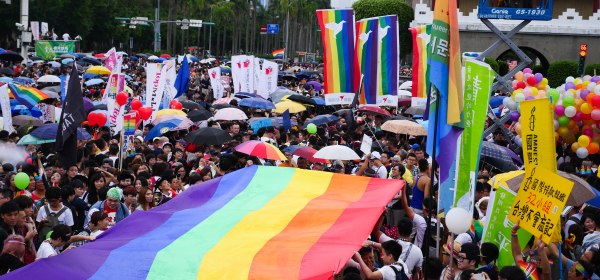
Written by Ting-Fai Yu. Unquestionably, the global visibilities of Taiwan’s recent human rights achievements, such as the legalisation of same-sex marriage in 2019, must have contributed to the voting members’ confidence in having WorldPride held there. However, while Taiwan’s LGBT development has served as an exemplar to which many non-Western countries, especially those in Asia, aspire, it is essential to note that progressive legal changes are not necessarily representative of how queerness is lived culturally.

Sexual Minorities Excluded by other Sexual Minorities: Bisexuality in Taiwan

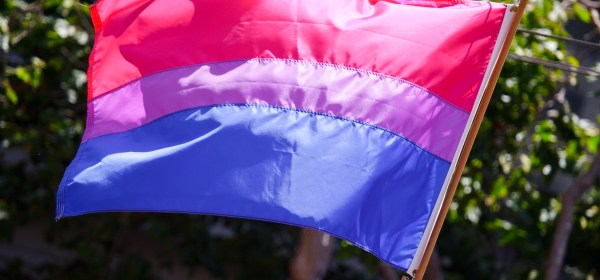
Written by Yen-Ting Kuo, Translated by George Bobyk. Just as most homosexual people do not take coming out to heterosexual people lightly, many bisexual people feel afraid to come out to either heterosexual or homosexual people for the above reasons. Today, due to the lack of “bisexual groups” in Taiwan, for many bisexual people, the only way to survive in gay circles and avoid stigma and discrimination is to hide their true identity and chose to identify as gay instead. 

Breaking Down the Wall: Generational Gaps, Generational Prejudice and HIV Treatment in Taiwan 

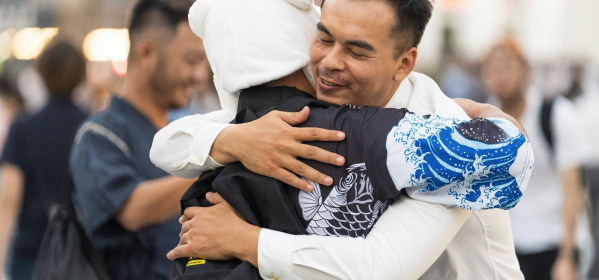
Written by Geng-Hui Lin. Compared to HIV risk, which is assessed through responses to a CDC survey, age is a relatively inflexible criterion for MSM’s who want to obtain PrEP through Taiwan’s PrEP program. There are ways to be categorised as an elevated risk for HIV infection depending on your answers to the CDC’s HIV risk assessment. As a result of these criteria, although some MSM’s over thirty-five have been enrolled in the program, access and availability remain mostly limited to those under this age. This leaves older MSM’s as outsiders to the program, unable to enter. 

USA, China, and Taiwan: Post-Endemic Strategies for a New Global Economy

Written by Ian Inkster. Joe Biden’s recent scooping up of the fog of ‘strategic ambiguity,’ the seldom re-specified policy of the USA towards China in the case of an overt attack on Taiwan, was made in haste but has set the tail of the cat alight and its very colour in doubt. In Japan, Biden warned that China was ‘flirting with danger’ and then admitted that the US would defend Taiwan against invasion by China as contra to the Ukraine case. He was then asked directly if the US would defend Taiwan militarily if China invaded, when it has not done so in the invasion of Russia against Ukraine.

Three Times is a Charm: President Biden’s Taiwan Remarks in Tokyo

Written by Gerrit van der Wees. At a press conference on 23 May 2022, President Biden – who was in Tokyo to attend a meeting of the Quadrilateral Security Dialogue and the launch of the Indo-Pacific Economic Forum (IPEF) – was asked by CBS reporter Nancy Cordes: “You didn’t want to get involved in the Ukraine conflict militarily for obvious reasons. Are you willing to get involved militarily to defend Taiwan if it comes to that?” “Yes,” Mr Biden answered flatly. “You are?” the reporter followed up. “That’s the commitment we made,” he said.

A Further Response to Sinology’s Involvement in Taiwan Studies

Written by Hung-yi Chien. In short, I would argue that “being Sinitic” is not inconceivable. New students of Taiwan studies in overseas countries need elements of sinology to grow up. The lesson from the Taiwan studies programmes in Taiwanese universities suggests that a new discipline requires a fertile ground to nurture it. In countries where sinology is available, this “politically incorrect” discipline is inevitable to play an important role in recruiting new students to Taiwan studies.

Taiwan’s Covid-19 Surge: From “Zero-Covid” to “Living with Covid” 

Written by Tsung-Mei Cheng. Time will tell how quickly Taiwan can bring the Covid surge under control. However, the fundamentals that worked so well for Taiwan before the surge—preparedness (a national plan), universal health coverage, advanced IT and communications infrastructure, and a cooperating public—should continue to serve Taiwan well in the fight against the current surge. Moreover, it will hopefully also defend us against future variants of the Covid-19 coronavirus to come.  

1 36 37 38 39 40 94