
Written by Nikal Kabalan’an (Margaret Yun-Pu Tu).
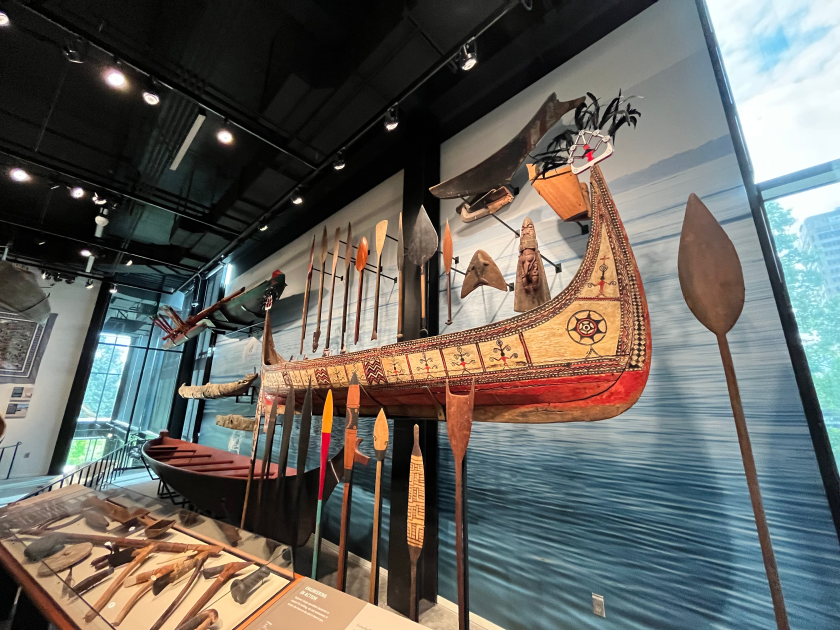
Image credit: Tatala at the Burke Museum of Natural History and Culture by Yi-Yu Lai.
Taiwan’s Indigenous artefacts were taken, bought, brought, or even got stolen and ended up miles away from the Indigenous communities where they were made by the hands of Indigenous ancestors. Some of these Taiwan Indigenous collections were already kept in a foreign museum overseas for almost a hundred years. Some of these museums are devoted to reflecting the devastating colonial history and decolonising the space by, for example, rewriting the narratives, displaying their collections in more inclusive ways, and collaborating with the cultural communities from which these cultural holdings originated. The Burke Museum of Natural History and Culture in Seattle, Washington States, United States, where I am currently leading the review and engagement plan for the Indigenous Taiwan holdings with my colleagues, is one example of decolonising the museums.
As many of us, particularly the younger generations, were unable to learn the Indigenous cultures in a natural or immersive way, but rather through books, media, and the Internet, these cultural heritages became invaluable resources for the Taiwan Indigenous peoples of the current generation to increase our understanding of the cultures passed down by our ancestors. I examine the stories behind those cultural collections in the storage units at the Burke Museum with my colleagues. We plan tours to invite undergraduate and graduate students at the University of Washington to visit the Burke Museum.
On tour, I will share with the students about a Pangcah/’Amis necklace made between 1954-1967 and donated to the Burke Museum in 1971, as well as a rain cape archived as a “Taiwanese Amis tribe” woven fibre raincoat/mourning cape used in the 19th century. There is also a beautiful ancient Tatala, or the assembled boat of the Tao People, born in Lanyu (Orchid Island), Taiwan. It was once a decoration at a local Salmon house and was eventually rescued and donated to the Burke Museum. For the Tao people, Tatala is a vehicle with unique crafts, such as the “eyes of the Tatala,” which leads men toward the boundless ocean and catches flying fish. Now this Tatala is displayed in the “Living Cultures” section as a common theme of “water” with other boats, canoe, and their paddles originally from communities on the Pacific Ocean and beyond.
Conversations through Indigenous Holdings
This April, I attended the 22nd Session of the United Nations Permanent Forum on Indigenous Issues (UNPFII). Besides participating in this forum on Indigenous Issues with other Indigenous young scholars as a team in the United Nations headquarters in New York City, we also collaborated with Habitat Pro, an Indigenous NGO, and other delegations from the Taiwan Indigenous communities to host a side event at the Taipei Economic and Cultural Office (TECO) in New York, to share our works in the fields. I shared my work at a Burke Museum and how I attempt to bridge the intergeneration knowledge and wisdom to the next generations, including my two young children. In addition to the forums and the side events of the Indigenous issues, I got the chance to visit the Metropolitan Museum of Art (The Met)in Manhattan, New York, with other delegations from the Paiwan communities and the officials from the Council of Indigenous Peoples (CIP) in Taiwan. The tour was led by an Oceania curator and her team.
At The Met, there are eleven Taiwan Indigenous holdings, a few from the Atayal or the Tao communities, and the rest are from Paiwan. The Paiwan teammates started to browse the catalogue and check the photos of the collections. We began our conversations by discussing the shape and patterns first, and then storytelling took place. Alongside my work in leading the review and engagement plan for the Indigenous Taiwan holdings at the Burke Museum, I attempt to discuss this big topic of decolonisation from the dimensions of time and space – to rewrite the narratives in the past and how those collections are displayed in the space of the museums.
Decolonisation is often a key term heard in the UNPFII. In this era of transformational justice pushing forward civil society, I ponder how to face the past in the museum space, particularly the generational trauma caused to the Indigenous peoples. Bringing the dialogue to an international level could be a way to practice decolonisation as a community effort in the museum together and to cross the boundaries of nationalities. The Oceania curator of The Met was born in England but raised in a local Māori community. We discussed the connections between Taiwan Indigenous peoples and the other Austronesian-speaking peoples with similarities in languages and cultural expressions. We also built collaborations between museums, such as transporting physical collections to other museums or co-exhibitions in multiple museums. Taiwan Indigenous peoples collaborating with museums overseas is not a lonely thought. Just last month, in the Museum of Ethnography, in Stockholm, Sweden, the Seediq people from Taiwan participated the European Union Taking Care Project (Ethnographic and World Cultures Museums as Spaces of Care) and the exhibition We are Seediq (April 22, 2023 – January 12, 2025) was born.
At the end of August last year, The Ministry of the Interior in Taiwan just approved a large-scale plan to build the park of the “National Museum of Indigenous Peoples” on the banks of Chengcheng Lake in Kaohsiung. The CIP will coordinate planning, design, development, construction, and subsequent operation and management. This national museum is expected to open in 2027. Linking back to the discussion on decolonising museums and the self-determination practice of the Indigenous peoples, I advocate the authorities in Taiwan to allocate resources to strengthening the connections of overseas Taiwan Indigenous collections as a vision in linking the material cultures to the international Indigenous communities. Furthermore, they should recruit talents, particularly the Indigenous peoples from various communities; in this way, Indigenous peoples are the active agents to bring in voices and perspectives to form a more inclusive domain in the museums in different corners of the world.
Nikal Kabalan’an (Margaret Yun-Pu Tu) is a Ph.D. Candidate in the School of Law at the University of Washington. She is also affiliated with the University of Washington Taiwan Studies Program and the Centre of Austronesian Studies (COAST) as an Associate Research Fellow. She is currently leading the review and engagement plan for the Indigenous Taiwan holdings at the Burke Museum in Seattle, USA.
This article was published as part of a special issue on Indigenous storytelling in Taiwan.
 Taiwan Insight