
Written by Yi-Ping Wu.
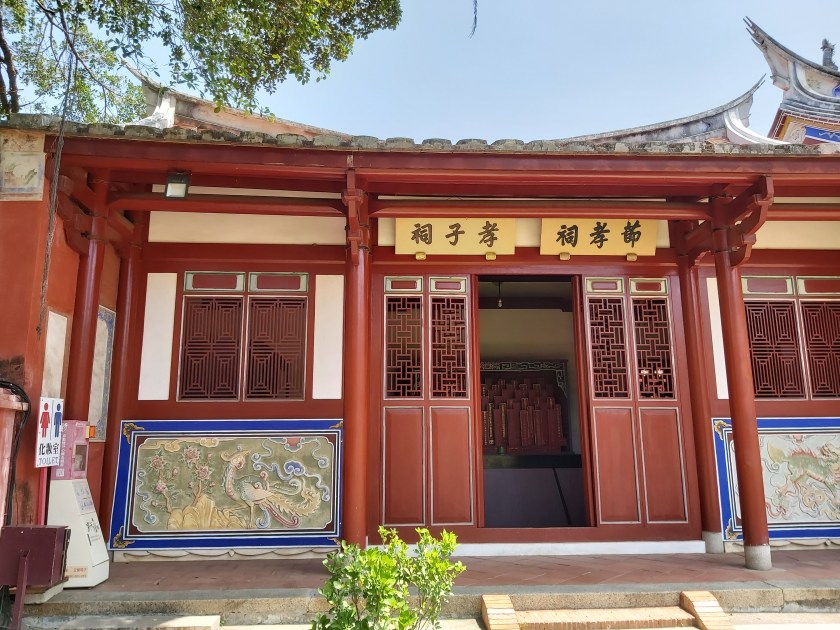
Image credit: Shrine of people of piety and virtue in Tainan Confucius Temple.2023-05-17 by 阿道 / Wikimedia.
The Forthcoming Ghost Month and its Influence
Staying at home, not going to the beach, or climbing mountains, and not even opening an umbrella indoors are just a few taboos everyone must remember when Ghost Month 鬼月 arrives. Although the origin of the concept of Ghost Month is uncertain, the Taiwanese still emphasize the rituals that must be practised and the taboos that must be prohibited during this period. What attracts our attention most is the colossal amount of money that the Taiwanese pay for the rituals, offerings, and joss paper (paper money) to honour their ancestors because their past loved ones could return to the world of living since the gate of the underworld would open on the first day of July on the lunar calendar. The huge income that the cultural concept of Ghost Month contributes reminds us of an interesting question to think about thoroughly: How much money the “ghosts” could make? This is a complicated question to delve into. Therefore, I would like to use a well-known ghost as an example to open the discussion and demonstrate the amazing financial results that ghosts as cultural icons could bring.
The Birth of the Chen Shou Niang Narrative
Chen Shou Niang’s story is famous among the Taiwanese for its terrifying plot and unforgettable ending. Chen Shou Niang, a young woman living in the Qin Dynasty, married Lin Shou. Unfortunately, soon after their marriage, Lin passed away from the disease. Thus, she vowed to preserve chastity for her husband. However, a county government official bribed her mother-in-law and sister-in-law to force Shou Niang to have sexual relations with him. Unsurprisingly, Shou Niang refused and was stabbed to death by them. Shou Niang’s younger brother saw his sister crying for justice in a dream at night and was suspicious of the cause of her death, so the investigation began. Although the mother-in-law and sister-in-law were sentenced to death, the county magistrate, Wang Ting Gan, caused public outrage by protecting his subordinate from pleading guilty. Thus, Shou Niang’s spirit appeared publicly, caused social unrest, and fought against other gods to demand justice. Eventually, she took revenge by killing the staff. She accepted the deal with the god in exchange for the privilege of being considered a supernatural spirit and worshipped at the Filial Piety Temple of the Confucius Temple in the old capital of Tainan.
The Transformation of the Image of Chen Shou Niang and its Byproducts
It is a tradition for Taiwanese opera troupes to perform Shou Niang’s story at night with their own stylized interpretations because of its terrifying plot. It never fails to scare the audience to death when it is performed at night. The story of Chen Shou Niang, however, has been known and remembered mainly by the Taiwanese elders but not by anyone else. Frankly speaking, her life story was long neglected in Taiwan until the popularity of the local ghost stories among the youth prompted writers and artists to dig into their roots to discover the forgotten history/her-story.
As briefly introduced above, Chen Shou Niang’s image is that of a poor victim who was murdered to fight for her own justice in terms of theatre, especially in the genre of Taiwanese opera so far. However, her image has been reinterpreted differently through the modern mode of transportation since 2013. The turning point is an article on PTT, a Taiwanese bulletin board system popular among young people, which, for the first time, defines Chen as the most powerful female spirit in Taiwan by analysing her battles with gods and punishing the murderers. In 2013, Wu Jia-Nan, who posted an article using the account kokone, introduced the story of Chen Shou Niang in a humorous and vivid tone on PTT. Chen Shou Niang was once again known and remembered by the younger generation as Taiwan’s most vigorous female spirit. With the transmission of the vivid and lively version, Chen Shou Niang was transformed into a much “younger” icon in the eyes of the Taiwanese. Compared to other legendary spirits that have been forgotten in modern times, Chen Shou Niang can be said to be a unique cultural symbol whose story has remained popular in Taiwan because of its young, modern, and humorous characteristics.
In addition, Chen’s story has been adapted to another modern genre: comic books. Cartoonist Xiao Nao Nao created the comic book Shou Niang, which was adapted from the story of Chen Shou Niang to develop another new story in 2019. By creating a main character, Jie Niang, a teenager, the readers who possibly are the same age have a stronger inclination to read the details and realize the cultural background of the text. In fact, the genre of comics really attracts another group of teenagers who may not know Chen’s story at first.
The story of Chen Shou Niang also contributes to the development of Taiwan’s cultural and creative industries. For example, the Tourism Bureau of Tainan City proposed a travel package of Jiangui 見鬼 [seeing ghosts] itinerary in Ghost Month in 2022 to guide tourists to visit the places in Chen Shou Niang’s story. The itinerary was so popular that it immediately sold out on the market. The tourists were attracted by the story of the most powerful female spirit and were willing to visit the temples and historical sites in person to perceive the charisma of Chen Shou Niang. The travel package as a business product demonstrates the potential of Chen’s story to be recognized and sold as a cultural product for business income. The example reminds us of the power of narrative, which shows the possibilities of reinterpreting the story of Chen Shou Niang.
After the claim of the widespread article in the young generation, Chen Shou Niang was recognized by the Taiwanese as the most powerful female ghost in the history of Taiwan. Because of the exaggerated title, Chen was regarded as a kind of tragic heroine whose ability to overcome her fate won the respect of the youth. In the eyes of the Taiwanese nowadays, she was seen as a magnificent spirit rather than a suffering victim. Therefore, the modern representation of Shou Niang’s image is successfully used and created to persuade customers to pay for this cultural reinterpretation.
Ghosts as A Good Business
Richard Florida wrote The Rise of the Creative Class in 2002 to explain the establishment of cultural industries and creative clusters to specify that the key to empowering urban economic development is the culture that connects culture, business, and industry to reinforce the potential of creativity. These cultural industries include cultural tourism, historic sites, museums, libraries, sports, and recreation, etc. The supporters of the creative industries believe that the cultural and creative industries can simultaneously stimulate the development of society and culture.
If we follow Florida’s argument to read the specific concept of Ghost Month in Taiwan, we can find that it has great potential for artists, designers, business people, and the government to work together to create a unique cultural product to attract customers’ attention. And it is evident that Chen Shou Niang, who is viewed as the most ferocious female ghost in Taiwan, is such an excellent example to show that the potential of the ghost can be reinterpreted as a cultural industry. Other famous ghosts in Taiwan could be developed to become a part of the “ghost industry” as well, such as Sister Lintou and the Tag-Along. In conclusion, ghosts, as a unique way to communicate with and remember the past, are advantageous for the Taiwanese to make a bold, innovative, and meaningful investment in cultural innovation and urban reform. So, if you ask me, I will say: yes, ghosts are a good business!
Notes from the author: The Tag-Along is an urban legend in Taiwan. It is a little girl in red who appears in the mountains, first captured in the photo of a family climbing the mountain in Taichung in 1998. As time went by, the Tag-Along kept appearing in other people’s occurrences as the witnesses aged. In addition, the places where she was seen have been moved to many different locations. In 2015 and 2017, Hank Tseng’s film company produced the movies The Tag-Along and The Tag-Along 2.
Yi-Ping Wu is an Assistant Professor in the Department of Radio and Television at Ming Chuan University. Her research interests focus on Taiwan studies, theatre and performance studies, and women, gender, and sexuality studies. She recently worked on examining old Taiwanese stories with theories of performance studies and feminism.
This article was published as part of a special issue on Taiwan and Its Ghost Culture.
 Taiwan Insight