
Written by Chee-Hann Wu.
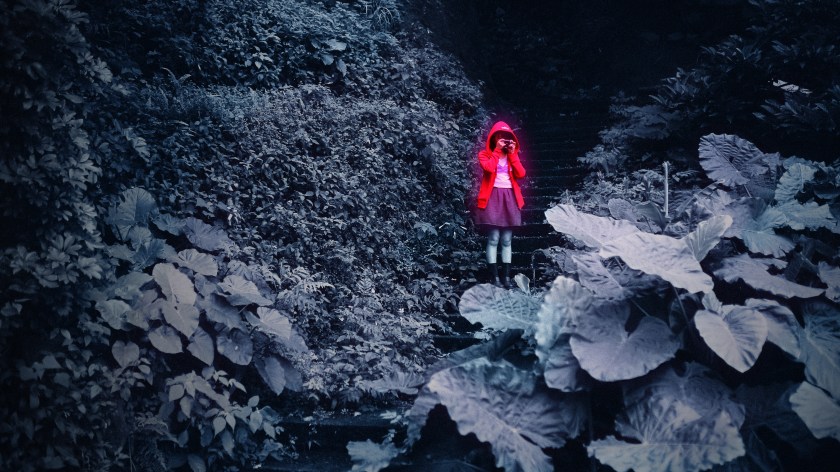
Image credit: 紅衣小女孩 九份 Taiwan Sigma 35mm Canon 6d (235137069).jpeg by Toomore Chiang / Wikimedia.
Taiwanese horror (taishi kongbu) is a rising genre that has claimed an important space in Taiwanese popular culture, particularly in the video game industry since the debut of Detention in 2017. These video games often incorporate elements of Taiwan’s local religions, ritual practices, and mythologies, especially the ones associated with ghosts and other supernatural beings. Although mostly implicit, many Taiwanese horror games contain hints of historical references to the 228 Incident and the White Terror under Martial Law. Malevolent monsters and ghosts become physical incarnations of state-sanctioned violence by perpetrators and accomplices and the suffering of those who were arrested, executed, or silenced.
I look at Detention (Fanxiou, 2017), Halflight (Xisheng, 2020), and Pagui 1 and 2 (2019; 2022) as case studies. Through conflicts and journeys of self-exploration and reconciliation, players engage with the reenactment of historical narratives in semi-fictional settings, witnessing how personal experiences are intertwined with collective memories.
Haunted
Their developers advertise Detention, Halflight, and Pagui as story-driven horror-adventure games that involve solving mysteries and fighting against ghosts and monsters. Detention begins with two students, Wei (Wei Chung-ting) and Ray (Fang Ray-shin), finding themselves trapped in Greenwood High School, the school they attend, which has suddenly become unsettling, deserted, and haunted by malicious and rampaging monsters. While the students try hiding from unrecognizable ghostly creatures, the cursed school’s dark past is slowly unveiled. In Halflight, players follow Xisheng, a young boy trying to find his missing brother. During his journey, he has to search for his brother’s traces and escape from the monsters that are chasing him for unknown reasons. Lin Huo-wang was taken in as an orphan by a temple in Pagui in the 1950s. After learning about his past, Lin went on a journey to find his family. During his journey, and while fighting the ghosts that haunt him, Lin uncovers the past and the truth of a ghost town.
Despite slight differences in the games’ emphasis on horror or adventure, they all use fantasy to mask real-world tragedy. Detention, Halflight, and Pagui use horror and fantasy as a political allegory for Taiwan’s history of the 228 Incident and the White Terror with either explicit historical references or metaphorical analogies.
For instance, Daphne K. Lee explains that Detention is based on “a real-life event that happened in 1949 in Keelung Middle School, where the school was caught running an underground newspaper. The principal was executed while hundreds of students [. . .] were jailed.” The newspaper was published by Chung Hao-tung, who once served as the principal of Keelung Middle School and was associated with pro-communism organizations promoting revolution and left-wing ideologies. Many teachers and students involved in the newspaper were imprisoned or executed.
Halflight implicitly refers to the 228 Incident as “a certain incident” (mouge shijian), and a painting resembling Sunset in Tamsui (1935) by Chen Cheng-po, who was killed as a result of the 228 Incident, is hidden as an Easter egg in a scene in Halflight. Finally, the developer of Pagui explained in an interview that he accidentally stumbled upon the story of the massacre of Liucuo Zhuang, a village in Chiayi, during the 228 Incident, which then became part of the game’s setting, a ghost town. On his way to find his family, the protagonist, Lin Huo-Wang, slowly learns that his parents were victims of the village purge (qingxiang) during the incident.
Although the games are all advertised as being set in fictional worlds, this fictionality is built upon or inspired by actual historical events. As the games progress, it becomes clearer that what haunts the characters and worlds and appears as a ghostly presence is the memory and history of the past. Furthermore, ghosts and monsters in the games are a manifestation or aggregation of collective consciousness that is unspoken, unrepresentable, or, once repressed, forbidden to be expressed or explained. Players/characters are asked to interact and negotiate with the past to confront the haunting that blinds them from seeing the way ahead. In a metatheatrical light, by confronting the ghosts and solving the puzzles in the games, players are actively engaged in reconfiguring history and reimagining the past, resisting the fading of once-lost memories.
Amnesia
Many victims survived the atrocities yet struggled their entire lives with post-traumatic complications that manifested both physically and mentally, as well as amnesia, social marginalization, and political stigma. Traumatic experiences are the yet-to-be-remembered memories that may temporarily deny people the ability to iterate and convey what has happened.
Interestingly, Detention, Halflight and Pagui all involve amnesia in their plots, and recovering the lost memory is the main task in the games. In Detention, Ray forgets that she was the informer who turned in members of the school book club, leading to their imprisonment and execution; in Halflight, Xisheng becomes amnesiac after feeling guilty for exposing his brother to the secret police when they accidentally witnessed the execution scene out of jealousy over their parents’ favouritism; and Pagui’s Lin Huo-Wang has no recollection of how he came to be separated from his parents and eventually abandoned in front of a temple.
The characters’ personal experiences with family dynamics can be interpreted as a stand-in for national history in a chaotic era. The games are a translation of personal memory into public discourse. There is also a translation of a nation’s public history through personal engagement with it in games. In playing the games, players experience, witness, and reenact the past by making their own choices and determining the direction of the game’s plot within the given framework. The games allow for a revisiting and retelling of previously untold or censored stories that go beyond the mere representation of terror and horror; meanwhile, players become active agents in creating personal connections with the past, which further allows that past to be reimagined and most importantly, remembered.
Reconciliation
Detention has two endings, which are determined by the choices that players make in the game’s final stages. In one version, Ray passes by the river of blood that appears in the first scene, but this time, there are bodies all over the river. Finally, she arrives at the auditorium, where she is awarded for her patriotism and eventually hangs herself. Everything seems to start over from the very beginning in this version. What the character tries to escape is not the haunted school but her own shame and guilt. The other ending dates take place years later. After being released from prison, Wei, much older now, revisits the school. Wei sits at a table inside a deserted classroom, reflecting on the past. Across from him is the ghost of Ray, looking remorseful and sitting solemnly. The two gaze at each other, reminiscing about a bygone era. The first ending can be construed as returning to a never-ending cycle of guilt and forgetting, while the second suggests acceptance and reconciliation.
Likewise, Halflight can be seen as a journey of self-realization and reconciliation. Xisheng got his brother, Musheng, caught by the police and eventually disappeared when they were young. His father was arrested while searching for Musheng, and his mother suffered a nervous breakdown. Xisheng blamed himself for his family’s tragedy. Eventually, he was told that an acquaintance had rescued Musheng from the police and given him up for adoption to keep the family safe. The person then arranged for the brothers to meet, thinking that time would be enough to heal the pain, but this triggered Xisheng’s guilt, and he fell asleep for 20 years. What the players experience is the twenty years of Xisheng’s journey of searching, realizing, and finally facing his mistakes and reconciling with himself in his dreams.
One of the most frequently asked questions is: Is there forgiveness, reconciliation, or redemption in the games? For the characters, what has happened cannot be undone, but they must go through the journey of re-experiencing all the hauntings to regain their once-lost memories and reconcile with themselves. Additionally, the games all involve elements and actions associated with Buddhist and Taoist traditions to either worship deities or sacrifice wandering souls. The game-playing itself can be seen as a ritual. The characters’ and players’ actions, such as preparing offerings and burning incense in the games, are to chaodu the ones who have passed but are trapped in the living world, essentially releasing the souls from suffering.
This article was presented as a paper at the 2023 North American Taiwan Studies Association conference and modified to enhance the readability.
Chee-Hann Wu is an Assistant Professor Faculty Fellow at NYU Tisch Drama. She received her Ph.D. in Drama and Theatre from the University of California, Irvine. Chee-Hann currently serves on the board of the North American Taiwan Studies Association and is an editor of Taiwan Insight. Her book project considers puppetry as a mediated means of narrating Taiwan’s cultural and sociopolitical development, as well as colonial and postcolonial histories.
This article was published as part of a special issue on Taiwan and Its Ghost Culture.
 Taiwan Insight