
Written by Belinda Han.
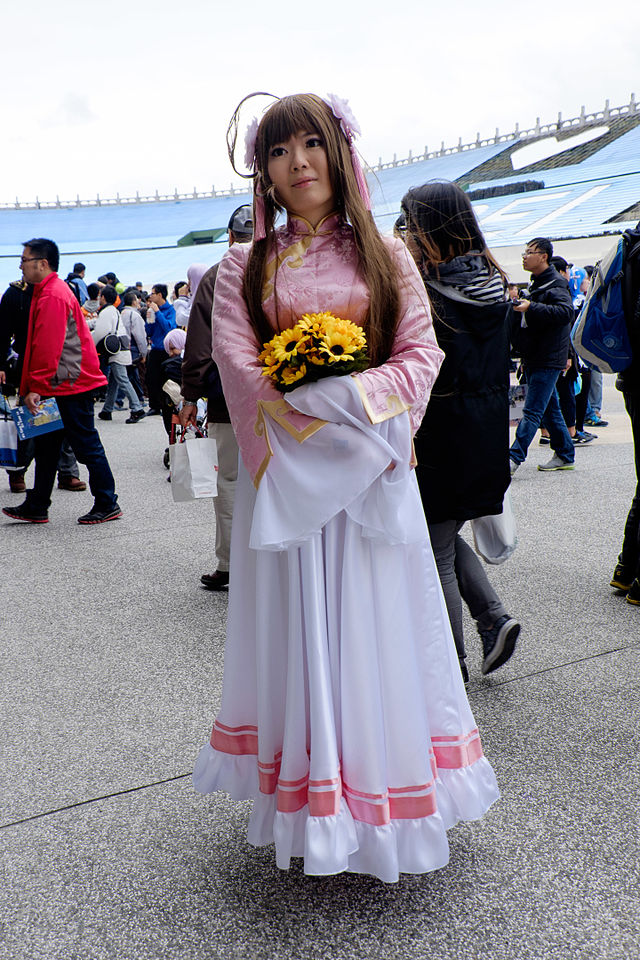
Image credit: Cosplayer of Taiwan, Hetalia in FF25 20150131 by 玄史生/ Wikimedia Commons, license: CC0 1.0.
First released in 2006, the Japanese webcomic Hetalia: Axis Powers has been a highly influential intellectual property (IP) within the East Asian subcultural sphere. The uniqueness of this work lies in its premise: it personifies various countries as distinct characters, humorously depicting world historical events and international relations through their interactions. Each character represents a different country or region, with their personalities and behaviours often reflecting the characteristics of these nations’ history, culture, and international affairs.
Among these diverse characters is Taiwan. In the series, Taiwan is depicted as a young girl dressed in a peach-coloured qipao-style top and a long white skirt. In the Chinese-speaking fan community, she is affectionately referred to as “Wan-Niang (灣娘).” My study intends to look into this fan community in both Taiwan and China and explore how this fandom of Wan-Niang, dealing with the materials’ complex nature, interprets and retells historical and political messages and acts as a field where emotions and identities are jumbled.
Knowledge Systems
Renowned Fan Studies scholar Henry Jenkins defines “fan” as a group of dedicated followers of media content who actively interact with the materials to formulate their understandings and explanations that extend beyond the original message. Fan works emerge from these explanations, taking forms from fiction comics to music and self-made video games. While Hetalia’s long-living popularity guarantees a vibrant fan base on both sides of the Strait, fan works that feature Wan-Niang bring out interesting phenomena.
Discussing the fan works of Hetalia Wan-Niang essentially involves exploring the intersection of three distinct knowledge systems. The character, underexplored and underdeveloped in the original work, offers vast creative freedom for fan fiction creators. This freedom amplifies three forms of interaction. First, the inherent historicity and political nature of personifying nations allow for a unique expression of historical memory and cultural identity within the cultural domain, resonating distinctively within subcultural communities. Second, within these subcultures, the reception and reinterpretation of information by the audience create a dynamic interaction with the original work, forming the first step in fan fiction creation. Third, a unique interaction specific to the Chinese-language fan works of Hetalia Wan-Niang emerges from the differing understandings among young people from Taiwan and mainland China concerning the questions “What is Taiwan?” and “Who are the Taiwanese?” This understanding is projected onto the fan works, alternatively reflecting the cognitive clashes between the youth on both sides of the Strait.
These interactions can be illustrated through a simple example in the context of fan creations: How is the relationship between Wan-Niang and the character representing China (also referred to follow-on by his character name, Wang Yao) portrayed in fan works?
The original author does not explicitly define the identity relationship between Taiwan and these two characters. Regardless of the original intent behind the ambiguous character setting, fan creators are granted the opportunity to freely express their interpretations. Common portrayals of the Taiwan-China relationship in fan works include the following three types.
First of these types is that in some works, Wan-Niang is depicted as Wang Yao’s biological younger sister. This portrayal is often found in creations from China, where Wang is presented as the elder brother to various East Asian countries and regions (Taiwan, Hong Kong, Macau, Japan, South Korea, etc.). In these narratives, a blood relationship with Hong Kong, Macau, and Taiwan is emphasised, suggesting an inseparable bond aligning with China’s mainstream discourse on sovereignty over these regions. This narrative reflects the perception of Taiwan’s status in Asia under the overarching Chinese cultural leadership.
Conversely, some other works attempt to deliberately downplay this relationship. In these works, the concept of the “East Asian family” is challenged as a false notion or an outdated concept that no longer accurately reflects the realities of character relationships. For instance, in a short fan fiction posted on the fan creation platform AO3, Taiwanese fan author bubbleteahime explores the complexity of this relationship by depicting Taiwan’s reflection on where home is during New Year’s Eve, representing an understanding of Taiwan’s political reality from a Taiwanese-centric perspective.
There is also a third type of interpretation in fan works that breaks away from the perspectives above by depicting Taiwan and China as mirror-image characters, essentially two sides of the same coin. For example, in the self-published 2009 fan book “Glorious October” by Taiwanese creator Linshi, there are two identical-looking characters representing China, distinguished only by their clothing, and two similarly distinguishable characters representing Taiwan. In this fan-created comic book, the primary personalities and narrative subjects on both sides are the one personification that represents the Republic of China (ROC), and the relationship between these two characters, ROC-China and ROC-Taiwan is ambiguously portrayed only as “us,” suggesting a closer twin-like relationship. This portrayal reflects the creator’s perception of the concepts of the ROC and Chinese identity.
Emotion and Identity
The interactions within the Hetalia fandom often rely heavily on online platforms. As a result, the construction of online personas tends to stem from fans’ online fan behaviours and self-expressed preferences. This leads to a dual need for self-validation and self-discipline. The need for self-validation implies that fan creators and readers seek affirmation for their personas in the fandom. At the same time, self-discipline refers to the conscious adherence to implicit rules by individual fans in order to integrate into the fandom community. These needs for self-validation and self-discipline are amplified within the Wan-Niang fandom due to its particular context.
The reinterpretation of the character Taiwan is often closely associated with the creators’ understanding and perception of real-world Taiwan, necessitating careful handling of the content. Creating fan works with strong political implications, such as those that metaphorically depict Taiwan’s international status or political trends, is considered a risky endeavour. This perception is common not only among Chinese fans but, surprisingly, also among Taiwanese fans, who similarly wish to maintain a distance from real-world politics. There is a collective desire to preserve the “purity” of the Hetalia fandom as a space that embodies the ideal of a universally peaceful world. Consequently, this intentional depoliticisation process paradoxically manifests a hyperpolitical aspect in the acts of fan creation and consumption.
In the field research component of this study, interviews were conducted with several fans, some of whom are currently active or have been active in the fandom. One interviewee, K, is a Chinese fan who favours the Japan/Taiwan pairing. She enjoys reading and creating fan works centred around the romantic relationship between the characters Japan and Taiwan. In our conversation, K mentioned the status of this pairing within the Chinese internet. In mainstream Chinese historical narratives, Japan’s colonisation of Taiwan is considered part of the “Century of Humiliation” in late 19th and early 20th-century Chinese history. The existence of the Japan/Taiwan pairing in the Hetalia fandom is widely regarded in the Chinese fan community as an irreverent play of this national humiliation, and creating works featuring this pairing is seen as disrespectful to history and an insult to national dignity. The Baidu Tieba forum, where K and her fellow Japan/Taiwan pairing fans often interacted, was reported and subsequently shut down. Despite K’s enjoyment of the pairing being solely based on her perception of the character personalities’ compatibility and her deliberate avoidance of their nature as personifications of nations by setting stories in a parallel universe and them as ordinary humans, she still finds herself having to repeatedly clarify that she is neither a “traitor of China (hanjian)” nor a supporter of Taiwan independence to other fellow fans.
On another level, previous studies on fan creation have often explored its queerness in regards to relations with interpersonal relationships and sexual orientations; from studying Hetalia, a work featuring the personification of nations, we see how fan creations offer fans a tool for deconstructing national symbols, too. Similar to the aforementioned fan book “Glorious October,” Taiwanese fan creator Mio has also published a fan comic book titled “Double Tenth: A Non-existent Nation,” which revolves around the Double Tenth Day and features two twin representations of Taiwan as the main characters. In this work, Mio uses the debate between the two Wan-Niangs to express her conflicting reflections on Taiwan’s national identity and a strong sense of detachment from the name ROC, expressing what she found hard to tell directly in real-life scenarios.
From the brief discussion above, we can see that the fandom surrounding Hetalia Wan-Niang serves as a unique lens for examining expressions of alternative knowledge systems, emotions, and identity awareness within subcultural phenomena due to its multifaceted nature. This study will also further explore how the inherently political yet intentionally depoliticised cultural field of the Hetalia Wan-niang fan community interacts with political realities, such as social movements, to uncover some other intriguing phenomena.
Belinda Han is completing an MA degree in Taiwan Studies at SOAS University of London. Her research interest lies in transnational Asian fandoms and participatory culture, with a focus on identity, gender and nationalism in East Asian fan experiences.
This article was published as part of a special issue on ‘SOAS Taiwan Studies Summer School’.
 Taiwan Insight
