

Written by Thomas Fliß.
Image credit: Group photo of the participants at the end of the workshop on November 9 2024 by the author.
Taiwan plays a crucial role in East Asia’s geo-political security and is of utmost importance economically and technologically as a leading manufacturer of semiconductors. It is also a political and social pioneer regarding broad-based social and political participation and integration of several languages through its language policies. The joint research program “Taiwan as a pioneer” (TAP), funded by the German Ministry of Education and Research (BMBF), pursues the question of which institutional frameworks, conditions, and social actors have made it possible for Taiwan to assume such a pioneering role is one of its goals. Besides Taiwan’s political and social importance, Taiwan has a distinctive cultural and linguistic uniqueness. As such, we need a thorough understanding of it if Taiwan is to be understood and taught in related classes for a better comprehension of Taiwan’s situation and understanding of Taiwan’s people. To address this requirement, the TAP postdoc team at Trier University, consisting of Thomas Fliß and Josie-Marie Perkuhn, held the workshop “Mapping Taiwan Teaching – Teaching Taiwan in Script, Speech and Performance.” It was conducted in English, Chinese, German, and Taiwanese (Taiyu, Tâi-gí). Arranged over three days from 7th to 9th November, a diverse group of 9 lecturers about Taiwan presented at the workshop, including postdocs, established scholars, and teachers. Teachers and scholars from Trier University and other German universities also attended. The presentations explored both practical and theoretical aspects of Taiwan, covering Taiwanese culture and performing arts, cross-cultural perspectives, language instruction, and approaches to incorporating Taiwan Studies into university academic programs.
The workshop’s structure was split into two parts: after a few words of welcome by Josie-Marie Perkuhn and Thomas Fliß, the program started with two lectures presenting first-hand sources of Taiwan’s multifaceted diversity as input and a discussion session about teaching material. The second part consisted of the presentations.
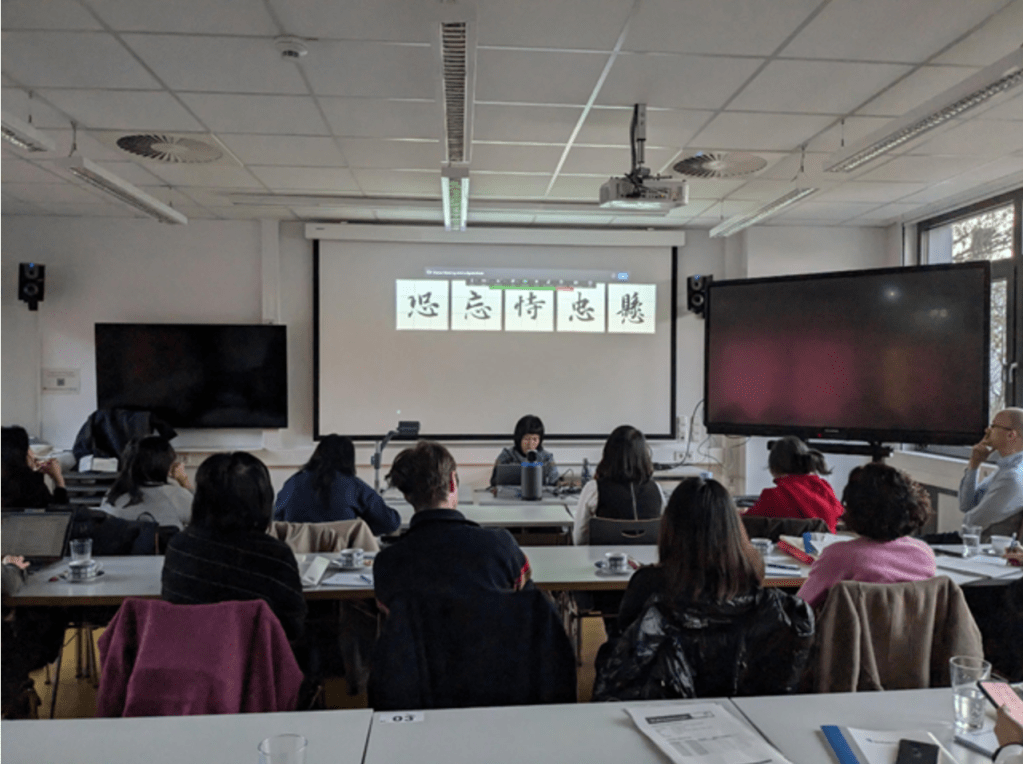
The independent Taiwanese artist Wu Yu-Hsuan (吳俞萱) started with the keynote speech “Taiwan’s ‘heart’ radical dictionary“ (台灣的心部字典), sharing her experience with the Taiwanese culture. Against the background of her diverse teaching experience in the USA, Peru, Germany, France, Bulgaria, and Montenegro and the related cultural perspectives, she presented a diverse range of topics defining Taiwan. These were, under the umbrella of five Mandarin characters containing the “heart” radical: “forgiveness” 恕, “forgetfulness” 忘, “reliance” 恃, “faithfulness” 忠, and “precipitousness” 懸. These topics which are consequently usable for teaching Taiwan included historical events (February 28 incident), ethnical groups and their languages (Taiyu, Hakka, Indigenous), art, music, and film (e.g., The Horrifying Inspection 恐怖的檢查 by Huang Rongcan 黃榮燦, Fire Ex 滅火器, A City of Sadness 悲情城市).
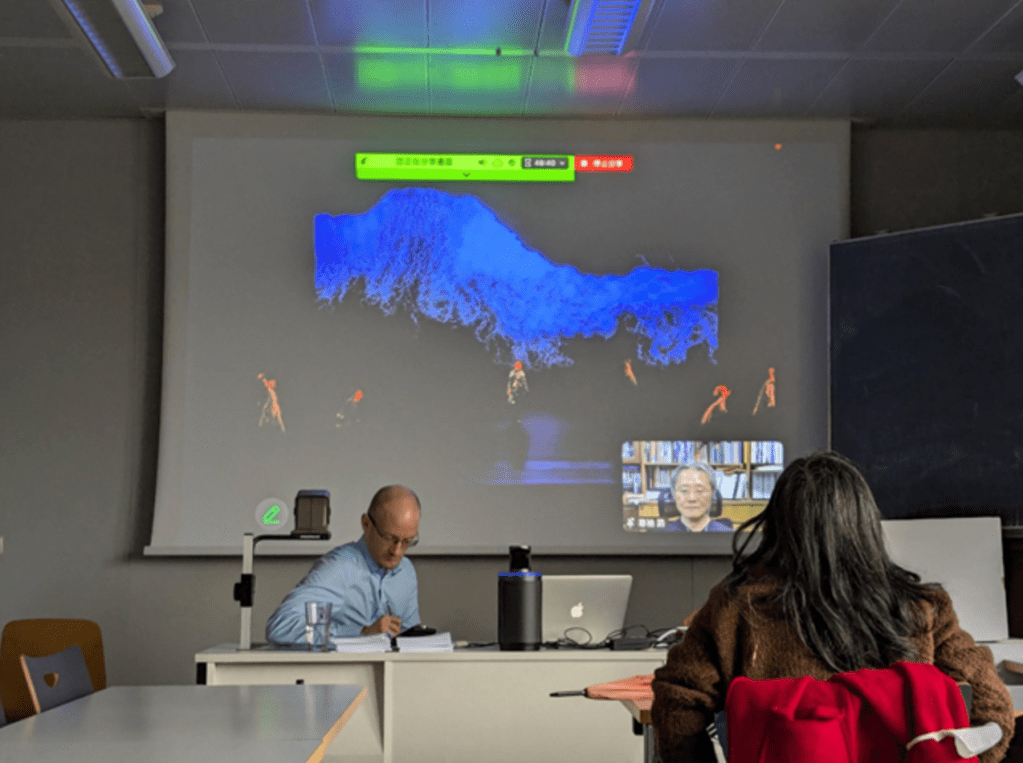
The next session featured practical experiences, where the Trier TAP team presented their integration of the “Gateway to the World” lecture series into the workshop. This annual lecture series is organized in partnership with the Association for Taiwan Literature (台灣文學學會). On the morning of November 8, the well-known writer Lu Hanxiu (路寒袖) gave a hybrid presentation titled “After Script Grew Feathers: Talking About My Creation of Taiwanese Poetry and Song” (文字發翼了後: 講淡薄仔我的臺語歌詩創作) from Taiwan. He presented the development of his poetry set against the context of the broader development of Taiwanese poetry and songs, and with the help of vivid examples, also showed how his poetry evolved into a synthesis of language, performance, and music.
After these two hybrid lectures, the academic presentations and discussions in person began. In the first panel, Mirjam Tröster from the Sinology Department of Goethe University Frankfurt and Stefanie Elbern, based at the “China School Academy” in the Institute of Chinese Studies at Heidelberg University, gave their presentations. Mirjam Tröster talked about the importance and usability of digital performance archives for theatre researchers not based in Taiwan. She introduced and discussed some relevant digital archives for teaching contemporary Taiwanese theatre. In the end, linked to the issue that every performance is unique, she also addressed the debate about the teaching purposes of digital performance archives, whether they should provide documentation or serve the canonization of theatre. Stefanie Elbern provided insight into the problem that in many textbooks for German secondary schools, information about the Republic of China (Taiwan) is very often from PRC resources and/or filled with mistakes and stereotypes. These textbooks seldom provide Taiwanese perspectives and focus mainly on the PRC-Taiwan conflict. Against this background, Elbern presented how the “China School Academy” promotes a critical and multi-perspective approach to China, Taiwan, Hong Kong, Macau, the Sinophone diaspora, and “Chineseness.”
The second panel dealt with teaching Taiwan from intercultural perspectives, consisting of the lectures of Belén Cuadra-Mora based at the Department of General Linguistics and Literature Theory at the University of Granada, Huang Ya-Ying (黃雅英) from the Mandarin Learning and Education Centre at National Taiwan Ocean University, and Charles Terseer Akwen from the Department of English at the University of Lagos, Nigeria. Against the background that intercultural competence and cultural diversity have become an important aspect of school education around Europe, Belén Cuadra-Mora presented how she and her international team of scholars and researchers initiated a dialogue on how translated literature can contribute to enhancing and developing intercultural competence by the example of the Taiwanese writer San Mao (三毛). She presented the fruitful results of a book trailer contest based on the book Stories of the Sahara (撒哈拉的故事), focusing on how the outputs of the students participating in the project reflected different dimensions of intercultural competence. Huang Ya-Ying addressed the question of teaching content to foreigners staying in Taiwan. She presented her current research outcome of intergenerational learning between foreigners and Taiwanese elders, pointing out the high motivational impact on learners, the intercultural real-life experience they gained, and the positive effect on the self-esteem of the participating elders. Charles Terseer Akwen pointed out that Taiwan and many African nations share postcolonial histories and experiences of navigating identity and autonomy after periods of foreign control. A comparison of Taiwanese literature with African literature has helped Nigerian students reflect on the themes of resistance, nationalism, and the challenges of post-independence societies.
Different from the other panels, the third one was about the situation of teaching Taiwan in universities. Dafydd Fell and Henning Klöter discussed the institutionalization of Taiwan Studies in universities. Dafydd Fell from the School of Oriental and African Studies at the University of London briefly summarised the trajectory of the SOAS Taiwan teaching program. Then, it outlined some strategies adopted to make the program sustainable. These include securing external funding, integrating Taiwan modules into a wide range of degrees, connecting the Taiwan events program to the teaching program, creating a diverse teaching team, and adapting the program to meet changing student interests and institutional pressures. Henning Klöter, based at the Department of East Asian Studies at Humboldt University zu Berlin, engaged critically with some of the arguments in the debate on the curricular placement of Taiwan Studies. Klöter then presented Humboldt University’s approach, focusing on how Taiwan Studies intersect with Chinese language instruction. He discussed both opportunities and challenges in teaching content beyond political science and cross-strait relations.
The last panel dealt with the topic of teaching Taiwanese languages. Lee Meng-Chen from the Institute of Sinology at Ludwig Maximilian University of Munich presented her experience teaching Taiwanese, precisely the learning challenges to German-speaking students regarding Taiwanese pronunciation, grammar, and cultural nuances. Lee also showed her didactic methods to support and facilitate the learning process, especially digital material. The second speaker was Liu Chan-Yueh (劉展岳), who teaches Taiwanese at the Institut National des Langues et Civilisations Orientales (INALCO) in Paris. He focused mainly on three points: the development trajectory of the Taiwanese language community from 2020 to the present, beginning with a high number of students to reaching a stable learning community; how the strategy of ‘performativity’ in the shape of singing and theatre has become the mediator of the ‘Taiwanese language community,’ not only attracting a considerable number of diligent and enthusiastic students but also bringing out students with astonishing language abilities; the challenges the Taiwanese language curriculum faced in France.
Finally, the workshop concluded with a round table discussion, in which the participants exchanged their views on a wide range of topics, e.g., the promotion of Taiwan, Taiwan research, and Taiwan Studies on a national, European, and international level through research, meetings, exchanges, collaborations, and videos, also integrating students and their experiences; cooperations with Taiwanese institutions; problems these cooperations might face, et cetera.
With all the insightful presentations about a diversity of topics, this was a fruitful workshop. On the one hand, it provided input about Taiwan’s cultural and language diversity, i.e., the material for teaching Taiwan. On the other hand, it was also an overview of the current state of Taiwan teaching in Europe, Taiwan, and Nigeria. As every lecture revealed, students in many countries are interested in and in demand for courses about Taiwan. At the same time, the workshop also made clear that there is a considerable deficit regarding language and culture courses. Although Taiyu, Hakka, and the Austronesian languages play a key role in the definition of Taiwan and its people, classes for Taiyu are rare, and there are no classes for Hakka, especially none for the Indigenous languages. Some may say that Mandarin is more than sufficient for communication in Taiwan. However, to comprehend the people behind Taiwan’s political, social, and economic innovation, a better understanding of their culture, especially their languages as a vehicle of culture and thought, is urgently needed.
Thomas Fliß is a postdoctoral researcher in the “Taiwan as a Pioneer” project at Trier University. He finished his Ph.D. on rhyme behaviour in Taiwanese rhyme literature at National Cheng Kung University (NCKU) in Tainan, Taiwan. Afterward, he worked as an adjunct assistant professor in NCKU’s Department of Taiwanese Literature. In the overall context of the Anthropocene, his current project’s research focuses on environmental topics and perspectives in Taiwanese literature written in Mandarin and Taiyu (Taiwanese Southern Min), and memory narratives and national identity in Taiwanese ballads and poetry. Further research interests are Taiwanese proverbs and Taiwanese linguistics.
This article was published as part of a special issue on ‘Teaching Taiwan’.
 Taiwan Insight