

Written by Fasa’ Namoh.
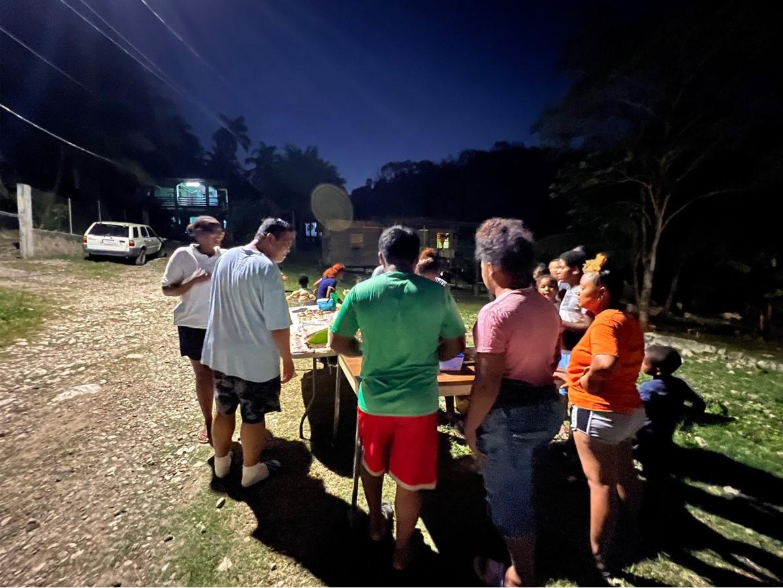
Image credit: A scene from a joint gathering between a Paiwan-led church and Belizean Maya Indigenous people. Photo by Fasa Namoh. March 2024.
Indigenous studies in Taiwan have not traditionally addressed transnational migration as a central focus. Previous studies concentrated on how the Indigenous population copes with modernisation, cultural shifts, and mobility between urban and rural regions in Taiwan; however, there has been a series of international academic interests in the study of Indigenous transnational migration. In this article, I focus on the concept of Indigenous transnational migration in Taiwan, concentrating on the case of Paiwan migrants who moved to Belize in Central America in the 1990s. This migration cannot be explained solely through economic or political motivations. Instead, I examine how charismatic Christian prophecy, emerging in the 1990s, provided a spiritual framework that shaped the decision to migrate. This aligns with growing literature on how spiritual beliefs and prophetic visions offer alternative rationalities to migration, particularly within Indigenous and charismatic Christian contexts.
The Historical Context of Political Situations
In June 1995, President Lee Teng-hui (李登輝), representing the Kuomintang (KMT 國民黨), visited Cornell University in the United States, his alma mater, as part of his re-election campaign. This visit marked a significant diplomatic milestone, as he was the first sitting president of the Republic of China (R.O.C.) to travel to the United States since the severing of formal diplomatic relations in 1979. However, this visit provoked a strong reaction from the Chinese government, which subsequently conducted missile tests near Taiwan in July 1995 as a means of intimidation. These military exercises occurred near Pengjia Islet (彭佳嶼), located approximately 60 kilometres from the coast of Keelung (基隆). This series of events, known as the Third Taiwan Strait Crisis, heightened concerns about the region’s potential for conflict and political instability.
In the context of ongoing geopolitical tensions, several Paiwan families from Laiyi (來義), a Township in Pingtung County, Taiwan, have migrated to Belize. Their decision was strongly motivated by Pentecostal prophetic teachings. Their religious leaders have described Belize as a divinely ordained sanctuary of peace. To understand this migration, it is essential to examine the rise of apocalyptic prophecies disseminated by leaders of the Prayer Mountain ministry (officially known as the Chinese Prayer Mountain), a charismatic Christian organisation established in 1981 in Zaoqiao (造橋鄉), Miaoli (苗栗) County. Between 1990 and 1995, these leaders articulated visions predicting a potential Chinese invasion of Taiwan before the year 2000. Such proclamations resonated deeply within Indigenous communities where Christianity had become an integral part of daily life. The large-scale missile tests conducted by the People’s Republic of China in March 1995 further validated these concerns. For many Taiwanese, this crisis represented a significant threat to Taiwan’s democratic development.
A contemporaneous publication titled The Intercalary August 1995: The Warning of Taiwan Strait War echoed these prophetic warnings within church communities, reinforcing the belief among certain Indigenous Christians that emigration from Taiwan was necessary for their survival. Consequently, one Paiwan family, consisting of over 40 members, relocated to Belize, initiating a transnational migration driven by religious revelation rather than traditional economic motivations.
Migration as a Spiritual Journey
In Belize, religious beliefs served as a lens through which individuals understood threats and justified their decisions to leave Taiwan. Participants reported receiving what they perceived as divine guidance through dreams, prophetic messages, and prayer. These spiritual encounters, which included visions of natural disasters such as floods, earthquakes, and fires, heightened communal anxiety and motivated proactive measures. A primary informant, Ms. Y.H., shared her insights during an interview conducted on May 30, 2023:
Since 1991, pastors have consistently asserted the possibility of China invading Taiwan. Reactions to these claims have varied significantly among individuals. Initially, my husband and I felt uncertain about the situation. In response, I began to pray nightly, seeking divine guidance through a sign or vision. Ultimately, I received a vision that gave me peace, allowing me to accept this calling.
Charismatic Christianity places significant emphasis on direct encounters with the divine, such as through dreams, speaking in tongues, and prophecy, which make these spiritual messages particularly compelling. In contrast to mainstream denominations that adhere to strict doctrinal frameworks, charismatic movements prioritise personal revelation as a legitimate form of theological knowledge. Within Indigenous churches, phrases such as “leave the world,” “come out of Babylon,” and “go to the land prepared by the Lord” serve to reinforce a spatial and theological imperative for migration. Belize has been conceptualised as a “New Canaan (新迦南地) ” for these believers in this context. A key informant, Mr. H., who played a pivotal role in constructing homes and churches in Belmopan, elaborated on this during an interview on April 20, 2024:
Upon arriving in Belmopan, the urban landscape primarily consisted of single-story structures. However, the influx of Taiwanese entrepreneurs prompted the development of retail establishments, for which I was commissioned. Additionally, I secured contracts from mainland Chinese businesspersons, resulting in my involvement in constructing most of the taller buildings in Belmopan. My workers have affectionately dubbed me the “underground mayor.”
By the 1990s, charismatic Christianity had significantly influenced Indigenous churches throughout Taiwan, with Prayer Mountain as a central focal point. Nearly all Indigenous church communities were aware of or affected by apocalyptic prophecies. These beliefs were further reinforced through international revival camps, the involvement of Korean American pastors, and Pentecostal training events, where physical manifestations such as falling, crying, and speaking in tongues heightened the perceived urgency of an impending crisis. Consequently, migration was conceptualised as a religious act, representing both an escape from conflict and a pathway to salvation. Kinship networks and spiritual leaders also guided this migration.
Paiwan Ethnic Interactions in Belizean Society
Belize has become more than a geographical destination for Paiwan migrants; it is now a significant spiritual focal point. Although initially unfamiliar to those seeking new opportunities, the country was “revealed” through prayer and affirmed by faith. In this context, migration represented a physical transition and a metaphysical calling, thereby blurring the distinction between spiritual vision and responses to geopolitical crisis. In summary, the influence of charismatic Christianity was not peripheral to Paiwan migration in the 1990s; instead, it was a fundamental component of the migration experience. Prophecies of war, divine visions, and charismatic networks provided legitimacy and a heightened sense of urgency to the migration process.
Grounded in ethnographic fieldwork conducted between 2023 and 2024 in Belize, I investigate how the Paiwan community negotiates identity, education, and religious life within their new environment. Churches function as cultural centres, where multilingual services in Paiwan, Mandarin, English, and Spanish reflect the community’s resilience and hybridity. While English and Spanish are predominantly spoken among second and third-generation youth, efforts to revitalise the Paiwan language persist through online workshops and intergenerational exchanges with elders in Taiwan. The Paiwan immigrant community continues to practice traditional naming ceremonies, songs, and rituals. Additionally, interactions with local Maya communities introduce further cultural complexity. Collaborative participation in ceremonies and events enhances cross-cultural understanding, providing valuable insights into how Indigenous peoples navigate shared colonial histories, collective memory, and resilience.
The diasporic Paiwan community effectively maintains familial connections and cultural memory across national boundaries through social media, remittances, and short-term visits. These transnational exchanges of communication and spirituality contribute to forming an Indigenous knowledge circuit. Notably, the diverse experiences of the Paiwan diaspora illustrate an ongoing and significant process of cultural reconstruction. They have skilfully navigated the challenges of globalisation and deterritorialisation, creating new cultural spaces that integrate traditional beliefs with contemporary realities. This phenomenon highlights the dynamic nature of Indigenous identity, which can thrive beyond conventional geographic boundaries. My doctoral research aims to contribute to broader discourses on cultural resilience, transnational migration, sacred geographies, and identity politics within Paiwan studies and global Indigenous scholarship. This project continues to employ an ethnographic methodology firmly grounded in the lived experiences of Paiwan migrants and their Indigenous epistemologies.
Coincidentally, the topic explored in my dissertation, the intersections of military tensions in the Taiwan Strait and religious prophecy as drivers of transnational Indigenous narratives, resonates with contemporary global conflicts. From the Russia-Ukraine War to the Israel-Iran conflict, what lies beyond the macro-political analyses are the lived realities of civilians displaced by warfare, the lives lost to bombing, and the human suffering embedded in forced displacement. These complex social and historical dynamics compel humanities and social sciences scholars to confront the urgent responsibilities of engaging with global political realities and human development.
Fasa’ Namoh is a PhD candidate at National Taiwan University’s Graduate Institute of Building and Planning. His research focuses on Indigenous migration, charismatic Christianity, and transnational landscapes, particularly Indigenous Peoples’ movement from Taiwan to Belize during the 1995 Taiwan Strait Crisis. His fieldwork spans Belize, South Africa, Japan, and the United States.
 Taiwan Insight