
Written by Mark Hsiang-Yu Feng.
Image credit by the author.
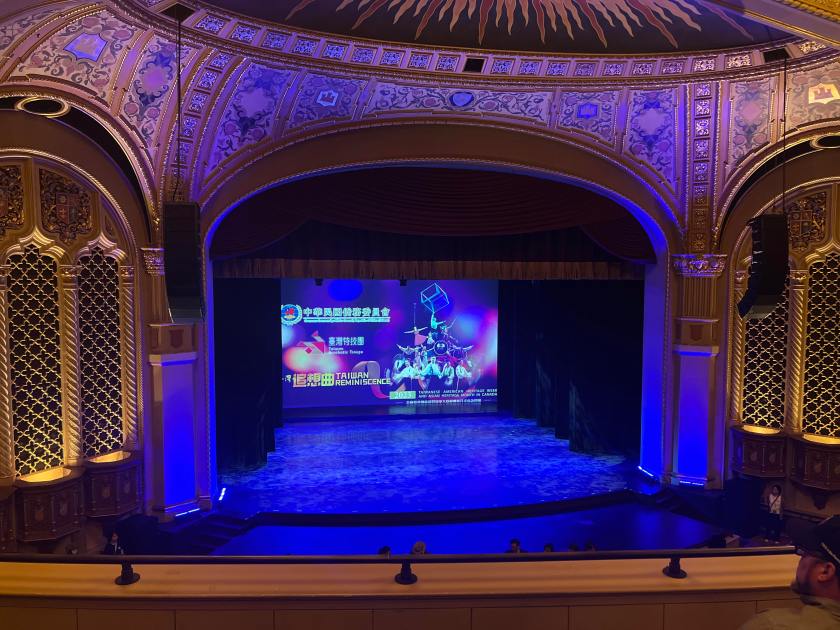
Busy as usual was Highway number eighty, but Mother’s Day made downtown San Jose unexpectedly quiet. However, in front of the California Theatre, lively chat sounded out of the silence, marking this celebratory moment for the twentieth anniversary of the Taiwanese American Center of Northern California during Asian and Pacific Islander heritage month. Families came to fill most of the seats, and three languages—Hoklo Taiwanese, Taiwanese Mandarin, and English—were spoken to express the identity of these participants. To honour the culture of Taiwanese and Taiwanese Americans, the overall narrative of Taiwanese Reminiscence contextualises a mixture of stunts, acrobatic movements, and dance into a condensed representation of the twentieth history of Taiwan.
Drawing connections between the island of Formosa and the continent of the United States, the performance connected the performers from Taiwan and Taiwanese American audience and, more specifically, my homeland and diaspora. Giving such a performance during this special month made me wonder. “Was my culture from the island your heritage on this continent? The unsettled mind was armed to observe the conceptualised Taiwan being performed on stage, especially as my in-betweenness, which engendered from my status as an international student, informed my latter questioning of how Taiwanese Reminiscence demonstrated hegemonic Han centrism that dominated the current historical narrative and political discourses around Taiwaneseness and Taiwanese Americanness.
The Story of Settlers
Depicting a dangerous voyage across the ocean as a group of Han people sought to resettle was the first scene, “Crossing the Sea.” The program states, “The draperies on the stage symbolise rogue waves, and the long mast represents the lone ship. Eventually, the explorer overcame the dangers and hardship and landed on a new home.” The ocean was perceived beyond merely the struggle that the Han ancestors experienced; Interestingly, it contained double meanings as Taiwanese Reminiscence was performed on the other side of the Pacific. The ocean could simultaneously refer to Taiwan Strait, where Han ancestors got across to resettle in Taiwan before the late nineteenth century, and the Pacific Ocean for Taiwanese American people.
These double meanings of the ocean indicated an immigration trajectory from southern China to Taiwan and, finally, the United States. From one continent to the island and another continent…It was uncomfortable to watch as an implication of continental ideology, which minimises the island’s importance, snuck into this performative construction of Taiwaneseness. What roles does the island of Formosa exactly play in the immigration history of Taiwanese American people? Is it home or merely an intermediate islet for a temporary stay during the prolonged voyage from southern China? The questions remained unanswered, but the historical narrative of Taiwanese ancestors and the double meaning tangibly amplified their colonial mindset. What a story of settlers.
The second scene, “Prosperous City,” reproduced “the robust and busy scene at Taipei’s Dadaocheng of the early twentieth century. Under the Japanese colonial period (1895-1945), it was an international business port that brought prosperity to northern agricultural Taiwan; oddly, none of any component of this scene contributed to making a time travel back to the early twentieth century but, more precisely, to the latter half of the twentieth century instead.
Images of the program and the stage design showed hand-drawn posters of the early Taiwanese film Hometown at Dusk(1965) upon the revivalist wall of a brickfield. A medley of early Taiwanese pop songs was played to further immerse the audience in Taiwan’s early 1970s and 1980s. “Hotline for You and Me” by Wen-Cheng Liu (1983), “Give Me a Kiss” by Loo Cheng (1970), and “Lovely Roses” by Fei-Fei Fong (1974) all were productions of a more significant trend of musical Americanisation influenced by the US government’s cultural diplomacy and American Force Network Taiwan in the late 1960s. The ending piece of the medley, “Let’s Go Trippin’” by The Beach Boys (1963), indicated a strong representation of Americanness through the globalisation of rock music in Taiwan. Music, thus, was an indicator that Taiwanese Reminiscence targeted their audience, mostly the first and second-generation Taiwanese American people.
Some Critique…
The “Prosperous City” referred not only to Taipei’s Dadaocheng but also an idealised projection of the American dream—the dream of prosperity. Playing the Han Taiwanese male character, an actor wore tangzhuang with a black suitcase, which looked much identical to images of the nineteenth-century Chinese immigrants displayed at the Chinese American Museum in LA. None of the Taiwanese Americans would have worn themselves like that in the 1970s, but their historical impression was indeed occupied by its Han-ness under the stereotypes of the Asian racial category in the mainland US, once again reinforcing a faulty equation of Chinese and Taiwanese due to the “shared Han ethnicity.”
The “Prosperous City” also enacted an interesting power dynamic between this Easterner and other male performers who had a Western clothing style, representing a group of Westerners. To continuously showcase the struggle and hardship that the first-generation Taiwanese American had experienced, this Easterner was theatrically bullied by the Westerners in this scene. Being pushed, mocked, and physically abused, the Easterner could not perform his stunt, whereas the Westerners did. The acrobatic movements, which required physical strength and skills, symbolised power. The Westerners had them, but the Easterner was strengthless, inept, and powerless as he had no choice but to sit on the floor. Taiwanese people had already been disadvantaged in many ways in our reality; why even here in such a theatrical representation?
In addition, why do the Eastern and the Western characters have to be by men? Why couldn’t these characters be women or any non-gender binary people? Why do men always represent somewhat heroic characters who overcome tremendous hardship and finally triumph? Why couldn’t men of minority be excused by the mainstream social norms? As I wrote this essay in transition and LGBT Pride Month as well as Men’s Mental Health Month in June, this obsolete way of performing past and current hardships of Taiwanese American people lit my fire of rage as I reflected on the representations of Taiwaneseness. Furthermore, whose Taiwaneseness is this anyway? It was not my memory associating with most of the Taiwanese pop songs being performed except “Turn on the Sun” by a Taiwanese heavy metal group, Flesh Juicer (2019), in the second half of the performance when showcasing the culture of Guan Jiang Shou.
Understandably, the stunt show is performed for those Taiwanese people who have already been here in the States for decades. However, the Taiwanese Reminiscence performance seemed to represent a limited understanding of the history and culture of Taiwan. Hakka Taiwanese and Taiwanese Indigenous cultures were misrepresented and exoticised, whereas the Han Taiwanese cultures were overemphasised. Objects such as paper umbrellas and printed cloth were employed to represent Hakka Taiwanese culture; similarly, bizarre dance movements to Taiwanese Indigenous people. That is a critical lack of cultural diversity in the twentieth-first century.
As this event was organised by the Taipei Economic and Culture Office in San Francisco and the Culture Center of Taipei Economic and Cultural Office in San Francisco (Milpitas) and sponsored by prestigious, renowned Taiwanese international enterprises, does it mean such a lack of cultural diversity in its narrative of Taiwanese Americanness has been institutionalised and capitalised to further disadvantage Taiwanese minorities in the US? Also, how might dancing along with white American boys’ rock ‘n roll and Han Taiwanese rock and heavy metal music to celebrate the cultural heritage of Taiwanese American people represent the proximity to whiteness in constructing Taiwaneseness? Especially when the mission of the Taiwanese American Center of Northern California is to “enhance cultural interaction between the US American mainstream societal, cultural norms and Taiwanese American in Northern California,” I believe we need to contemplate Taiwanese and Taiwanese American people’s positionality on domestic and international racial/ethnic politics.
Finale
Respect for elderly people and ancestors has always been an essential value among Taiwanese people; perhaps this is why Taiwanese Reminiscence was dedicated to supporting the first and second generations. The cultural connections between Taiwan and California they had are invaluable treasures of the community; however, such connections should not be deemed exclusive to the elderly people in the community. International students have them too!
The community is prone to believe that international students need jobs, visas, and green cards, as if there is no “culture” among us. As such, what was understood as “heritage” from a Taiwanese American perspective was fixed in time without seeing the cultural transformation in action. It was a privilege for the elderly Taiwanese American audience to enjoy such a wonderful, quality performance honouring their hard work and collective memories of a particular moment in the history of Taiwan; however, it was frustrating to understand that my culture has been perceived and reinvented as some other people’s “heritage” in the same community. This is what turns the powerful in-betweenness of international students into limbo despite the fact that Taiwanese Reminiscence ended with rounds of applause.
The story could be told differently. Having a sense of belonging is what every person in the Taiwanese American community deserves to have on this continent. On the island where I was born far across the Pacific, I used to believe that “home” is where people support me and the people I support stay, but when I am committed to supporting peoples of colour with my profession and research in solidarity, I hardly find myself supported by the community where I should belong to. I stepped outside of the California Theater. It was just a two-hour drive from San Jose back to my place, but I felt a long way to the point where I could call this place: home.
Mark Hsiang-Yu Feng is a PhD candidate in Ethnomusicology at the Department of Music, University of California, Davis. He can be reached at hyfeng@ucdavis.edu.
This article was published as part of a special issue on One Year After the Laguna Woods Shooting Tragedy.
 Taiwan Insight